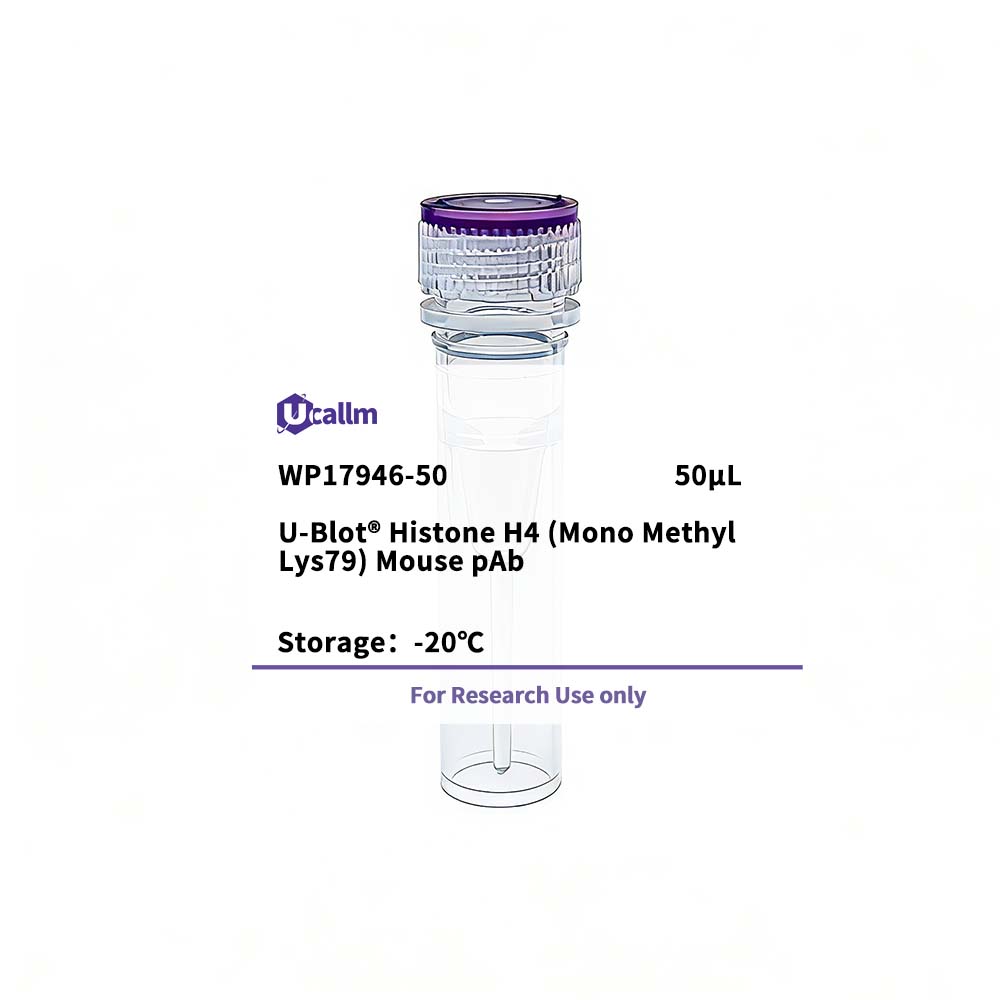
U-Blot® Histone H4 (Mono Methyl Lys79) Mouse pAb

Price range: $288.00 through $368.00

SKU: WP17946-100
Enter the quantity you would like, or drag the panel to find the quantity and price that best for you
Bulk QuoteAuthorize OEM & ODM

Product details

Background:

Histones are basic nuclear proteins that are responsible for the nucleosome structure of the chromosomal fiber in eukaryotes. Two molecules of each of the four core histones (H2A, H2B, H3, and H4) form an octamer, around which approximately 146 bp of DNA is wrapped in repeating units, called nucleosomes. The linker histone, H1, interacts with linker DNA between nucleosomes and functions in the compaction of chromatin into higher order structures. This gene is intronless and encodes a replication-dependent histone that is a member of the histone H4 family. Transcripts from this gene lack polyA tails but instead contain a palindromic termination element. This gene is found in the histone microcluster on chromosome 6p21.33. [provided by RefSeq, Aug 2015],

Specifications

Size50μL/100μL
TargetHistone H4 Mono Methyl Lys79
ReactivityHuman, Mouse, Rat
ApplicationsWB
MW(Calculated)
MW(Observed)14kD
Host SpeciesMouse
Isotype
Conjugate/Modificationmethylate
Recommended Dilution RatioWB 1:500-1000
FormulationPBS, pH 7.4, containing 0.5%BSA, 0.02% sodium azide as Preservative and 50% Glycerol.
PurificationThe antibody was affinity-purified from mouse ascites by affinity-chromatography using specific immunogen.
Storage-15°C to -25°C/1 year(Do not lower than -25°C)
Concentration
ClonalityPolyclonal
Clone Number
ImmunogenSynthetic Peptide of Histone H4 (Mono Methyl Lys79)
SpecificityThe antibody detects endogenous Histone H4 (Mono Methyl Lys79) protein.
Gene NameHIST1H4A/HIST1H4B/HIST1H4C/HIST1H4D/HIST1H4E/HIST1H4F/HIST1H4H/HIST1H4I/HIST1H4J/HIST1H4K/HIST1H4L/HIST2H4A/HIST2H4B/HIST4H4
Protein NameHistone H4
Other NameH4K79ME1; / HIST1H4A; / H4/A; / H4FA; / HIST1H4B; / H4/I; / H4FI; / HIST1H4C; / H4/G; / H4FG; / HIST1H4D; / H4/B; / H4FB; / HIST1H4E; / H4/J; / H4FJ; / HIST1H4F; / H4/C; / H4FC; / HIST1H4H; / H4/H; / H4FH; / HIST1H4I; / H4/M; / H4FM; / HIST1H4J; / H4/E; / H4FE; / HIST1H4K; / H4/D; / H4FD; / HIST1H4L; / H4/K; / H4FK; / HIST2H4A; / H4/N; / H4F2; / H4FN; / HIST2H4; / HIST2H4B; / H4/O; / H4FO; / HIST4H4; / Histone H4
SpeciesHuman
Gene ID121504;554313;8294;8359;8360;8361;8362;8363;8364;8365;8366;8367;8368;8370
UniprotP62805,
Species.1Mouse
Gene ID.1100041230
Uniprot.1P62806,
Species.2Rat
Gene ID.2100360950
Uniprot.2P62804
Cellular LocalizationNucleus. Chromosome.
Tissue ExpressionB-cell lymphoma,Bone marrow,Brain,Clones donated by HIP,Corpus call
Signaling_pathwayOrganismal Systems >> Immune system >> Neutrophil extracellular trap formation;Human Diseases >> Immune disease >> Systemic lupus erythematosus
Research Areas>>Neutrophil extracellular trap formation; / >>Alcoholism; / >>Viral carcinogenesis; / >>Systemic lupus erythematosus
FunctionFunction:Core component of nucleosome. Nucleosomes wrap and compact DNA into chromatin, limiting DNA accessibility to the cellular machineries which require DNA as a template. Histones thereby play a central role in transcription regulation, DNA repair, DNA replication and chromosomal stability. DNA accessibility is regulated via a complex set of post-translational modifications of histones, also called histone code, and nucleosome remodeling.,PTM:Acetylation at Lys-6, Lys-9, Lys-13 and Lys-17 occurs in coding regions of the genome but not in heterochromatin.,PTM:Citrullination at Arg-4 by PADI4 impairs methylation.,PTM:Monomethylated, dimethylated or trimethylated at Lys-21. Monomethylation is performed by SET8. Trimethylation is performed by SUV420H1 and SUV420H2 and induces gene silencing.,PTM:Monomethylation at Arg-4 by PRMT1 favors acetylation at Lys-9 and Lys-13. Demethylation is performed by JMJD6.,PTM:Sumoylated, which is associated with transcriptional repression.,PTM:Ubiquitinated by the CUL4-DDB-RBX1 complex in response to ultraviolet irradiation. This may weaken the interaction between histones and DNA and facilitate DNA accessibility to repair proteins.,similarity:Belongs to the histone H4 family.,subunit:The nucleosome is a histone octamer containing two molecules each of H2A, H2B, H3 and H4 assembled in one H3-H4 heterotetramer and two H2A-H2B heterodimers. The octamer wraps approximately 147 bp of DNA.,
Please login to post questions
Back to Top
Product has been added to your cart