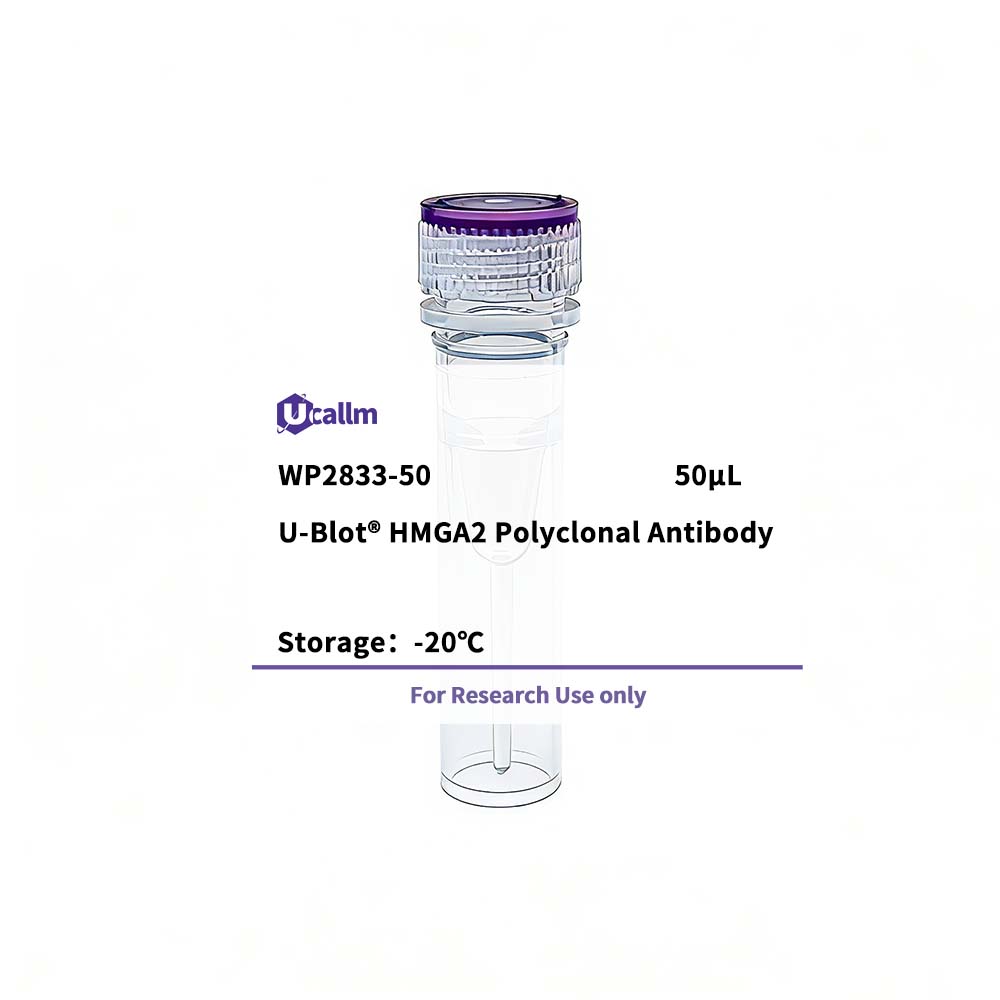
SKU: WP2833 Categories: ,

HMGA2 Polyclonal Antibody

Price range: $268.00 through $328.00

SKU: WP2833-100
Enter the quantity you would like, or drag the panel to find the quantity and price that best for you
Bulk QuoteAuthorize OEM & ODM

Product details

Background:

This gene encodes a protein that belongs to the non-histone chromosomal high mobility group (HMG) protein family. HMG proteins function as architectural factors and are essential components of the enhancesome. This protein contains structural DNA-binding domains and may act as a transcriptional regulating factor. Identification of the deletion, amplification, and rearrangement of this gene that are associated with myxoid liposarcoma suggests a role in adipogenesis and mesenchymal differentiation. A gene knock out study of the mouse counterpart demonstrated that this gene is involved in diet-induced obesity. Alternate transcriptional splice variants, encoding different isoforms, have been characterized. [provided by RefSeq, Jul 2008],


Specifications

Size50μL/100μL
TargetHMGA2
ReactivityHuman, Mouse
ApplicationsWB, ELISA
MW(Calculated)
MW(Observed)11kD
Host SpeciesRabbit
IsotypeIgG
Conjugate/ModificationUnmodified
Recommended Dilution RatioWB 1:500-2000; ELISA 1:5000-20000
FormulationLiquid in PBS containing 50% glycerol,0.5% BSA and 0.02% sodium azide.
PurificationThe antibody was affinity-purified from rabbit antiserum by affinity-chromatography using epitope-specific immunogen.
Storage-15°C to -25°C/1 year(Do not lower than -25°C)
Concentration1 mg/ml
ClonalityPolyclonal
Clone Number
ImmunogenSynthesized peptide derived from human protein . at AA range: 11-60
SpecificityHMGA2 Polyclonal Antibody detects endogenous levels of protein.
Gene NameHMGA2 HMGIC
Protein NameHigh mobility group protein HMGI-C (High mobility group AT-hook protein 2)
Other Name
SpeciesHuman
Gene ID8091
UniprotP52926,
Species.1Mouse
Gene ID.1
Uniprot.1P52927
Species.2
Gene ID.2
Uniprot.2
Cellular LocalizationNucleus.
Tissue ExpressionAorta endothelial cell,Hepatoma,
Signaling_pathwayHuman Diseases >> Cancer: overview >> Transcriptional misregulation in cancer;Human Diseases >> Cancer: overview >> MicroRNAs in cancer
Research Areas>>Transcriptional misregulation in cancer; / >>MicroRNAs in cancer
Functiondevelopmental stage:Expressed predominantly during embryogenesis.,Disease:A chromosomal aberration involving HMGA2 is associated with a subclass of benign mesenchymal tumors known as lipomas. Translocation t(3; 12)(q27-q28; q13-q15) with LPP is shown in lipomas. HMGA2 is also fused with a number of other genes in lipomas.,Disease:A chromosomal aberration involving HMGA2 is associated with parosteal lipomas. Translocation t(3; 12)(q28; q14) with LPP is also shown in one parosteal lipoma.,Disease:A chromosomal aberration involving HMGA2 is associated with pulmonary chondroid hamartomas. Translocation t(3; 12)(q27-q28; q14-q15) with LPP is detected in pulmonary chondroid hamartomas.,Disease:A chromosomal aberration involving HMGA2 is found in uterine leiomyoma (UL) [MIM:150699]. Translocation t(12; 14)(q15; q23-24) with RAD51L1. Chromosomal rearrangements involving HMGA2 do not seem to be the principle pathobiological mechanism in uterine leiomyoma.,Function:Functions as a transcriptional regulator. Functions in cell cycle regulation through CCNA2.,polymorphism:Genetic variation in HMGA2 has been associated with stature as a quantitative trait (STQTL9) [MIM:611547]. Human height is a classic, highly heritable quantitative trait.,PTM:Regulated by cell cycle-dependent phosphorylation which alters its DNA binding affinity.,similarity:Belongs to the HMGA family.,similarity:Contains 3 A.T hook DNA-binding domains.,subunit:Interacts with E4F1.,
Please login to post questions
Back to Top
Product has been added to your cart
