

HMGB1 [PTR2339] mouse mAb
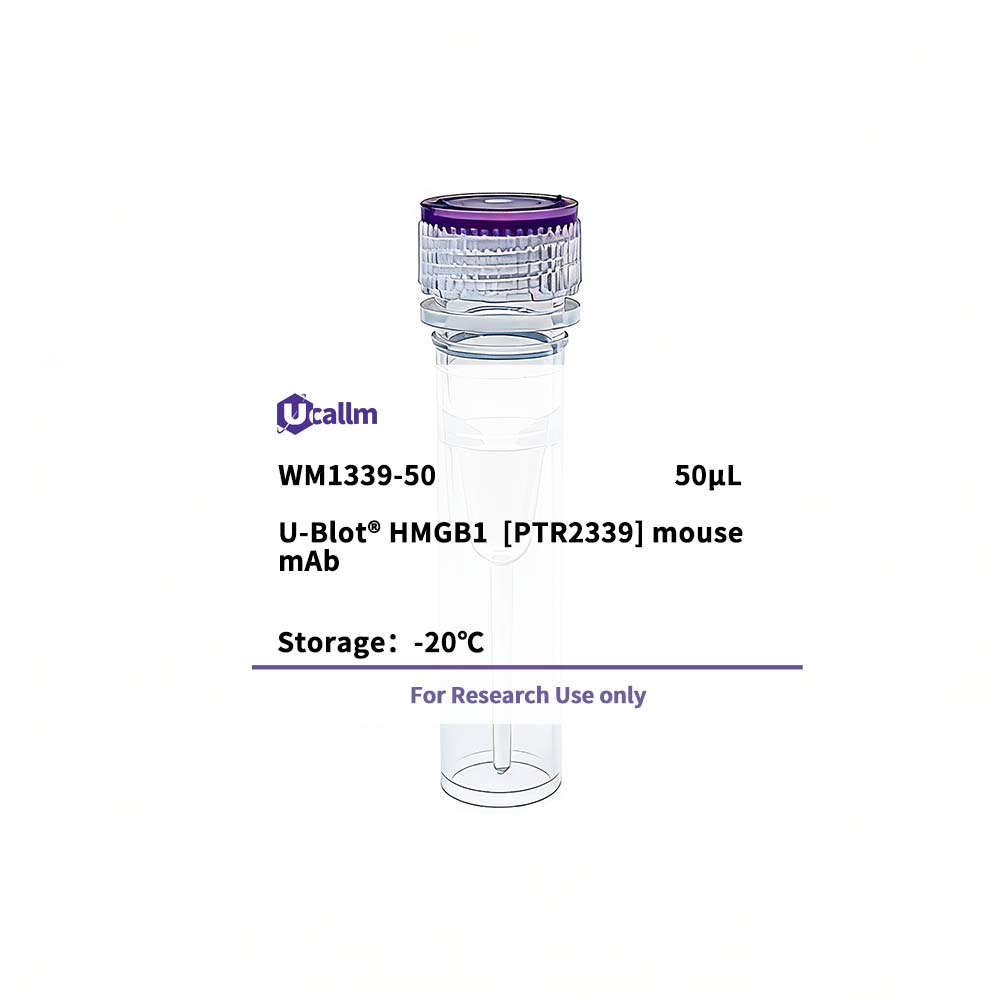
Ucallm_WM1339-50
Price range: $268.00 through $328.00
Product details
Background:
high mobility group box 1(HMGB1) Homo sapiens This gene encodes a protein that belongs to the High Mobility Group-box superfamily. The encoded non-histone, nuclear DNA-binding protein regulates transcription, and is involved in organization of DNA. This protein plays a role in several cellular processes, including inflammation, cell differentiation and tumor cell migration. Multiple pseudogenes of this gene have been identified. Alternative splicing results in multiple transcript variants that encode the same protein. [provided by RefSeq, Sep 2015],
Specifications
| Size | 50μL/100μL |
| Target | HMGB1 |
| Reactivity | Human, Mouse, Rat |
| Applications | WB, IF, ELISA |
| MW(Calculated) | 25kD |
| MW(Observed) | 24kD |
| Host Species | Mouse |
| Isotype | IgG1,Kappa |
| Conjugate/Modification | Unmodified |
| Recommended Dilution Ratio | WB 1:500-2000; IF 1:100-500; ELISA 1:1000-5000 |
| Formulation | PBS, 50% glycerol, 0.05% Proclin 300, 0.05%BSA |
| Purification | Recombinant Antibody expressed in animal component-free (ACF) media, purified via Protein G affinity chromatography. |
| Storage | -15°C to -25°C/1 year(Do not lower than -25°C) |
| Concentration | |
| Clonality | Monoclonal |
| Clone Number | RMMR2339 |
| Immunogen | Synthesized peptide derived from human HMGB1 AA range: 100-200 |
| Specificity | This antibody detects endogenous levels of HMGB1 protein. |
| Gene Name | HMGB1 HMG1 |
| Protein Name | High mobility group protein B1 (High mobility group protein 1) (HMG-1) |
| Other Name | High mobility group protein B1; / High mobility group protein 1; / HMG-1 |
| Species | Human |
| Gene ID | 3146 |
| Uniprot | P09429, |
| Species.1 | Mouse |
| Gene ID.1 | 100862258 |
| Uniprot.1 | P63158, |
| Species.2 | Rat |
| Gene ID.2 | 25459 |
| Uniprot.2 | P63159 |
| Cellular Localization | |
| Tissue Expression | Ubiquitous. Expressed in platelets (PubMed:11154118). |
| Signaling_pathway | Cellular Processes >> Transport and catabolism >> Autophagy - animal;Cellular Processes >> Cell growth and death >> Necroptosis;Organismal Systems >> Immune system >> Neutrophil extracellular trap formation |
| Research Areas | >>Base excision repair; / >>Autophagy - animal; / >>Necroptosis; / >>Neutrophil extracellular trap formation |
| Function | Function:Binds preferentially single-stranded DNA and unwinds double stranded DNA.,similarity:Belongs to the HMGB family.,similarity:Contains 2 HMG box DNA-binding domains., |
Please login to post questions
Related products




