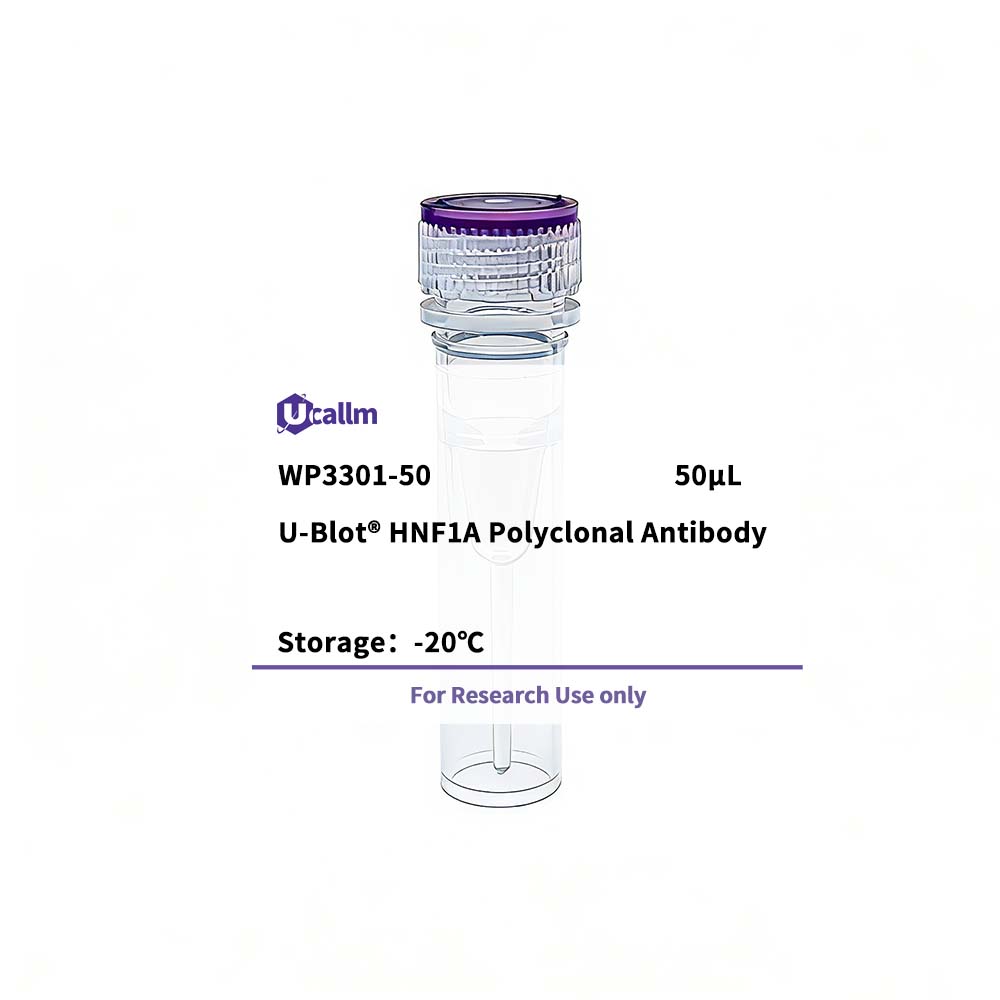
SKU: WP3301 Categories: ,

HNF1A Polyclonal Antibody

Price range: $268.00 through $328.00

SKU: WP3301-100
Enter the quantity you would like, or drag the panel to find the quantity and price that best for you
Bulk QuoteAuthorize OEM & ODM

Product details

Background:

The protein encoded by this gene is a transcription factor required for the expression of several liver-specific genes. The encoded protein functions as a homodimer and binds to the inverted palindrome 5'-GTTAATNATTAAC-3'. Defects in this gene are a cause of maturity onset diabetes of the young type 3 (MODY3) and also can result in the appearance of hepatic adenomas. Alternative splicing results in multiple transcript variants encoding different isoforms. [provided by RefSeq, Apr 2015],

Specifications

Size50μL/100μL
TargetHNF1A
ReactivityHuman, Mouse, Rat
ApplicationsWB, ELISA
MW(Calculated)
MW(Observed)69kD
Host SpeciesRabbit
IsotypeIgG
Conjugate/ModificationUnmodified
Recommended Dilution RatioWB 1:500-2000; ELISA 1:5000-20000
FormulationLiquid in PBS containing 50% glycerol,0.5% BSA and 0.02% sodium azide.
PurificationThe antibody was affinity-purified from rabbit antiserum by affinity-chromatography using epitope-specific immunogen.
Storage-15°C to -25°C/1 year(Do not lower than -25°C)
Concentration1 mg/ml
ClonalityPolyclonal
Clone Number
ImmunogenSynthesized peptide derived from part region of human protein
SpecificityHNF1A Polyclonal Antibody detects endogenous levels of protein.
Gene NameHNF1A TCF1
Protein NameHepatocyte nuclear factor 1-alpha (HNF-1-alpha) (HNF-1A) (Liver-specific transcription factor LF-B1) (LFB1) (Transcription factor 1) (TCF-1)
Other NameHepatocyte nuclear factor 1-alpha; / HNF-1-alpha; / HNF-1A; / Liver-specific transcription factor LF-B1; / LFB1; / Transcription factor 1; / TCF-1
SpeciesHuman
Gene ID6927
UniprotP20823,
Species.1Mouse
Gene ID.121405
Uniprot.1P22361,
Species.2Rat
Gene ID.224817
Uniprot.2P15257
Cellular LocalizationNucleus .
Tissue ExpressionLiver.
Signaling_pathway
Research Areas>>Maturity onset diabetes of the young
FunctionDisease:Defects in HNF1A are a cause of susceptibility to insulin-dependent diabetes mellitus (IDDM) [MIM:222100].,Disease:Defects in HNF1A are the cause of maturity onset diabetes of the young type 3 (MODY3) [MIM:600496]; also symbolized MODY-3. MODY [MIM:606391] is a form of diabetes characterized by an autosomal dominant mode of inheritance, age of onset of 25 years or younger and a primary defect in insulin secretion. The clinical phenotype of MODY3 is characterized by severe insulin secretory defects, and by major hyperglycemia associated with microvascular complications.,Disease:Defects in HNF1A may predispose to hepatic adenomas [MIM:142330]. Hepatic adenomas are benign tumors at risk of malignant transformation. Bi-allelic inactivation of HNF1A, whether sporadic or associated with MODY3, may be an early step in the developmant of some hepatocellular carcinomas.,Function:Required for the expression of several liver specific genes. Binds to the inverted palindrome 5'-GTTAATNATTAAC-3'.,online information:Hepatocyte nuclear factors entry,polymorphism:The Ala-98/Val-98 polymorphism is associated with a reduction in glucose-induced serum C-peptide and insulin responses.,similarity:Belongs to the HNF1 homeobox family.,similarity:Contains 1 homeobox DNA-binding domain.,subunit:Binds DNA as a dimer.,tissue specificity:Liver.,
Please login to post questions
Back to Top
Product has been added to your cart

