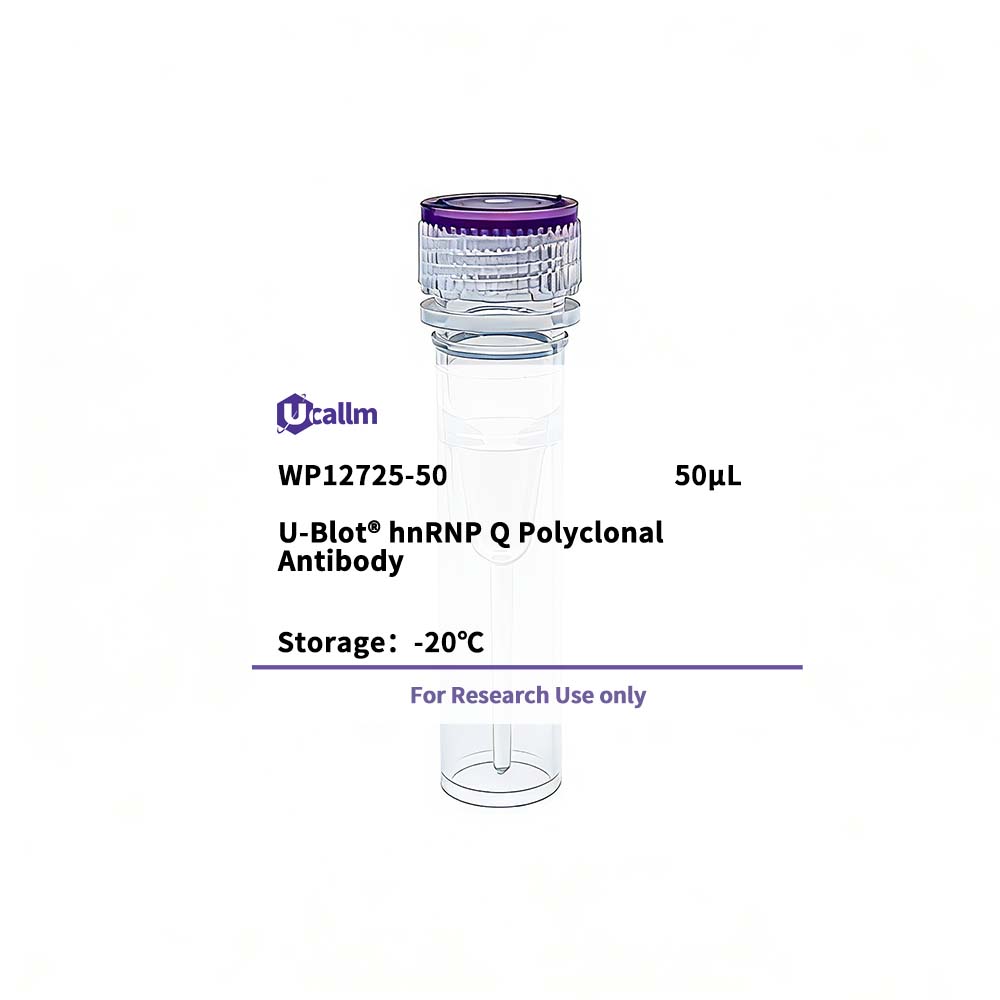
SKU: WP12725 Categories: ,

hnRNP Q Polyclonal Antibody

Price range: $268.00 through $328.00

SKU: WP12725-100
Enter the quantity you would like, or drag the panel to find the quantity and price that best for you
Bulk QuoteAuthorize OEM & ODM

Product details

Background:

This gene encodes a member of the cellular heterogeneous nuclear ribonucleoprotein (hnRNP) family. hnRNPs are RNA binding proteins that complex with heterogeneous nuclear RNA (hnRNA) and regulate alternative splicing, polyadenylation, and other aspects of mRNA metabolism and transport. The encoded protein plays a role in multiple aspects of mRNA maturation and is associated with several multiprotein complexes including the apoB RNA editing-complex and survival of motor neurons (SMN) complex. Alternatively spliced transcript variants encoding multiple isoforms have been observed for this gene, and a pseudogene of this gene is located on the short arm of chromosome 20. [provided by RefSeq, Dec 2011],

Specifications

Size50μL/100μL
TargethnRNP Q
ReactivityHuman, Mouse, Rat
ApplicationsWB, IHC, IF, ELISA
MW(Calculated)
MW(Observed)62kD
Host SpeciesRabbit
IsotypeIgG
Conjugate/ModificationUnmodified
Recommended Dilution RatioWB 1:500-1:2000; IHC 1:100-1:300; IF 1:200-1:1000; ELISA 1:20000; Not yet tested in other applications. / Note: For IHC, we suggest antigen retrieval with TE buffer pH 9.0 (Cat#WT1004)
FormulationLiquid in PBS containing 50% glycerol, 0.5% BSA and 0.02% sodium azide.
PurificationThe antibody was affinity-purified from rabbit antiserum by affinity-chromatography using epitope-specific immunogen.
Storage-15°C to -25°C/1 year(Do not lower than -25°C)
Concentration1 mg/ml
ClonalityPolyclonal
Clone Number
ImmunogenThe antiserum was produced against synthesized peptide derived from human hnRNP Q. AA range:236-285
SpecificityhnRNP Q Polyclonal Antibody detects endogenous levels of hnRNP Q protein.
Gene NameSYNCRIP
Protein NameHeterogeneous nuclear ribonucleoprotein Q
Other NameSYNCRIP; / HNRPQ; / NSAP1; / Heterogeneous nuclear ribonucleoprotein Q; / hnRNP Q; / Glycine- and tyrosine-rich RNA-binding protein; / GRY-RBP; / NS1-associated protein 1; / Synaptotagmin-binding; / cytoplasmic RNA-interacting protein
SpeciesHuman
Gene ID10492
UniprotO60506,
Species.1Mouse
Gene ID.156403
Uniprot.1Q7TMK9,
Species.2Rat
Gene ID.2363113
Uniprot.2Q7TP47
Cellular LocalizationCytoplasm . Microsome . Endoplasmic reticulum . Nucleus . The tyrosine phosphorylated form bound to RNA is found in microsomes (By similarity). Localized in cytoplasmic mRNP granules containing untranslated mRNAs (By similarity). .; [Isoform 1]: Nucleus, nucleoplasm . Expressed predominantly in the nucleoplasm. .; [Isoform 2]: Nucleus, nucleoplasm . Expressed predominantly in the nucleoplasm. .; [Isoform 3]: Nucleus, nucleoplasm . Expressed predominantly in the nucleoplasm. .
Tissue ExpressionUbiquitously expressed. Detected in heart, brain, pancreas, placenta, spleen, lung, liver, skeletal muscle, kidney, thymus, prostate, uterus, small intestine, colon, peripheral blood and testis.
Signaling_pathway
Research Areas
FunctionDomain:The domain containing eight Arg-Gly-Gly repeats may be involved in RNA-binding and protein-protein interactions.,Function:Heterogenous nuclear ribonucleoprotein (hnRNP) implicated in mRNA processing mechanisms. Isoform 1, isoform 2 and isoform 3 are associated in vitro with pre-mRNA, splicing intermediates and mature mRNA protein complexes. Isoform 1 binds to apoB mRNA AU-rich sequences. Isoform 1 is part of the APOB mRNA editosome complex and may modulate the postranscriptional C to U RNA-editing of the APOB mRNA through either by binding to A1CF (APOBEC1 complementation factor), to APOBEC1 or to RNA itself. May be involved in translationally coupled mRNA turnover. Implicated with other RNA-binding proteins in the cytoplasmic deadenylation/translational and decay interplay of the FOS mRNA mediated by the major coding-region determinant of instability (mCRD) domain. Interacts in vitro preferentially with poly(A) and poly(U) RNA sequences. Isoform 3 may be involved in cytoplasmic vesicle-based mRNA transport through interaction with synaptotagmins.,PTM:Phosphorylated on tyrosine. The membrane-bound form found in microsomes is phosphorylated in vitro by insulin receptor tyrosine kinase (INSR). Phosphorylation is inhibited upon binding to RNA, whereas the cytoplasmic form is poorly phosphorylated (By similarity). Phosphorylated upon DNA damage, probably by ATM or ATR.,sequence Caution:Contaminating sequence. Potential poly-A sequence starting in position 413.,similarity:Contains 3 RRM (RNA recognition motif) domains.,subcellular location:Expressed predominantly in the nucleoplasm.,subcellular location:The tyrosine phosphorylated form bound to RNA is found in microsomes.,subunit:Isoform 1 is a component of the APOB mRNA editosome complex and interacts with APOBEC1 and A1CF (APOBEC1 complementation factor). Part of a complex associated with the FOS mCRD domain and consisting of PABPC1, PAIP1, CSDE1/UNR, HNRPD and SYNCRIP. Isoform 3 interacts with HNRPR. Interacts with POLR2A hyperphosphorylated C-terminal domain. Interacts with minute virus of mice (MVM) NS1 protein. Isoform 1, isoform 2 and isoform 3 interact with SMN. Isoform 3 interacts through its C-terminal domain with SYT7, SYT8 and SYT9 (By similarity). The non-phosphorylated and phosphorylated forms are colocalized with PAIP1 in polysomes (By similarity). Identified in the spliceosome C complex, at least composed of AQR, ASCC3L1, C19orf29, CDC40, CDC5L, CRNKL1, DDX23, DDX41, DDX48, DDX5, DGCR14, DHX35, DHX38, DHX8, EFTUD2, FRG1, GPATC1, HNRPA1, HNRPA2B1, HNRPA3, HNRPC, HNRPF, HNRPH1, HNRPK, HNRPM, HNRPR, HNRPU, KIAA1160, KIAA1604, LSM2, LSM3, MAGOH, MORG1, PABPC1, PLRG1, PNN, PPIE, PPIL1, PPIL3, PPWD1, PRPF19, PRPF4B, PRPF6, PRPF8, RALY, RBM22, RBM8A, RBMX, SART1, SF3A1, SF3A2, SF3A3, SF3B1, SF3B2, SF3B3, SFRS1, SKIV2L2, SNRPA1, SNRPB, SNRPB2, SNRPD1, SNRPD2, SNRPD3, SNRPE, SNRPF, SNRPG, SNW1, SRRM1, SRRM2, SYF2, SYNCRIP, TFIP11, THOC4, U2AF1, WDR57, XAB2 and ZCCHC8.,tissue specificity:Ubiquitously expressed. Detected in heart, brain, pancreas, placenta, spleen, lung, liver, skeletal muscle, kidney, thymus, prostate, uterus, small intestine, colon, peripheral blood and testis.,
Please login to post questions
Back to Top
Product has been added to your cart

