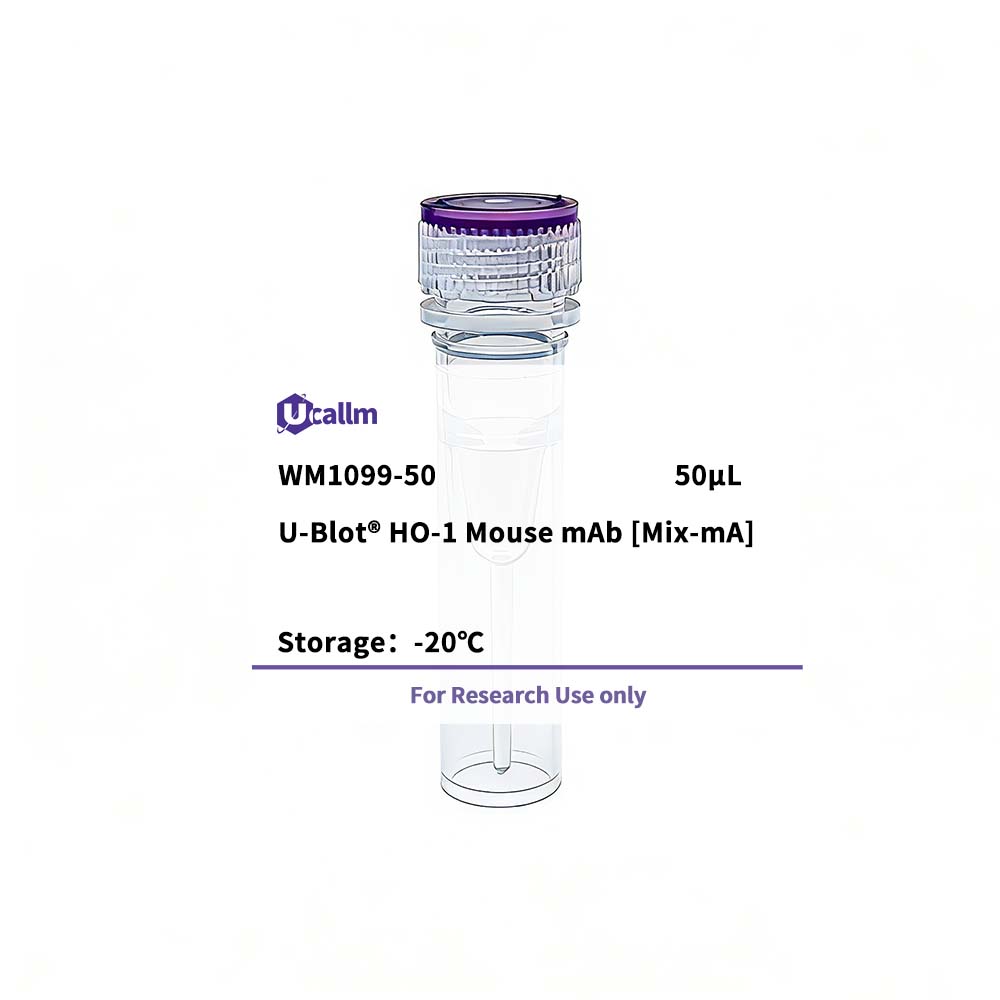
SKU: WM1099 Categories: ,

HO-1 Mouse mAb [Mix-mA]

Price range: $268.00 through $328.00

SKU: WM1099-50
Enter the quantity you would like, or drag the panel to find the quantity and price that best for you
Bulk QuoteAuthorize OEM & ODM

Product details

Background:
heme oxygenase 1(HMOX1) Homo sapiens Heme oxygenase, an essential enzyme in heme catabolism, cleaves heme to form biliverdin, which is subsequently converted to bilirubin by biliverdin reductase, and carbon monoxide, a putative neurotransmitter. Heme oxygenase activity is induced by its substrate heme and by various nonheme substances. Heme oxygenase occurs as 2 isozymes, an inducible heme oxygenase-1 and a constitutive heme oxygenase-2. HMOX1 and HMOX2 belong to the heme oxygenase family. [provided by RefSeq, Jul 2008],


Specifications

Size50μL/100μL
TargetHO1
ReactivityHuman, Mouse, Rat
ApplicationsIHC, WB, IF
MW(Calculated)
MW(Observed)28kD
Host SpeciesMouse
Isotype
Conjugate/ModificationUnmodified
Recommended Dilution RatioIF 1:50-200; IHC1:50-200; WB 1:1000-2000 / Note: For IHC, we suggest antigen retrieval with TE buffer pH 9.0 (Cat#WT1004)
FormulationLiquid in PBS containing 50% glycerol, 0.5% BSA and 0.02% sodium azide.
PurificationThe antibody was affinity-purified from mouse ascites by affinity-chromatography using specific immunogen.
Storage-15°C to -25°C/1 year(Do not lower than -25°C)
Concentration1 mg/ml
ClonalityMonoclonal
Clone Number19C10
ImmunogenSynthesized peptide derived from human HO-1
SpecificityThis antibody detects endogenous levels of HO-1 at Human, Mouse,Rat
Gene NameHMOX1 HO HO1
Protein NameHO-1
Other NameHeme oxygenase 1; / HO-1
SpeciesHuman
Gene ID3162
UniprotP09601,
Species.1Mouse
Gene ID.115368
Uniprot.1P14901,
Species.2Rat
Gene ID.224451
Uniprot.2P06762
Cellular LocalizationEndoplasmic reticulum membrane; Single-pass type IV membrane protein; Cytoplasmic side .
Tissue ExpressionExpressed at higher levels in renal cancer tissue than in normal tissue (at protein level).
Signaling_pathwayCellular Processes >> Cell growth and death >> Ferroptosis;Human Diseases >> Cancer: overview >> Pathways in cancer;Human Diseases >> Cancer: overview >> MicroRNAs in cancer;Human Diseases >> Cancer: specific types >> Hepatocellular carcinoma;Environmental Information Processing >> Signal transduction >> HIF-1 signaling pathway
Research Areas>>Porphyrin metabolism; / >>Metabolic pathways; / >>HIF-1 signaling pathway; / >>Ferroptosis; / >>Mineral absorption; / >>Pathways in cancer; / >>MicroRNAs in cancer; / >>Chemical carcinogenesis - reactive oxygen species; / >>Hepatocellular carcinoma; / >>Fluid shear stress and atherosclerosis
FunctionCatalytic activity:Heme + 3 AH(2) + 3 O(2) = biliverdin + Fe(2+) + CO + 3 A + 3 H(2)O.,Function:Heme oxygenase cleaves the heme ring at the alpha methene bridge to form biliverdin. Biliverdin is subsequently converted to bilirubin by biliverdin reductase. Under physiological conditions, the activity of heme oxygenase is highest in the spleen, where senescent erythrocytes are sequestrated and destroyed.,induction:Heme oxygenase 1 activity is highly inducible by its substrate heme and by various non-heme substances such as heavy metals, bromobenzene, endotoxin, oxidizing agents and UVA.,similarity:Belongs to the heme oxygenase family.,
Please login to post questions
Back to Top
Product has been added to your cart

