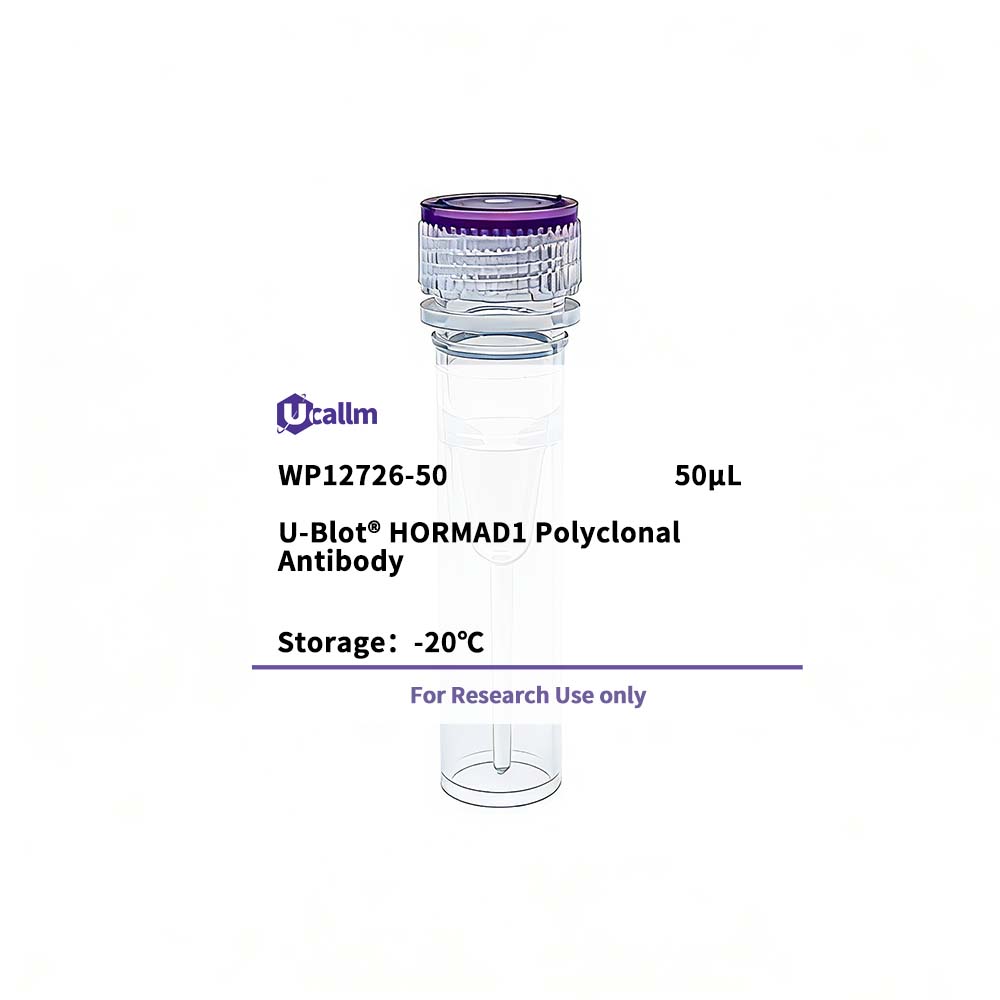
SKU: WP12726 Categories: ,

HORMAD1 Polyclonal Antibody

Price range: $268.00 through $328.00

SKU: WP12726-100
Enter the quantity you would like, or drag the panel to find the quantity and price that best for you
Bulk QuoteAuthorize OEM & ODM

Product details

Background:

This gene encodes a HORMA domain-containing protein. HORMA domains are involved in chromatin binding and play a role in cell cycle regulation. The encoded protein may play a role in meiosis, and expression of this gene is a potential marker for cancer. A pseudogene of this gene is located on the long arm of chromosome 6. Alternatively spliced transcript variants encoding multiple isoforms have been observed for this gene. [provided by RefSeq, Dec 2010],


Specifications

Size50μL/100μL
TargetHORMAD1
ReactivityHuman, Mouse, Rat
ApplicationsWB, ELISA
MW(Calculated)
MW(Observed)45kD
Host SpeciesRabbit
IsotypeIgG
Conjugate/ModificationUnmodified
Recommended Dilution RatioWB 1:500-1:2000; ELISA 1:10000; Not yet tested in other applications.
FormulationLiquid in PBS containing 50% glycerol, 0.5% BSA and 0.02% sodium azide.
PurificationThe antibody was affinity-purified from rabbit antiserum by affinity-chromatography using epitope-specific immunogen.
Storage-15°C to -25°C/1 year(Do not lower than -25°C)
Concentration1 mg/ml
ClonalityPolyclonal
Clone Number
ImmunogenThe antiserum was produced against synthesized peptide derived from human HORMAD1. AA range:321-370
SpecificityHORMAD1 Polyclonal Antibody detects endogenous levels of HORMAD1 protein.
Gene NameHORMAD1
Protein NameHORMA domain-containing protein 1
Other NameHORMAD1; / NOHMA; / HORMA domain-containing protein 1; / Cancer/testis antigen 46; / CT46; / Newborn ovary HORMA protein
SpeciesHuman
Gene ID84072
UniprotQ86X24,
Species.1Mouse
Gene ID.1
Uniprot.1Q9D5T7
Species.2
Gene ID.2
Uniprot.2
Cellular LocalizationNucleus . Chromosome . Preferentially localizes to unsynapsed or desynapsed chromosomal regions during the prophase I stage of meiosis. TRIP13 is required for depletion from synapsed chromosomes. The expression of the phosphorylated form at Ser-377 is restricted to unsynapsed chromosomal regions (By similarity). .
Tissue ExpressionTestis-specific. Over-expressed in carcinomas.
Signaling_pathway
Research Areas
Functionsimilarity:Contains 1 HORMA domain.,tissue specificity:Testis-specific. Over-expressed in carcinomas.,
Please login to post questions
Back to Top
Product has been added to your cart
