


HRD1/SYVN1 rabbit pAb
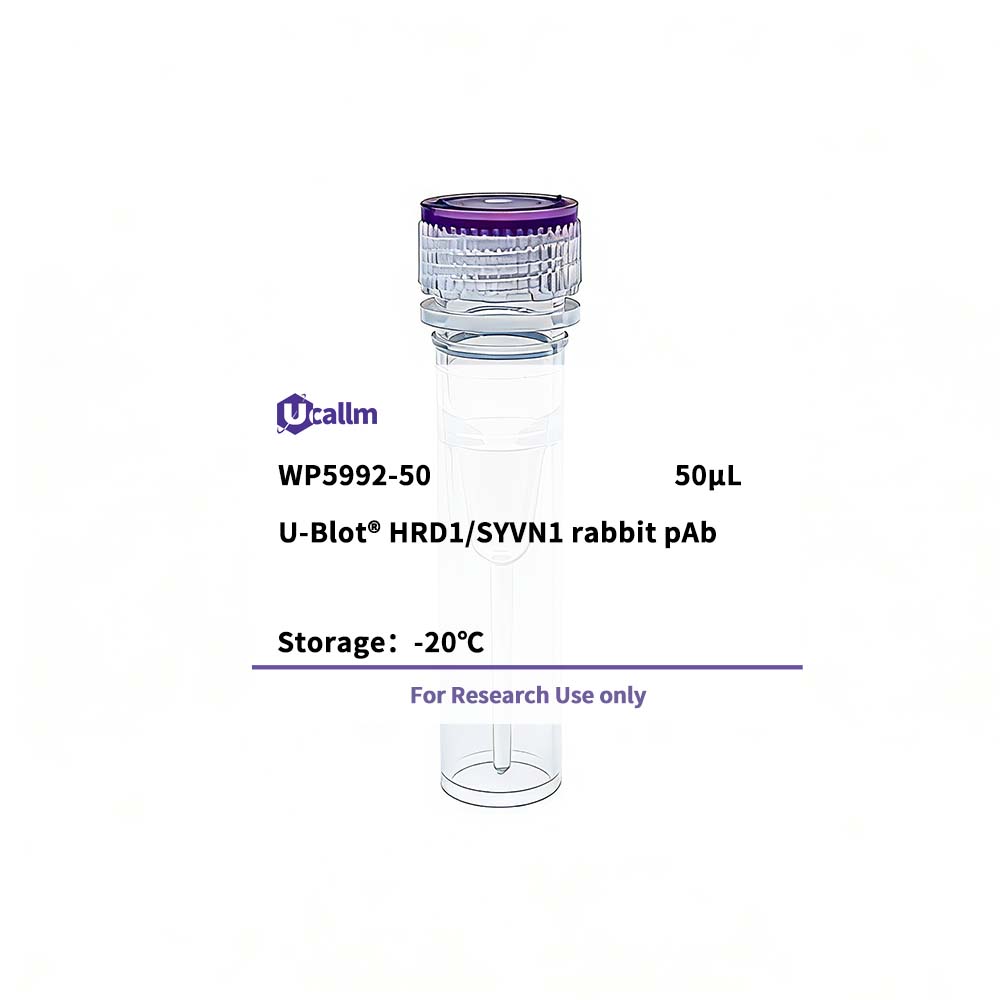
Ucallm_WP5992-50
Price range: $268.00 through $328.00
Product details
Background:
Specifications
| Size | 50μL/100μL |
| Target | SYVN1 |
| Reactivity | Human, Mouse |
| Applications | WB |
| MW(Calculated) | 68kD |
| MW(Observed) | |
| Host Species | Rabbit |
| Isotype | IgG |
| Conjugate/Modification | Unmodified |
| Recommended Dilution Ratio | WB 1:500-2000 |
| Formulation | Liquid in PBS containing 50% glycerol, 0.5% BSA and 0.02% sodium azide. |
| Purification | The antibody was affinity-purified from rabbit antiserum by affinity-chromatography using epitope-specific immunogen. |
| Storage | -15°C to -25°C/1 year(Do not lower than -25°C) |
| Concentration | 1 mg/ml |
| Clonality | Polyclonal |
| Clone Number | |
| Immunogen | Synthesized peptide derived from human HRD1/SYVN1 |
| Specificity | This antibody detects endogenous levels of HRD1/SYVN1 at Human, Mouse |
| Gene Name | SYVN1 HRD1 KIAA1810 |
| Protein Name | E3 ubiquitin-protein ligase synoviolin (Synovial apoptosis inhibitor 1) |
| Other Name | |
| Species | Human |
| Gene ID | 84447 |
| Uniprot | Q86TM6, |
| Species.1 | Mouse |
| Gene ID.1 | 74126 |
| Uniprot.1 | Q9DBY1 |
| Species.2 | |
| Gene ID.2 | |
| Uniprot.2 | |
| Cellular Localization | Endoplasmic reticulum membrane; Multi-pass membrane protein . |
| Tissue Expression | Ubiquitously expressed, with highest levels in liver and kidney (at protein level). Up-regulated in synovial tissues from patients with rheumatoid arthritis (at protein level). |
| Signaling_pathway | Genetic Information Processing >> Folding, sorting and degradation >> Ubiquitin mediated proteolysis |
| Research Areas | |
| Function | E3 ubiquitin-protein ligase which accepts ubiquitin specifically from endoplasmic reticulum-associated UBC7 E2 ligase and transfers it to substrates, promoting their degradation . Component of the endoplasmic reticulum quality control (ERQC) system also called ER-associated degradation (ERAD) involved in ubiquitin-dependent degradation of misfolded endoplasmic reticulum proteins . Also promotes the degradation of normal but naturally short-lived proteins such as SGK. Protects cells from ER stress-induced apoptosis. Protects neurons from apoptosis induced by polyglutamine-expanded huntingtin (HTT) or unfolded GPR37 by promoting their degradation . Sequesters p53/TP53 in the cytoplasm and promotes its degradation, thereby negatively regulating its biological function in transcription, cell cycle regulation and apoptosis . Mediates the ubiquitination and subsequent degradation of cytoplasmic NFE2L1 (By similarity). During the early stage of B cell development, required for degradation of the pre-B cell receptor (pre-BCR) complex, hence supporting further differentiation into mature B cells (By similarity). |
Please login to post questions
Related products




