


HSP 75 Polyclonal Antibody
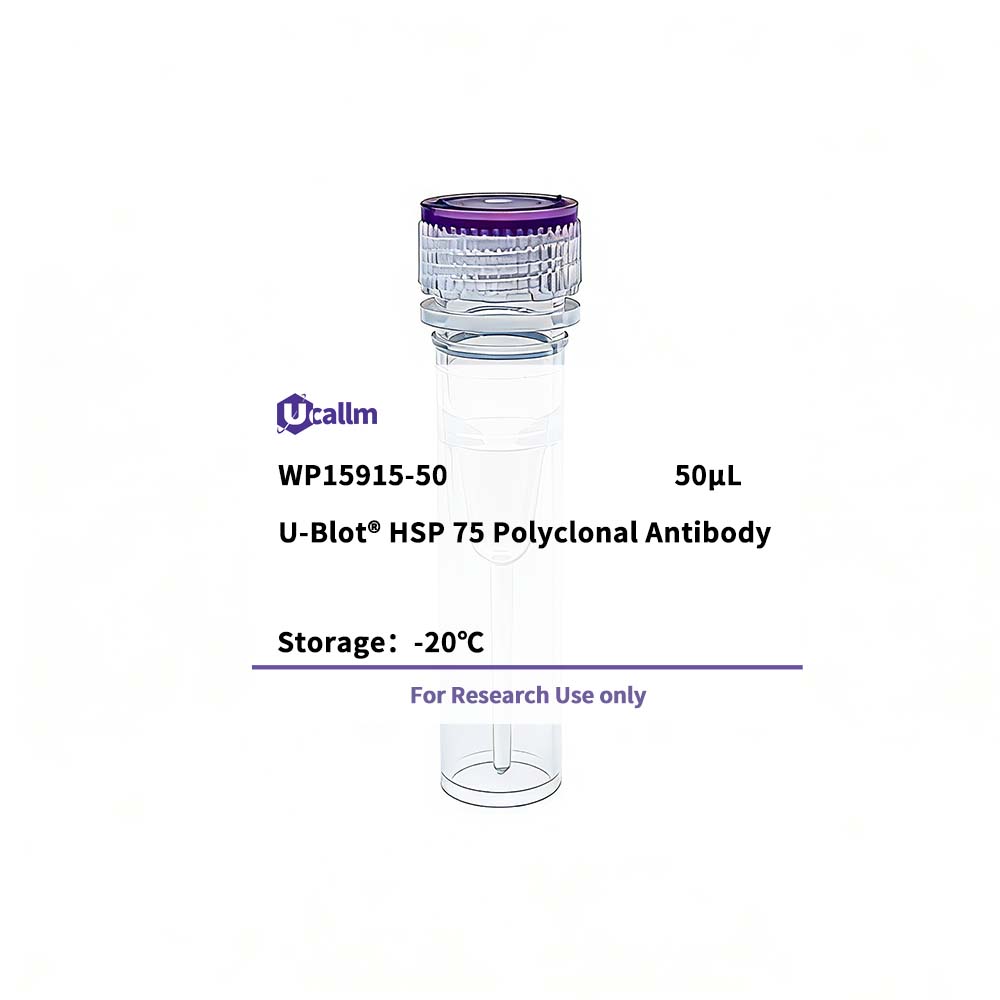
Ucallm_WP15915-50
Price range: $268.00 through $328.00
Product details
Background:
This gene encodes a mitochondrial chaperone protein that is member of the heat shock protein 90 (HSP90) family. The encoded protein has ATPase activity and interacts with tumor necrosis factor type I. This protein may function in regulating cellular stress responses. Alternate splicing results in multiple transcript variants. [provided by RefSeq, Jan 2013],
Specifications
| Size | 50μL/100μL |
| Target | HSP 75 |
| Reactivity | Human, Mouse, Rat |
| Applications | IHC, IF, ELISA |
| MW(Calculated) | |
| MW(Observed) | |
| Host Species | Rabbit |
| Isotype | IgG |
| Conjugate/Modification | Unmodified |
| Recommended Dilution Ratio | IHC 1:50-200; ELISA 1:10000-20000; IF 1:50-200 / Note: For IHC, we suggest antigen retrieval with TE buffer pH 9.0 (Cat#WT1004) |
| Formulation | Liquid in PBS containing 50% glycerol, 0.5% BSA and 0.02% sodium azide. |
| Purification | The antibody was affinity-purified from rabbit antiserum by affinity-chromatography using epitope-specific immunogen. |
| Storage | -15°C to -25°C/1 year(Do not lower than -25°C) |
| Concentration | 1 mg/ml |
| Clonality | Polyclonal |
| Clone Number | |
| Immunogen | The antiserum was produced against synthesized peptide derived from the Internal region of human TRAP1. AA range:481-530 |
| Specificity | The antibody detects endogenous HSP 75 |
| Gene Name | TRAP1 HSP75 |
| Protein Name | Heat shock protein 75 kDa, mitochondrial (HSP 75) (TNFR-associated protein 1) (Tumor necrosis factor type 1 receptor-associated protein) (TRAP-1) |
| Other Name | Heat shock protein 75 kDa, mitochondrial; / HSP 75; / TNFR-associated protein 1; / Tumor necrosis factor type 1 receptor-associated protein; / TRAP-1 |
| Species | Human |
| Gene ID | 10131 |
| Uniprot | Q12931, |
| Species.1 | Mouse |
| Gene ID.1 | 68015 |
| Uniprot.1 | Q9CQN1 |
| Species.2 | |
| Gene ID.2 | |
| Uniprot.2 | |
| Cellular Localization | Mitochondrion . Mitochondrion inner membrane . Mitochondrion matrix . |
| Tissue Expression | Found in skeletal muscle, liver, heart, brain, kidney, pancreas, lung, placenta and bladder. Expression is highly reduced in bladder cancer and renal cell carcinoma specimens compared to healthy tissues, but it is increased in other type of tumors. |
| Signaling_pathway | Human Diseases >> Neurodegenerative disease >> Parkinson disease;Human Diseases >> Neurodegenerative disease >> Pathways of neurodegeneration - multiple diseases |
| Research Areas | >>Parkinson disease; / >>Pathways of neurodegeneration - multiple diseases |
| Function | Function:Chaperone that expresses an ATPase activity.,similarity:Belongs to the heat shock protein 90 family.,subunit:Binds to the intracellular domain of tumor necrosis factor type 1 receptor. Binds to RB1.,tissue specificity:Found in skeletal muscle, liver, heart, brain, kidney, pancreas, lung and placenta., |
Please login to post questions
Related products





