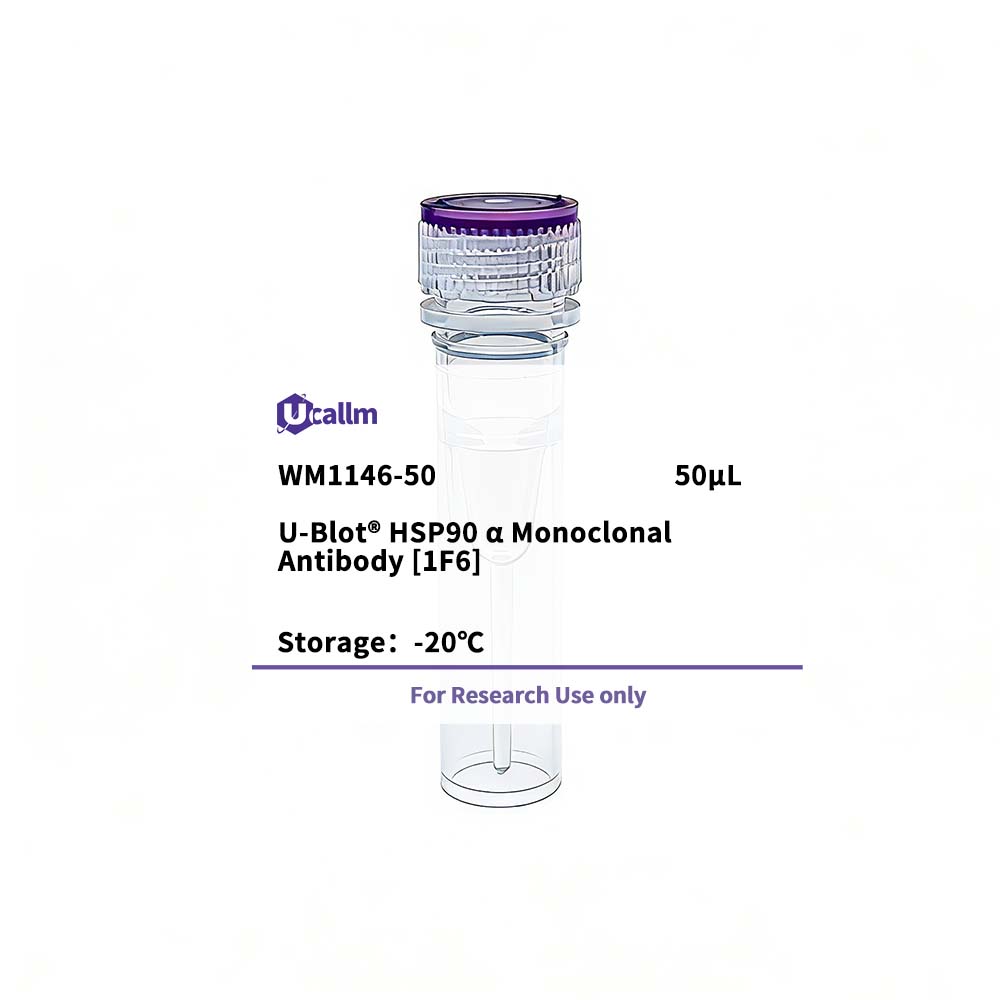
SKU: WM1146 Categories: ,

HSP90 α Monoclonal Antibody [1F6]

Price range: $268.00 through $328.00

SKU: WM1146-50
Enter the quantity you would like, or drag the panel to find the quantity and price that best for you
Bulk QuoteAuthorize OEM & ODM

Product details

Background:
The protein encoded by this gene is an inducible molecular chaperone that functions as a homodimer. The encoded protein aids in the proper folding of specific target proteins by use of an ATPase activity that is modulated by co-chaperones. Two transcript variants encoding different isoforms have been found for this gene. [provided by RefSeq, Jan 2012],


Specifications

Size50μL/100μL
TargetHSP 90
ReactivityHuman, Mouse, Rat
ApplicationsWB, IHC, IF
MW(Calculated)
MW(Observed)95kD
Host SpeciesMouse
IsotypeIgG2a,kappa
Conjugate/ModificationUnmodified
Recommended Dilution RatioWB 1:500-1:2000; IHC 1:100-1:300; ELISA 1:40000,; IF 1:50-200 / Note: For IHC, we suggest antigen retrieval with TE buffer pH 9.0 (Cat#WT1004)
FormulationLiquid in PBS containing 50% glycerol, 0.5% BSA and 0.02% sodium azide.
PurificationThe antibody was affinity-purified from mouse antiserum by affinity-chromatography using epitope-specific immunogen.
Storage-15°C to -25°C/1 year(Do not lower than -25°C)
Concentration1 mg/ml
ClonalityMonoclonal
Clone Number1F6
ImmunogenSynthesized peptide derived from the C-terminal region of human HSP90A. at AA range: 660-740
SpecificityThe antibody detects endogenous HSP90 α protein
Gene NameHSP90AA1
Protein NameHeat shock protein HSP 90-alpha (Heat shock 86 kDa) (HSP 86) (HSP86) (Renal carcinoma antigen NY-REN-38)
Other NameHeat shock protein HSP 90-alpha; / Heat shock 86 kDa; / HSP 86; / HSP86; / Renal carcinoma antigen NY-REN-38
SpeciesHuman
Gene ID3320
UniprotP07900,
Species.1Mouse
Gene ID.115519
Uniprot.1P07901,
Species.2Rat
Gene ID.2299331
Uniprot.2P82995
Cellular LocalizationNucleus . Cytoplasm . Melanosome . Cell membrane . Mitochondrion . Identified by mass spectrometry in melanosome fractions from stage I to stage IV.
Tissue ExpressionAdult brain,Brain,Brain cortex,Breast,Cajal-Retzius
Signaling_pathwayCellular Processes >> Cell growth and death >> Necroptosis;Organismal Systems >> Immune system >> NOD-like receptor signaling pathway;Organismal Systems >> Immune system >> Antigen processing and presentation;Organismal Systems >> Immune system >> Th17 cell differentiation;Organismal Systems >> Immune system >> IL-17 signaling pathway;Organismal Systems >> Endocrine system >> Estrogen signaling pathway;Human Diseases >> Cancer: overview >> Pathways in cancer;Human Diseases >> Cancer: specific types >> Prostate cancer;Environmental Information Processing >> Signal transduction >> PI3K-Akt signaling pathway;Genetic Information Processing >> Folding, sorting and degradation >> Protein processing in endoplasmic reticulum
Research Areas>>Protein processing in endoplasmic reticulum; / >>PI3K-Akt signaling pathway; / >>Necroptosis; / >>Antigen processing and presentation; / >>NOD-like receptor signaling pathway; / >>IL-17 signaling pathway; / >>Th17 cell differentiation; / >>Progesterone-mediated oocyte maturation; / >>Estrogen signaling pathway; / >>Salmonella infection; / >>Pathways in cancer; / >>Chemical carcinogenesis - receptor activation; / >>Prostate cancer; / >>Lipid and atherosclerosis; / >>Fluid shear stress and atherosclerosis
FunctionCaution:Despite classification as a pseudogene, the existence of this protein is supported by unambiguous mass spectrometry evidence.,Function:Molecular chaperone.,Function:Molecular chaperone. Has ATPase activity.,similarity:Belongs to the heat shock protein 90 family.,subcellular location:Identified by mass spectrometry in melanosome fractions from stage I to stage IV.,subunit:Homodimer. Interacts with AHSA1, SMYD3 and TOM34. Interacts with FNIP1 and HSF1.,
Please login to post questions
Back to Top
Product has been added to your cart
