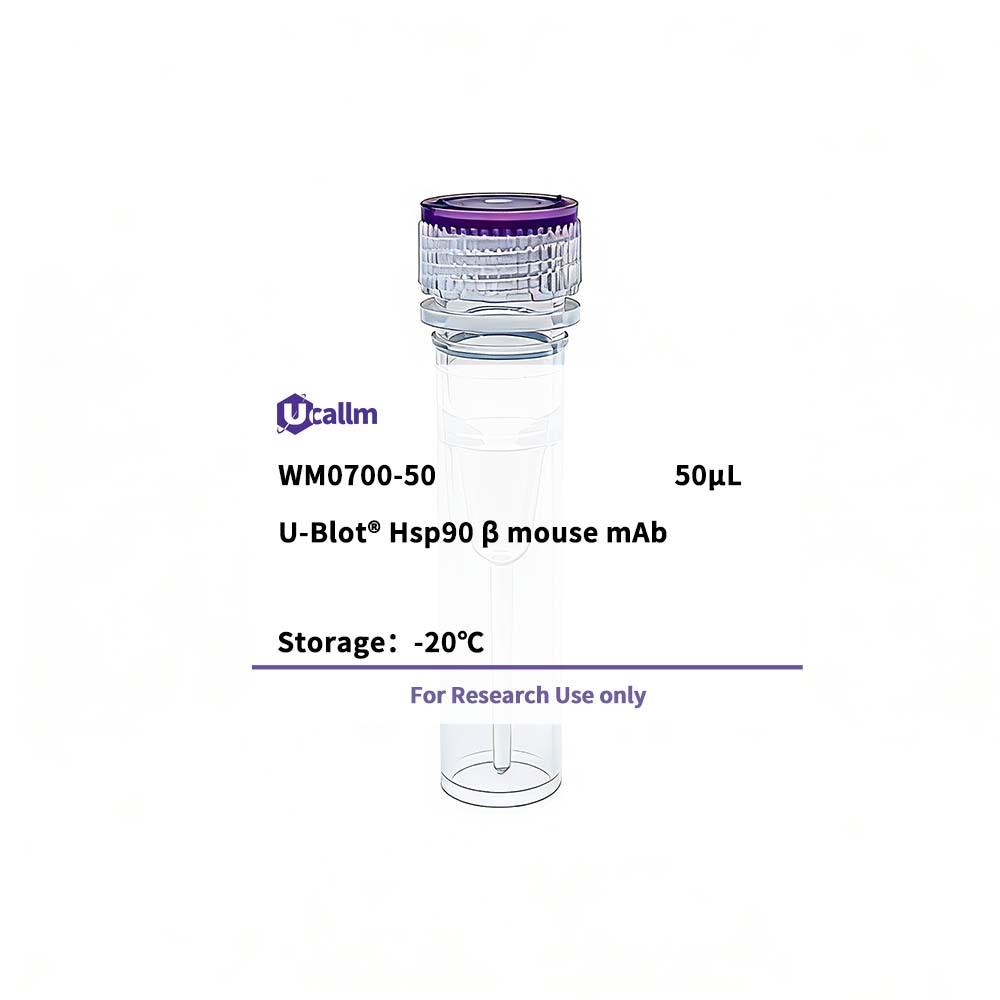
SKU: WM0700 Categories: ,

Hsp90 β mouse mAb

Price range: $268.00 through $328.00

SKU: WM0700-50
Enter the quantity you would like, or drag the panel to find the quantity and price that best for you
Bulk QuoteAuthorize OEM & ODM

Product details

Background:
This gene encodes a member of the heat shock protein 90 family; these proteins are involved in signal transduction, protein folding and degradation and morphological evolution. This gene encodes the constitutive form of the cytosolic 90 kDa heat-shock protein and is thought to play a role in gastric apoptosis and inflammation. Alternative splicing results in multiple transcript variants. Pseudogenes have been identified on multiple chromosomes. [provided by RefSeq, Dec 2012],


Specifications

Size50μL/100μL
TargetHSP90β
ReactivityHuman, Mouse, Rat, Monkey, Hamster
ApplicationsWB, ICC, IP
MW(Calculated)
MW(Observed)90kD
Host SpeciesMouse
Isotype
Conjugate/ModificationUnmodified
Recommended Dilution RatioWB 1:2000; ICC 1:200
FormulationLiquid in PBS containing 50% glycerol, 0.5% BSA and 0.02% sodium azide.
PurificationThe antibody was affinity-purified from mouse ascites by affinity-chromatography using epitope-specific immunogen.
Storage-15°C to -25°C/1 year(Do not lower than -25°C)
Concentration
ClonalityMonoclonal
Clone Number12D4
ImmunogenPurified recombinant human Hsp90 beta protein fragments expressed in E.coli
SpecificityThis antibody detects endogenous levels of Hsp90 beta and does not cross-react with Hsp90 alpha and other proteins.
Gene Namehsp90ab1
Protein Name
Other NameHSP90AB1; / 90 kda heat shock protein beta HSP90 beta; / D6S182; / FLJ26984; / Heat shock 84 kDa; / Heat shock 90kD protein 1, beta; / Heat shock 90kDa protein 1 beta; / Heat shock protein 90kDa alpha; / cytosolic; / class B member 1; / Heat shock protein beta; / Heat shock protein HSP 90 beta; / Heat shock protein HSP 90-beta; / HS90B_HUMAN; / HSP 84; / HSP 90; / HSP 90 b; / HSP 90b; / HSP84; / HSP90 BETA; / hsp90ab1; / HSP90B; / HSPC2; / HSPCB.
SpeciesHuman
Gene ID3326
UniprotP08238,
Species.1Mouse
Gene ID.1
Uniprot.1P11499
Species.2
Gene ID.2
Uniprot.2
Cellular LocalizationCytoplasm . Melanosome . Nucleus . Secreted . Cell membrane . Dynein axonemal particle . Cell surface . Identified by mass spectrometry in melanosome fractions from stage I to stage IV (PubMed:17081065). Translocates with BIRC2 from the nucleus to the cytoplasm during differentiation (PubMed:18239673). Secreted when associated with TGFB1 processed form (LAP) (PubMed:20599762). .
Tissue ExpressionAmygdala,Brain cortex,Colon,Colon carcinoma,Embryon
Signaling_pathwayCellular Processes >> Cell growth and death >> Necroptosis;Organismal Systems >> Immune system >> NOD-like receptor signaling pathway;Organismal Systems >> Immune system >> Antigen processing and presentation;Organismal Systems >> Immune system >> Th17 cell differentiation;Organismal Systems >> Immune system >> IL-17 signaling pathway;Organismal Systems >> Endocrine system >> Estrogen signaling pathway;Human Diseases >> Cancer: overview >> Pathways in cancer;Human Diseases >> Cancer: specific types >> Prostate cancer;Environmental Information Processing >> Signal transduction >> PI3K-Akt signaling pathway;Genetic Information Processing >> Folding, sorting and degradation >> Protein processing in endoplasmic reticulum
Research Areas>>Protein processing in endoplasmic reticulum; / >>PI3K-Akt signaling pathway; / >>Necroptosis; / >>Antigen processing and presentation; / >>NOD-like receptor signaling pathway; / >>IL-17 signaling pathway; / >>Th17 cell differentiation; / >>Progesterone-mediated oocyte maturation; / >>Estrogen signaling pathway; / >>Salmonella infection; / >>Pathways in cancer; / >>Chemical carcinogenesis - receptor activation; / >>Prostate cancer; / >>Lipid and atherosclerosis; / >>Fluid shear stress and atherosclerosis
FunctionFunction:Molecular chaperone. Has ATPase activity.,PTM:Phosphorylated upon DNA damage, probably by ATM or ATR.,similarity:Belongs to the heat shock protein 90 family.,subcellular location:Identified by mass spectrometry in melanosome fractions from stage I to stage IV.,subunit:Homodimer. Interacts with TP53/p53 (By similarity). Interacts with UNC45A. Binding to UNC45A involves 2 UNC45A monomers per HSP90AB1 dimer.,
Please login to post questions
Back to Top
Product has been added to your cart
