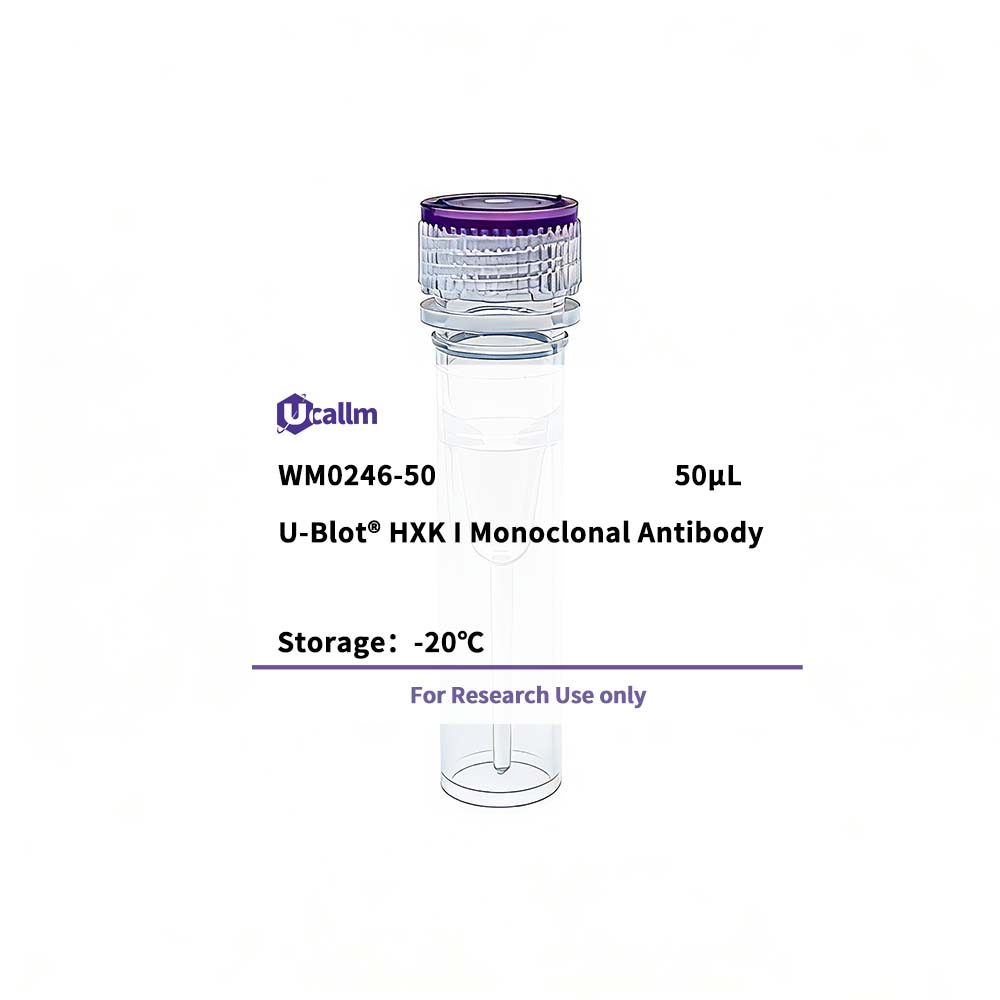
SKU: WM0246 Categories: ,

HXK I Monoclonal Antibody

Price range: $268.00 through $328.00

SKU: WM0246-50
Enter the quantity you would like, or drag the panel to find the quantity and price that best for you
Bulk QuoteAuthorize OEM & ODM

Product details

Background:
Hexokinases phosphorylate glucose to produce glucose-6-phosphate, the first step in most glucose metabolism pathways. This gene encodes a ubiquitous form of hexokinase which localizes to the outer membrane of mitochondria. Mutations in this gene have been associated with hemolytic anemia due to hexokinase deficiency. Alternative splicing of this gene results in several transcript variants which encode different isoforms, some of which are tissue-specific. [provided by RefSeq, Apr 2016],

Specifications

Size50μL/100μL
TargetHXK I
ReactivityHuman, Mouse, Rat
ApplicationsWB, IHC, IF, FC, ELISA
MW(Calculated)102kD
MW(Observed)
Host SpeciesMouse
Isotype
Conjugate/ModificationUnmodified
Recommended Dilution RatioWB 1:500-1:2000; IHC 1:200-1:1000; IF 1:200-1:1000; Flow Cyt 1:200-1:400; ELISA 1:10000; Not yet tested in other applications. / Note: For IHC, we suggest antigen retrieval with TE buffer pH 9.0 (Cat#WT1004)
FormulationLiquid in PBS containing 50% glycerol, 0.5% BSA and 0.02% sodium azide.
PurificationAffinity purification
Storage-15°C to -25°C/1 year(Do not lower than -25°C)
Concentration
ClonalityMonoclonal
Clone Number14H1
ImmunogenPurified recombinant fragment of human HXK I expressed in E. Coli.
SpecificityHXK I Monoclonal Antibody detects endogenous levels of HXK I protein.
Gene NameHK1
Protein NameHexokinase-1
Other NameHK1; / Hexokinase-1; / Brain form hexokinase; / Hexokinase type I; / HK I
SpeciesHuman
Gene ID3098
UniprotP19367,
Species.1Mouse
Gene ID.1
Uniprot.1P17710,
Species.2Rat
Gene ID.225058
Uniprot.2P05708
Cellular LocalizationMitochondrion outer membrane; Peripheral membrane protein . Cytoplasm, cytosol . The mitochondrial-binding peptide (MBP) region promotes association with the mitochondrial outer membrane (Probable). Dissociates from the mitochondrial outer membrane following inhibition by N-acetyl-D-glucosamine, leading to relocation to the cytosol (PubMed:27374331). .
Tissue ExpressionIsoform 2: Erythrocyte specific (Ref.6). Isoform 3: Testis-specific (PubMed:10978502). Isoform 4: Testis-specific (PubMed:10978502).
Signaling_pathwayOrganismal Systems >> Endocrine system >> Insulin signaling pathway;Human Diseases >> Cancer: overview >> Central carbon metabolism in cancer;Environmental Information Processing >> Signal transduction >> HIF-1 signaling pathway
Research Areas>>Glycolysis / Gluconeogenesis; / >>Fructose and mannose metabolism; / >>Galactose metabolism; / >>Starch and sucrose metabolism; / >>Amino sugar and nucleotide sugar metabolism; / >>Neomycin, kanamycin and gentamicin biosynthesis; / >>Metabolic pathways; / >>Carbon metabolism; / >>Biosynthesis of nucleotide sugars; / >>HIF-1 signaling pathway; / >>Insulin signaling pathway; / >>Type II diabetes mellitus; / >>Carbohydrate digestion and absorption; / >>Shigellosis; / >>Central carbon metabolism in cancer
FunctionCatalytic activity:ATP + D-hexose = ADP + D-hexose 6-phosphate.,Disease:Defects in HK1 are the cause of hexokinase deficiency [MIM:235700]. Hexokinase deficiency is a rare autosomal recessive disease with nonspherocytic hemolytic anemia as the predominant clinical feature.,Domain:The N- and C-terminal halves of this hexokinase show extensive sequence similarity to each other. The catalytic activity is associated with the C-terminus while regulatory function is associated with the N-terminus.,enzyme regulation:Hexokinase is an allosteric enzyme inhibited by its product Glc-6-P.,miscellaneous:In vertebrates there are four major glucose-phosphorylating isoenzymes, designated hexokinase I, II, III and IV (glucokinase).,online information:Hexokinase entry,pathway:Carbohydrate metabolism; hexose metabolism.,similarity:Belongs to the hexokinase family.,subcellular location:Its hydrophobic N-terminal sequence may be involved in membrane binding.,subunit:Monomer.,tissue specificity:Isoform 2 is erythrocyte specific; isoform 3 and isoform 4 are testis-specific.,
Please login to post questions
Back to Top
Product has been added to your cart

