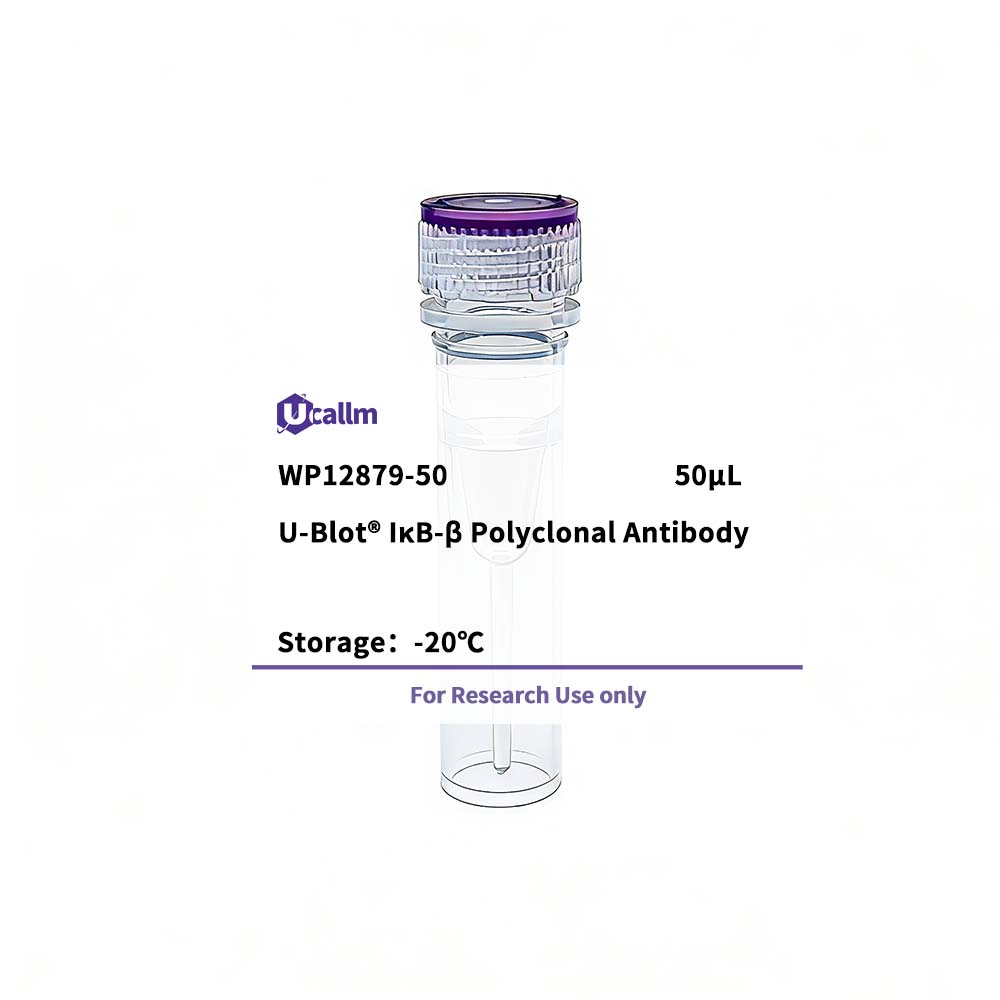
SKU: WP12879 Categories: ,

IκB-β Polyclonal Antibody

Price range: $268.00 through $328.00

SKU: WP12879-100
Enter the quantity you would like, or drag the panel to find the quantity and price that best for you
Bulk QuoteAuthorize OEM & ODM

Product details

Background:

The protein encoded by this gene belongs to the NF-kappa-B inhibitor family, which inhibit NF-kappa-B by complexing with, and trapping it in the cytoplasm. Phosphorylation of serine residues on these proteins by kinases marks them for destruction via the ubiquitination pathway, thereby allowing activation of the NF-kappa-B, which translocates to the nucleus to function as a transcription factor. Alternatively spliced transcript variants have been found for this gene.[provided by RefSeq, Jul 2011],

Specifications

TargetIκB β
ReactivityHuman, Mouse
ApplicationsWB, IHC
MW(Calculated)
MW(Observed)37kD
Host SpeciesRabbit
IsotypeIgG
Conjugate/ModificationUnmodified
Modification
Recommended Dilution RatioWB 1:500-2000; IHC 1:50-300 / Note: For IHC, we suggest antigen retrieval with TE buffer pH 9.0 (Cat#YS0004)
FormulationLiquid in PBS containing 50% glycerol, 0.5% BSA and 0.02% sodium azide.
Source
PurificationThe antibody was affinity-purified from rabbit antiserum by affinity-chromatography using epitope-specific immunogen.
Purity
Storage-15°C to -25°C/1 year(Do not lower than -25°C)
Concentration1 mg/ml
ClonalityPolyclonal
Clone Number
ImmunogenThe antiserum was produced against synthesized peptide derived from human IkappaB-beta. AA range:4-53
Sequence
SpecificityIκB-β Polyclonal Antibody detects endogenous levels of IκB-β protein.
Gene NameNFKBIB
Protein NameNF-kappa-B inhibitor beta
Other NameNFKBIB; / IKBB; / TRIP9; / NF-kappa-B inhibitor beta; / NF-kappa-BIB; / I-kappa-B-beta; / IkB-B; / IkB-beta; / IkappaBbeta; / Thyroid receptor-interacting protein 9; / TR-interacting protein 9; / TRIP-9
SpeciesHuman
Gene ID-14793
UniprotQ15653,
Species.1Mouse
Gene ID-218036
Uniprot.1Q60778
Species.2
Gene ID-3
Uniprot.2
Organism-4
Gene ID-4
SwissProt-4
BackgroundThe protein encoded by this gene belongs to the NF-kappa-B inhibitor family, which inhibit NF-kappa-B by complexing with, and trapping it in the cytoplasm. Phosphorylation of serine residues on these proteins by kinases marks them for destruction via the ubiquitination pathway, thereby allowing activation of the NF-kappa-B, which translocates to the nucleus to function as a transcription factor. Alternatively spliced transcript variants have been found for this gene.[provided by RefSeq, Jul 2011],
Cellular LocalizationCytoplasm . Nucleus .
Tissue ExpressionExpressed in all tissues examined.
Signaling_pathwayOrganismal Systems >> Immune system >> NOD-like receptor signaling pathway;Organismal Systems >> Immune system >> RIG-I-like receptor signaling pathway;Organismal Systems >> Immune system >> Cytosolic DNA-sensing pathway;Organismal Systems >> Immune system >> T cell receptor signaling pathway;Organismal Systems >> Immune system >> Th1 and Th2 cell differentiation;Organismal Systems >> Immune system >> Th17 cell differentiation;Organismal Systems >> Immune system >> B cell receptor signaling pathway;Organismal Systems >> Immune system >> Chemokine signaling pathway;Organismal Systems >> Endocrine system >> Adipocytokine signaling pathway;Organismal Systems >> Nervous system >> Neurotrophin signaling pathway;Human Diseases >> Cancer: overview >> PD-L1 expression and PD-1 checkpoint pathway in cancer
Research Areas>>Chemokine signaling pathway; / >>NOD-like receptor signaling pathway; / >>RIG-I-like receptor signaling pathway; / >>Cytosolic DNA-sensing pathway; / >>Th1 and Th2 cell differentiation; / >>Th17 cell differentiation; / >>T cell receptor signaling pathway; / >>B cell receptor signaling pathway; / >>Neurotrophin signaling pathway; / >>Adipocytokine signaling pathway; / >>Pathogenic Escherichia coli infection; / >>Shigellosis; / >>Leishmaniasis; / >>Toxoplasmosis; / >>Measles; / >>Influenza A; / >>Epstein-Barr virus infection; / >>Coronavirus disease - COVID-19; / >>PD-L1 expression and PD-1 checkpoint pathway in cancer
FunctionFunction:Inhibits NF-kappa-B by complexing with and trapping it in the cytoplasm. However, the unphosphorylated form resynthesized after cell stimulation is able to bind NF-kappa-B allowing its transport to the nucleus and protecting it to further IKBA-dependent inactivation. Association with inhibitor kappa B-interacting NKIRAS1 and NKIRAS2 prevent its phosphorylation rendering it more resistant to degradation, explaining its slower degradation.,PTM:Phosphorylated; followed by degradation. Interaction with NKIRAS1 and NKIRAS2 probably prevents phosphorylation.,similarity:Belongs to the NF-kappa-B inhibitor family.,similarity:Contains 6 ANK repeats.,subunit:Interacts with THRB (via ligand-binding domain). Interacts with RELA and REL. Interacts with COMMD1 and inhibitor kappa B-interacting Ras-like NKIRAS1 and NKIRAS2.,tissue specificity:Expressed in all tissues examined.,
RRID
Please login to post questions
Back to Top
Product has been added to your cart