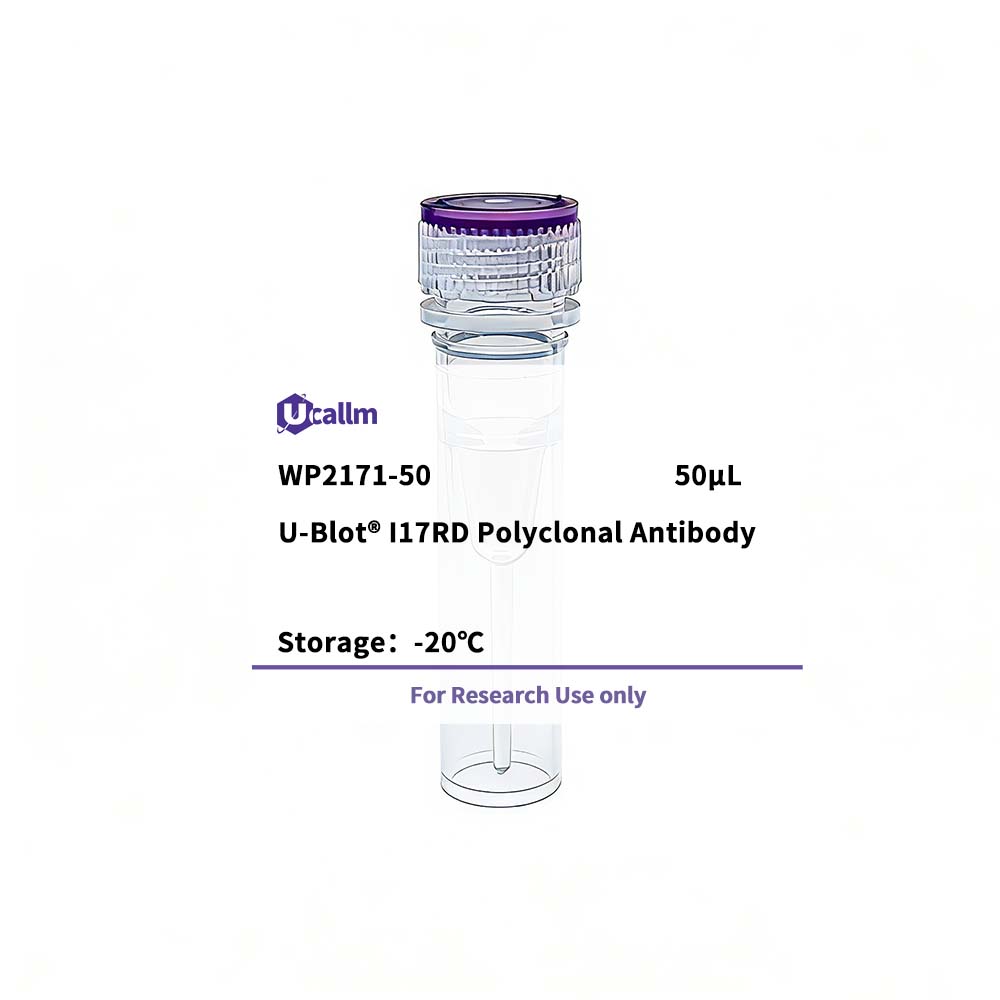
SKU: WP2171 Categories: ,

I17RD Polyclonal Antibody

Price range: $268.00 through $328.00

SKU: WP2171-100
Enter the quantity you would like, or drag the panel to find the quantity and price that best for you
Bulk QuoteAuthorize OEM & ODM

Product details

Background:

This gene encodes a membrane protein belonging to the interleukin-17 receptor (IL-17R) protein family. The encoded protein is a component of the interleukin-17 receptor signaling complex, and the interaction between this protein and IL-17R does not require the interleukin. The gene product also affects fibroblast growth factor signaling, inhibiting or stimulating growth through MAPK/ERK signaling. Alternate splicing generates multiple transcript variants encoding distinct isoforms. [provided by RefSeq, Jan 2016],

Specifications

Size50μL/100μL
TargetI17RD
ReactivityHuman, Mouse
ApplicationsWB, ELISA
MW(Calculated)
MW(Observed)81kD
Host SpeciesRabbit
IsotypeIgG
Conjugate/ModificationUnmodified
Recommended Dilution RatioWB 1:500-2000; ELISA 1:5000-20000
FormulationLiquid in PBS containing 50% glycerol,0.5% BSA and 0.02% sodium azide.
PurificationThe antibody was affinity-purified from rabbit antiserum by affinity-chromatography using epitope-specific immunogen.
Storage-15°C to -25°C/1 year(Do not lower than -25°C)
Concentration1 mg/ml
ClonalityPolyclonal
Clone Number
ImmunogenSynthesized peptide derived from part region of human protein .at AA range: 80-130
SpecificityI17RD Polyclonal Antibody detects endogenous levels of protein.
Gene NameIL17RD IL17RLM SEF UNQ6115/PRO20026
Protein NameInterleukin-17 receptor D (IL-17 receptor D) (IL-17RD) (IL17Rhom) (Interleukin-17 receptor-like protein) (Sef homolog) (hSef)
Other Name
SpeciesHuman
Gene ID54756
UniprotQ8NFM7,
Species.1Mouse
Gene ID.1
Uniprot.1Q8JZL1
Species.2
Gene ID.2
Uniprot.2
Cellular LocalizationGolgi apparatus membrane; Single-pass type I membrane protein . Cell membrane; Single-pass type I membrane protein . Predominantly associated with the Golgi apparatus and is partially translocated to the plasma membrane upon stimulation.; [Isoform 4]: Cytoplasm.
Tissue ExpressionExpressed in umbilical vein endothelial cells and in several highly vascularized tissues such as kidney, colon, skeletal muscle, heart and small intestine. Highly expressed in ductal epithelial cells of salivary glands, seminal vesicles and the collecting tubules of the kidney. Isoform 1 is also highly expressed in both fetal and adult brain, pituitary, tonsils, spleen, adenoids, fetal kidney, liver, testes and ovary. Isoform 1 is also expressed at moderate levels in primary aortic endothelial cells and adrenal medulla, and at low levels in adrenal cortex. Isoform 4 is specifically and highly expressed in pituitary, fetal brain and umbilical vein endothelial cells.
Signaling_pathway
Research Areas
FunctionFunction:Feedback inhibitor of fibroblast growth factor mediated Ras-MAPK signaling and ERK activation. May inhibit FGF-induced FGFR1 tyrosine phosphorylation. Regulates the nuclear ERK signaling pathway by spatially blocking nuclear translocation of activated ERK without inhibiting cytoplasmic phosphorylation of ERK. Mediates JNK activation and may be involved in apoptosis.,subcellular location:Predominantly associated with the Golgi apparatus and is partially translocated to the plasma membrane upon stimulation.,subunit:Interacts with MAP3K7 (By similarity). Self-associates. Interacts with FGFR1, FGFR2 and phosphorylated MAP2K1 or MAP2K2. Associates with a MAP2K1/2-MAPK1/3 complex.,tissue specificity:Expressed in umbilical vein endothelial cells and in several highly vascularized tissues such as kidney, colon, skeletal muscle, heart and small intestine. Highly expressed in ductal epithelial cells of salivary glands, seminal vesicles and the collecting tubules of the kidney. Isoform 1 is also highly expressed in both fetal and adult brain, pituarity, tonsils, spleen, adenoids, fetal kidney, liver, testes and ovary. Isoform 1 is also expressed at moderate levels in primary aortic endothelial cells and adrenal medulla, and at low levels in adrenal cortex. Isoform 4 is specifically and highly expressed in pituitary, fetal brain and umbilical vein endothelial cells.,
Please login to post questions
Back to Top
Product has been added to your cart