

IGF-IR Polyclonal Antibody
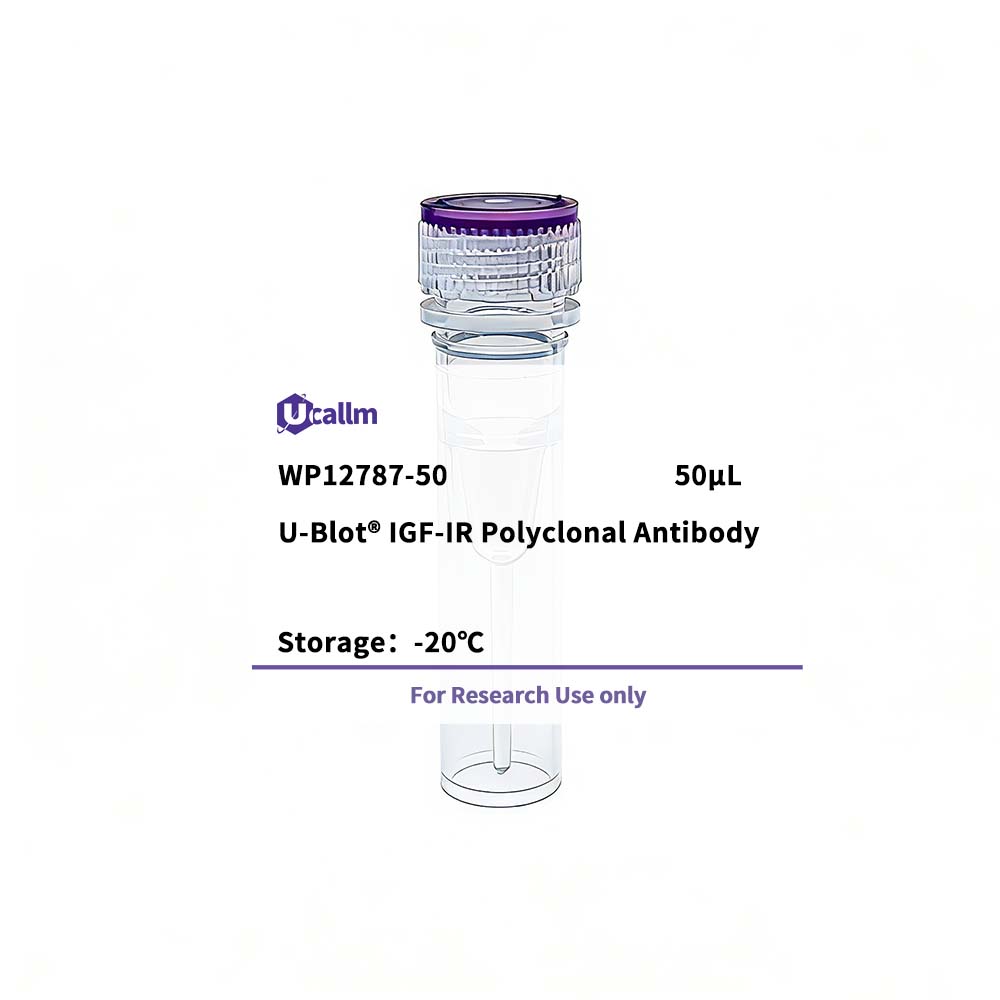
Ucallm_WP12787-50
Price range: $268.00 through $328.00
Product details
Background:
This receptor binds insulin-like growth factor with a high affinity. It has tyrosine kinase activity. The insulin-like growth factor I receptor plays a critical role in transformation events. Cleavage of the precursor generates alpha and beta subunits. It is highly overexpressed in most malignant tissues where it functions as an anti-apoptotic agent by enhancing cell survival. Alternatively spliced transcript variants encoding distinct isoforms have been found for this gene. [provided by RefSeq, May 2014],
Specifications
| Size | 50μL/100μL |
| Target | IGF-1R |
| Reactivity | Human, Mouse, Rat |
| Applications | WB, IHC, IF, ELISA |
| MW(Calculated) | |
| MW(Observed) | pro:155kD,recetor beta:95kD |
| Host Species | Rabbit |
| Isotype | IgG |
| Conjugate/Modification | Unmodified |
| Recommended Dilution Ratio | IHC: 100-300; WB 1:500-1:2000; ELISA 1:10000; IF 1:50-200 / Note: For IHC, we suggest antigen retrieval with TE buffer pH 9.0 (Cat#WT1004) |
| Formulation | Liquid in PBS containing 50% glycerol, 0.5% BSA and 0.02% sodium azide. |
| Purification | The antibody was affinity-purified from rabbit antiserum by affinity-chromatography using epitope-specific immunogen. |
| Storage | -15°C to -25°C/1 year(Do not lower than -25°C) |
| Concentration | 1 mg/ml |
| Clonality | Polyclonal |
| Clone Number | |
| Immunogen | The antiserum was produced against synthesized peptide derived from human IGF1R. AA range:1131-1180 |
| Specificity | IGF-IR Polyclonal Antibody detects endogenous levels of IGF-IR protein. |
| Gene Name | IGF1R |
| Protein Name | Insulin-like growth factor 1 receptor |
| Other Name | IGF1R; / Insulin-like growth factor 1 receptor; / Insulin-like growth factor I receptor; / IGF-I receptor; / CD antigen CD221 |
| Species | Human |
| Gene ID | 3480 |
| Uniprot | P08069, |
| Species.1 | Mouse |
| Gene ID.1 | 16001 |
| Uniprot.1 | Q60751, |
| Species.2 | Rat |
| Gene ID.2 | 25718 |
| Uniprot.2 | P24062 |
| Cellular Localization | Cell membrane; Single-pass type I membrane protein . |
| Tissue Expression | Found as a hybrid receptor with INSR in muscle, heart, kidney, adipose tissue, skeletal muscle, hepatoma, fibroblasts, spleen and placenta (at protein level). Expressed in a variety of tissues. Overexpressed in tumors, including melanomas, cancers of the colon, pancreas prostate and kidney. |
| Signaling_pathway | Cellular Processes >> Transport and catabolism >> Autophagy - animal;Cellular Processes >> Cellular community - eukaryotes >> Focal adhesion;Cellular Processes >> Cellular community - eukaryotes >> Adherens junction;Cellular Processes >> Cellular community - eukaryotes >> Signaling pathways regulating pluripotency of stem cells;Organismal Systems >> Aging >> Longevity regulating pathway;Organismal Systems >> Aging >> Longevity regulating pathway - multiple species;Human Diseases >> Cancer: overview >> Pathways in cancer;Human Diseases >> Cancer: overview >> Transcriptional misregulation in cancer;Human Diseases >> Cancer: specific types >> Hepatocellular carcinoma;Human Diseases >> Cancer: specific types >> Glioma;Human Diseases >> Cancer: specific types >> Melanoma;Human Diseases >> Cancer: specific types >> Prostate cancer;Human Diseases >> Cancer: specific types >> Breast cancer;Environmental Information Processing >> Signal transduction >> MAPK signaling pathway;Environmental Information Processing >> Signal transduction >> Ras signaling pathway;Environmental Information Processing >> Signal transduction >> Rap1 signaling pathway;Environmental Information Processing >> Signal transduction >> HIF-1 signaling pathway;Environmental Information Processing >> Signal transduction >> FoxO signaling pathway;Environmental Information Processing >> Signal transduction >> PI3K-Akt signaling pathway;Environmental Information Processing >> Signal transduction >> AMPK signaling pathway;Environmental Information Processing >> Signal transduction >> mTOR signaling pathway |
| Research Areas | >>EGFR tyrosine kinase inhibitor resistance; / >>Endocrine resistance; / >>MAPK signaling pathway; / >>Ras signaling pathway; / >>Rap1 signaling pathway; / >>HIF-1 signaling pathway; / >>FoxO signaling pathway; / >>Oocyte meiosis; / >>Autophagy - animal; / >>Endocytosis; / >>mTOR signaling pathway; / >>PI3K-Akt signaling pathway; / >>AMPK signaling pathway; / >>Longevity regulating pathway; / >>Longevity regulating pathway - multiple species; / >>Focal adhesion; / >>Adherens junction; / >>Signaling pathways regulating pluripotency of stem cells; / >>Long-term depression; / >>Ovarian steroidogenesis; / >>Progesterone-mediated oocyte maturation; / >>Pathways in cancer; / >>Transcriptional misregulation in cancer; / >>Proteoglycans in cancer; / >>Glioma; / >>Prostate cancer; / >>Melanoma; / >>Breast cancer; / >>Hepatocellular carcinoma |
| Function | Catalytic activity:ATP + a [protein]-L-tyrosine = ADP + a [protein]-L-tyrosine phosphate.,Disease:Defects in IGF1R may be a cause in some cases of resistance to insulin-like growth factor 1 (IGF1 resistance) [MIM:270450]. IGF1 resistance is a gowth deficiency disorder characterized by intrauterine growth retardation and poor postnatal growth accompanied with increased plasma IGF1.,enzyme regulation:Autophosphorylation activates the kinase activity.,Function:This receptor binds insulin-like growth factor 1 (IGF1) with a high affinity and IGF2 with a lower affinity. It has a tyrosine-protein kinase activity, which is necessary for the activation of the IGF1-stimulated downstream signaling cascade. When present in a hybrid receptor with INSR, binds IGF1. PubMed:12138094 shows that hybrid receptors composed of IGF1R and INSR isoform Long are activated with a high affinity by IGF1, with low affinity by IGF2 and not significantly activated by insulin, and that hybrid receptors composed of IGF1R and INSR isoform Short are activated by IGF1, IGF2 and insulin. In contrast, PubMed:16831875 shows that hybrid receptors composed of IGF1R and INSR isoform Long and hybrid receptors composed of IGF1R and INSR isoform Short have similar binding characteristics, both bind IGF1 and have a low affinity for insulin.,online information:IGF-1 receptor entry,PTM:Phosphorylation of Tyr-980 is required for IRS1- and SHC1-binding.,PTM:The cytoplasmic domain of the beta subunit is autophosphorylated on tyrosine residues in response to insulin-like growth factor I (IGF I).,similarity:Belongs to the protein kinase superfamily. Tyr protein kinase family. Insulin receptor subfamily.,similarity:Contains 1 protein kinase domain.,similarity:Contains 3 fibronectin type-III domains.,subunit:Tetramer of 2 alpha and 2 beta chains linked by disulfide bonds. The alpha chains contribute to the formation of the ligand-binding domain, while the beta chain carries the kinase domain. Interacts with PIK3R1 and with the PTB/PID domains of IRS1 and SHC1 in vitro when autophosphorylated on tyrosine residues. Forms a hybrid receptor with INSR, the hybrid is a tetramer consisting of 1 alpha chain and 1 beta chain of INSR and 1 alpha chain and 1 beta chain of IGF1R.,tissue specificity:Found as a hybrid receptor with INSR in muscle, heart, kidney, adipose tissue, skeletal muscle, hepatoma, fibrobasts, spleen and placenta (at protein level). Expressed in a variety of tissues., |
Please login to post questions
Related products



