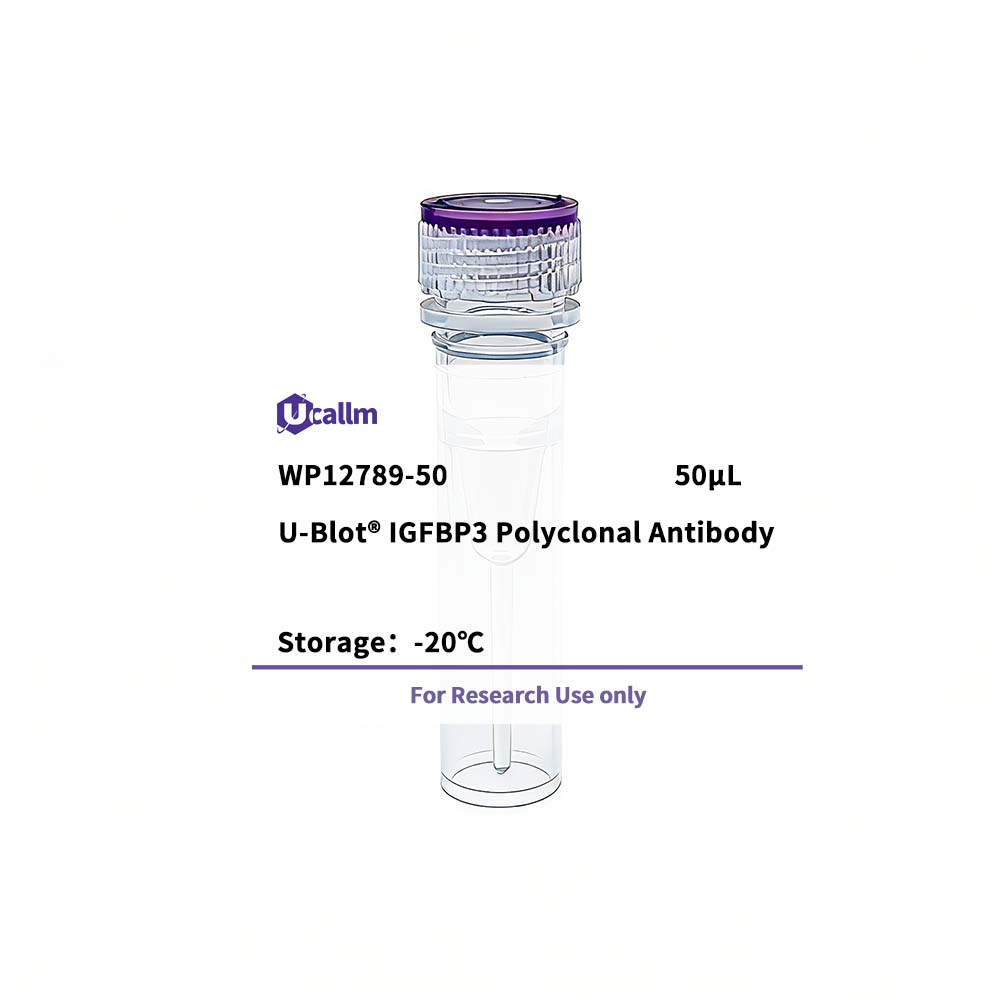
SKU: WP12789 Categories: ,

IGFBP3 Polyclonal Antibody

Price range: $268.00 through $328.00

SKU: WP12789-100
Enter the quantity you would like, or drag the panel to find the quantity and price that best for you
Bulk QuoteAuthorize OEM & ODM

Product details

Background:

This gene is a member of the insulin-like growth factor binding protein (IGFBP) family and encodes a protein with an IGFBP domain and a thyroglobulin type-I domain. The protein forms a ternary complex with insulin-like growth factor acid-labile subunit (IGFALS) and either insulin-like growth factor (IGF) I or II. In this form, it circulates in the plasma, prolonging the half-life of IGFs and altering their interaction with cell surface receptors. Alternate transcriptional splice variants, encoding different isoforms, have been characterized. [provided by RefSeq, Jul 2008],

Specifications

Size50μL/100μL
TargetIGFBP3
ReactivityHuman, Mouse
ApplicationsWB, IHC, IF, ELISA
MW(Calculated)
MW(Observed)31kD
Host SpeciesRabbit
IsotypeIgG
Conjugate/ModificationUnmodified
Recommended Dilution RatioWB 1:500-2000; IHC 1:100-500; IF/ICC1:100-500; ELISA 1:5000-20000 / Note: For IHC, we suggest antigen retrieval with TE buffer pH 9.0 (Cat#WT1004)
FormulationLiquid in PBS containing 50% glycerol, 0.5% BSA and 0.02% sodium azide.
PurificationThe antibody was affinity-purified from rabbit antiserum by affinity-chromatography using epitope-specific immunogen.
Storage-15°C to -25°C/1 year(Do not lower than -25°C)
Concentration1 mg/ml
ClonalityPolyclonal
Clone Number
ImmunogenThe antiserum was produced against synthesized peptide derived from human IGFBP-3. AA range:151-200
SpecificityIGFBP3 Polyclonal Antibody detects endogenous levels of IGFBP3 protein.
Gene NameIGFBP3
Protein NameInsulin-like growth factor-binding protein 3
Other NameIGFBP3; / IBP3; / Insulin-like growth factor-binding protein 3; / IBP-3; / IGF-binding protein 3; / IGFBP-3
SpeciesHuman
Gene ID3486
UniprotP17936,
Species.1Mouse
Gene ID.1
Uniprot.1P47878
Species.2
Gene ID.2
Uniprot.2
Cellular LocalizationSecreted .
Tissue ExpressionExpressed by most tissues. Present in plasma.
Signaling_pathwayCellular Processes >> Cell growth and death >> p53 signaling pathway;Cellular Processes >> Cell growth and death >> Cellular senescence;Organismal Systems >> Endocrine system >> Growth hormone synthesis, secretion and action;Human Diseases >> Cancer: overview >> Transcriptional misregulation in cancer
Research Areas>>p53 signaling pathway; / >>Cellular senescence; / >>Growth hormone synthesis, secretion and action; / >>Transcriptional misregulation in cancer
Functiondevelopmental stage:IGFBP3 levels are higher during extrauterine life and peak during puberty.,Domain:The thyroglobulin type-1 domain mediates interaction with HN.,Function:IGF-binding proteins prolong the half-life of the IGFs and have been shown to either inhibit or stimulate the growth promoting effects of the IGFs on cell culture. They alter the interaction of IGFs with their cell surface receptors.,induction:IGFBP3 levels increase in the presence of IGF1, insulin and other growth-stimulating factors such as growth hormone, epidermal growth factor, and phorbol esters.,online information:The Singapore human mutation and polymorphism database,similarity:Contains 1 IGFBP N-terminal domain.,similarity:Contains 1 thyroglobulin type-1 domain.,subunit:Interacts with XLKD1 (By similarity). Binds IGF2 more than IGF1. Forms a ternary complex of about 140 to 150 kDa with IGF1 or IGF2 and a 85 kDa glycoprotein (ALS). Interacts with HN.,tissue specificity:Expressed by most tissues.,
Please login to post questions
Back to Top
Product has been added to your cart
