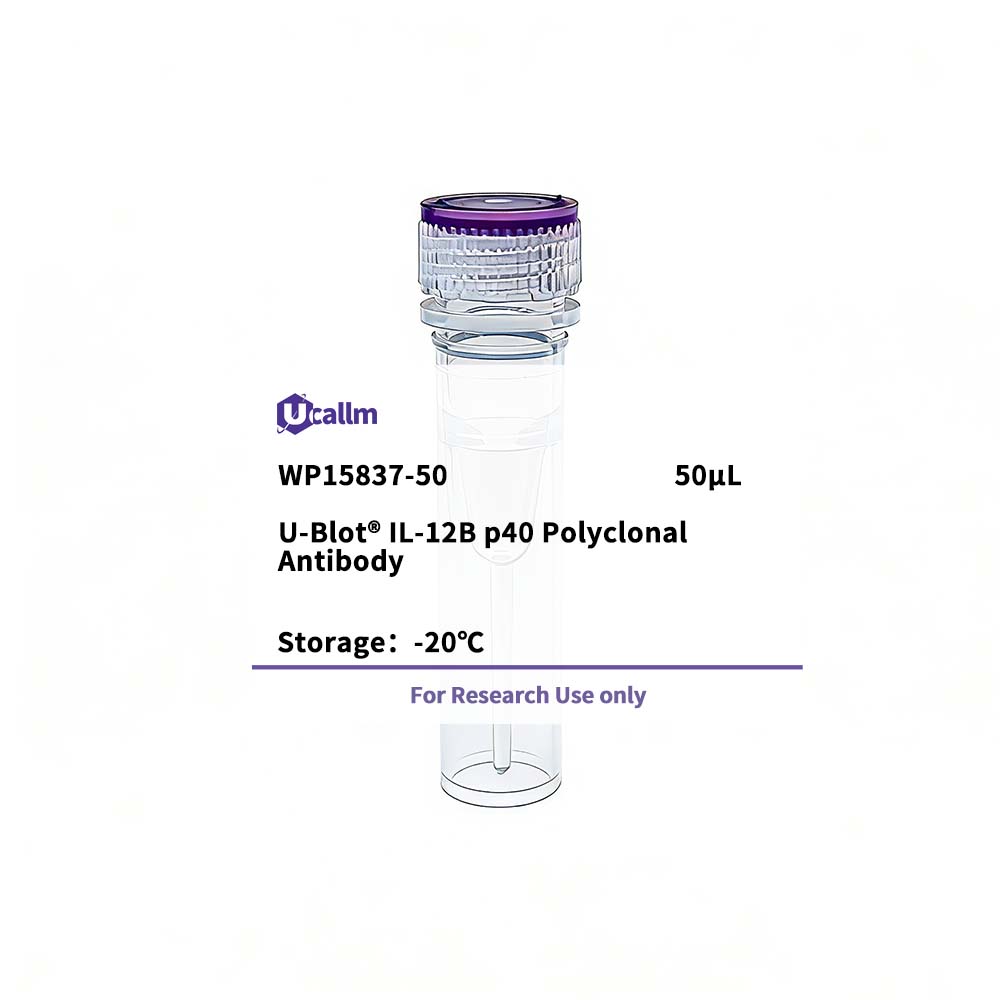
SKU: WP15837 Categories: ,

IL-12B p40 Polyclonal Antibody

Price range: $268.00 through $328.00

SKU: WP15837-100
Enter the quantity you would like, or drag the panel to find the quantity and price that best for you
Bulk QuoteAuthorize OEM & ODM

Product details

Background:

This gene encodes a subunit of interleukin 12, a cytokine that acts on T and natural killer cells, and has a broad array of biological activities. Interleukin 12 is a disulfide-linked heterodimer composed of the 40 kD cytokine receptor like subunit encoded by this gene, and a 35 kD subunit encoded by IL12A. This cytokine is expressed by activated macrophages that serve as an essential inducer of Th1 cells development. This cytokine has been found to be important for sustaining a sufficient number of memory/effector Th1 cells to mediate long-term protection to an intracellular pathogen. Overexpression of this gene was observed in the central nervous system of patients with multiple sclerosis (MS), suggesting a role of this cytokine in the pathogenesis of the disease. The promoter polymorphism of this gene has been reported to be associated with the severity of atopic and non-atopic asthma in children. [provi

Specifications

Size50μL/100μL
TargetIL-12B
ReactivityHuman, Mouse
ApplicationsWB, IHC, IF, ELISA
MW(Calculated)
MW(Observed)40kD
Host SpeciesRabbit
IsotypeIgG
Conjugate/ModificationUnmodified
Recommended Dilution RatioWB 1:500-2000; IHC 1:50-200; ELISA 1:10000-20000; IF 1:50-200 / Note: For IHC, we suggest antigen retrieval with TE buffer pH 9.0 (Cat#WT1004)
FormulationLiquid in PBS containing 50% glycerol, 0.5% BSA and 0.02% sodium azide.
PurificationThe antibody was affinity-purified from rabbit antiserum by affinity-chromatography using epitope-specific immunogen.
Storage-15°C to -25°C/1 year(Do not lower than -25°C)
Concentration1 mg/ml
ClonalityPolyclonal
Clone Number
ImmunogenSynthetic peptide from human protein at AA range: 241-290
SpecificityThe antibody detects endogenous IL-12B p40
Gene NameIL12B NKSF2
Protein NameInterleukin-12 subunit beta (IL-12B) (Cytotoxic lymphocyte maturation factor 40 kDa subunit) (CLMF p40) (IL-12 subunit p40) (NK cell stimulatory factor chain 2) (NKSF2)
Other NameInterleukin-12 subunit beta; / IL-12B; / Cytotoxic lymphocyte maturation factor 40 kDa subunit; / CLMF p40; / IL-12 subunit p40; / NK cell stimulatory factor chain 2; / NKSF2
SpeciesHuman
Gene ID3593
UniprotP29460,
Species.1Mouse
Gene ID.116160
Uniprot.1P43432
Species.2
Gene ID.2
Uniprot.2
Cellular LocalizationSecreted.
Tissue ExpressionBrain,
Signaling_pathwayOrganismal Systems >> Immune system >> Toll-like receptor signaling pathway;Organismal Systems >> Immune system >> RIG-I-like receptor signaling pathway;Organismal Systems >> Immune system >> Th1 and Th2 cell differentiation;Human Diseases >> Cancer: overview >> Pathways in cancer;Human Diseases >> Immune disease >> Inflammatory bowel disease;Human Diseases >> Immune disease >> Allograft rejection;Environmental Information Processing >> Signal transduction >> JAK-STAT signaling pathway;Environmental Information Processing >> Signaling molecules and interaction >> Cytokine-cytokine receptor interaction
Research Areas>>Cytokine-cytokine receptor interaction; / >>Toll-like receptor signaling pathway; / >>RIG-I-like receptor signaling pathway; / >>C-type lectin receptor signaling pathway; / >>JAK-STAT signaling pathway; / >>Th1 and Th2 cell differentiation; / >>Alcoholic liver disease; / >>Type I diabetes mellitus; / >>Pertussis; / >>Legionellosis; / >>Leishmaniasis; / >>Chagas disease; / >>African trypanosomiasis; / >>Toxoplasmosis; / >>Amoebiasis; / >>Tuberculosis; / >>Measles; / >>Influenza A; / >>Herpes simplex virus 1 infection; / >>Coronavirus disease - COVID-19; / >>Pathways in cancer; / >>Proteoglycans in cancer; / >>Inflammatory bowel disease; / >>Allograft rejection; / >>Lipid and atherosclerosis
FunctionDisease:Defects in IL12B are a cause of mendelian susceptibility to mycobacterial disease (MSMD) [MIM:209950]; also known as familial disseminated atypical mycobacterial infection. This rare condition confers predisposition to illness caused by moderately virulent mycobacterial species, such as Bacillus Calmette-Guerin (BCG) vaccine and environmental non-tuberculous mycobacteria, and by the more virulent Mycobacterium tuberculosis. Other microorganisms rarely cause severe clinical disease in individuals with susceptibility to mycobacterial infections, with the exception of Salmonella which infects less than 50% of these individuals. The pathogenic mechanism underlying MSMD is the impairment of interferon-gamma mediated immunity, whose severity determines the clinical outcome. Some patients die of overwhelming mycobacterial disease with lepromatous-like lesions in early childhood, whereas others develop, later in life, disseminated but curable infections with tuberculoid granulomas. MSMD is a genetically heterogeneous disease with autosomal recessive, autosomal dominant or X-linked inheritance.,Function:Associates with IL23A to form the IL-23 interleukin, an heterodimeric cytokine which functions in innate and adaptive immunity. IL-23 may constitute with IL-17 an acute response to infection in peripheral tissues. IL-23 binds to an heterodimeric receptor complex composed of IL12RB1 and IL23R, activates the Jak-Stat signaling cascade, stimulates memory rather than naive T-cells and promotes production of proinflammatory cytokines. IL-23 induces autoimmune inflammation and thus may be responsible for autoimmune inflammatory diseases and may be important for tumorigenesis.,Function:Cytokine that can act as a growth factor for activated T and NK cells, enhance the lytic activity of NK/lymphokine-activated killer cells, and stimulate the production of IFN-gamma by resting PBMC.,online information:IL12B mutation db,PTM:Known to be C-mannosylated in the recombinant protein; it is not yet known for sure if the wild-type protein is also modified.,similarity:Belongs to the type I cytokine receptor family. Type 3 subfamily.,similarity:Contains 1 fibronectin type-III domain.,similarity:Contains 1 Ig-like C2-type (immunoglobulin-like) domain.,subunit:Heterodimer with IL12A; disulfide-linked. The heterodimer is known as interleukin IL-12. Heterodimer with IL23A; disulfide-linked. The heterodimer is known as interleukin IL-23. Also secreted as a monomer.,
Please login to post questions
Back to Top
Product has been added to your cart

