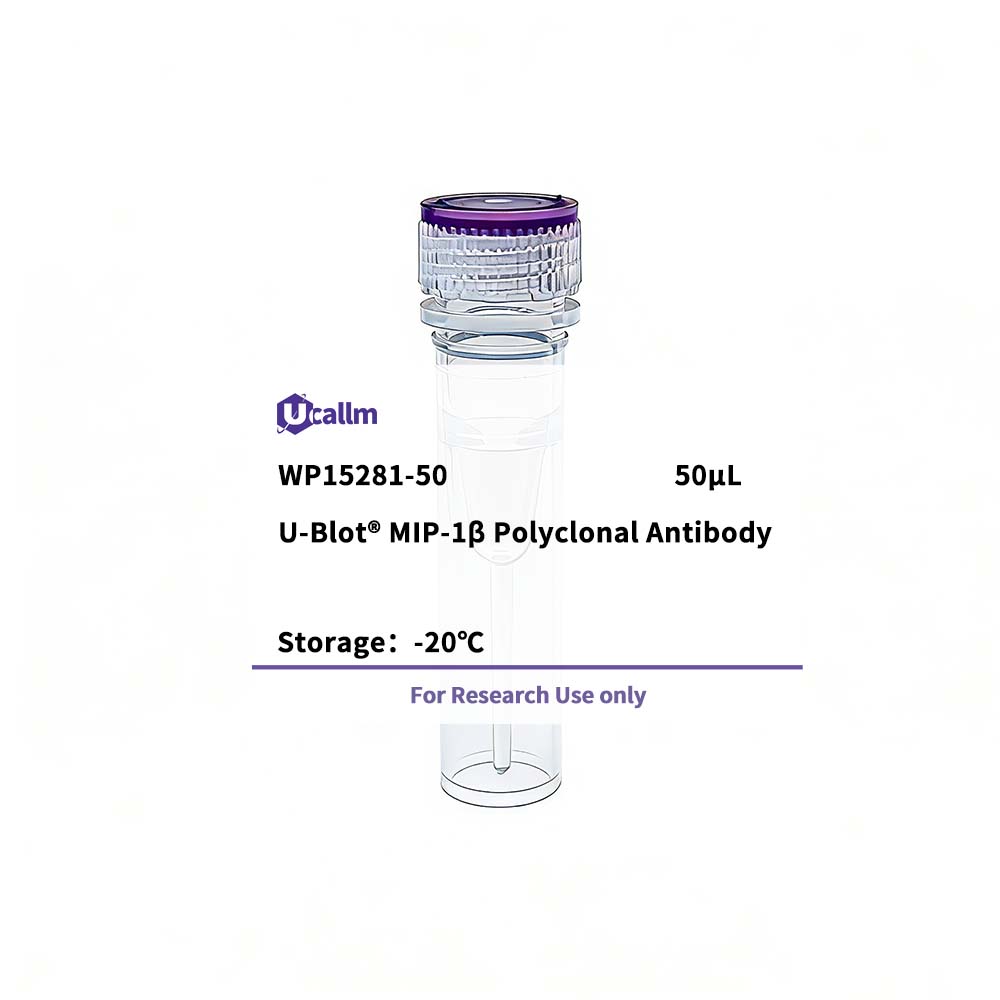
SKU: WP15281 Categories: ,

MIP-1β Polyclonal Antibody

Price range: $268.00 through $328.00

SKU: WP15281-100
Enter the quantity you would like, or drag the panel to find the quantity and price that best for you
Bulk QuoteAuthorize OEM & ODM

Product details

Background:

The protein encoded by this gene is a mitogen-inducible monokine and is one of the major HIV-suppressive factors produced by CD8+ T-cells. The encoded protein is secreted and has chemokinetic and inflammatory functions. [provided by RefSeq, Dec 2012],

Specifications

Size50μL/100μL
TargetMIP-1β
ReactivityHuman, Mouse, Rat
ApplicationsWB, IHC
MW(Calculated)
MW(Observed)16kD
Host SpeciesRabbit
IsotypeIgG
Conjugate/ModificationUnmodified
Recommended Dilution RatioWB 1:500-2000; IHC 1:50-300 / Note: For IHC, we suggest antigen retrieval with TE buffer pH 9.0 (Cat#WT1004)
FormulationLiquid in PBS containing 50% glycerol, 0.5% BSA and 0.02% sodium azide.
PurificationThe antibody was affinity-purified from rabbit antiserum by affinity-chromatography using epitope-specific immunogen.
Storage-15°C to -25°C/1 year(Do not lower than -25°C)
Concentration1 mg/ml
ClonalityPolyclonal
Clone Number
ImmunogenThe antiserum was produced against synthesized peptide derived from the Internal region of human CCL4. AA range:41-90
SpecificityMIP-1β Polyclonal Antibody detects endogenous levels of MIP-1β protein.
Gene NameCCL4
Protein NameC-C motif chemokine 4
Other NameCCL4; / LAG1; / MIP1B; / SCYA4; / C-C motif chemokine 4; / G-26 T-lymphocyte-secreted protein; / HC21; / Lymphocyte activation gene 1 protein; / LAG-1; / MIP-1-beta; / 1-69; / Macrophage inflammatory protein 1-beta; / MIP-1-beta; / PAT 744; / Protein H400; / SIS-gamma; / Small-inducible cytokine A4; / T-cell activation protein 2; / ACT-2
SpeciesHuman
Gene ID388372
UniprotP13236,
Species.1Mouse
Gene ID.120303
Uniprot.1P14097
Species.2
Gene ID.2
Uniprot.2
Cellular LocalizationSecreted.
Tissue ExpressionBlood,Brain,Lung,Natural killer cell,T-cell,
Signaling_pathwayOrganismal Systems >> Immune system >> Toll-like receptor signaling pathway;Organismal Systems >> Immune system >> Cytosolic DNA-sensing pathway;Organismal Systems >> Immune system >> Chemokine signaling pathway;Environmental Information Processing >> Signal transduction >> NF-kappa B signaling pathway;Environmental Information Processing >> Signaling molecules and interaction >> Cytokine-cytokine receptor interaction;Environmental Information Processing >> Signaling molecules and interaction >> Viral protein interaction with cytokine and cytokine receptor
Research Areas>>Cytokine-cytokine receptor interaction; / >>Viral protein interaction with cytokine and cytokine receptor; / >>Chemokine signaling pathway; / >>NF-kappa B signaling pathway; / >>Toll-like receptor signaling pathway; / >>Cytosolic DNA-sensing pathway; / >>Human cytomegalovirus infection
FunctionAlternative products:CCL4L1 and CCL4L2 genes differ in their non-coding regions. Thus, alternative splicing events differ between the two genes,Caution:Was originally (PubMed:9521068) thought to be a ligand for CCR8.,Function:Chemokine that induces chemotaxis of cells expressing CCR5 or CCR1. Inhibits HIV replication in peripheral blood monocytes that express CCR5.,Function:Monokine with inflammatory and chemokinetic properties. Binds to CCR5. One of the major HIV-suppressive factors produced by CD8+ T-cells. Recombinant MIP-1-beta induces a dose-dependent inhibition of different strains of HIV-1, HIV-2, and simian immunodeficiency virus (SIV). The processed form MIP-1-beta(3-69) retains the abilities to induce down-modulation of surface expression of the chemokine receptor CCR5 and to inhibit the CCR5-mediated entry of HIV-1 in T-cells. MIP-1-beta(3-69) is also a ligand for CCR1 and CCR2 isoform B.,induction:By mitogens.,online information:Macrophage inflammatory protein entry,polymorphism:The copy number of the CC4L1 gene varies among individuals; most individuals have 1 to 6 copies in the diploid genome.,PTM:N-terminal processed form MIP-1-beta(3-69) is produced by proteolytic cleavage after secretion from peripheral blood lymphocytes.,similarity:Belongs to the intercrine beta (chemokine CC) family.,subunit:Homodimer and heterodimer of MIP-1-alpha(4-69) and MIP-1-beta(3-69).,subunit:Interacts with CCR5.,tissue specificity:Detected in B-cells.,
Please login to post questions
Back to Top
Product has been added to your cart
