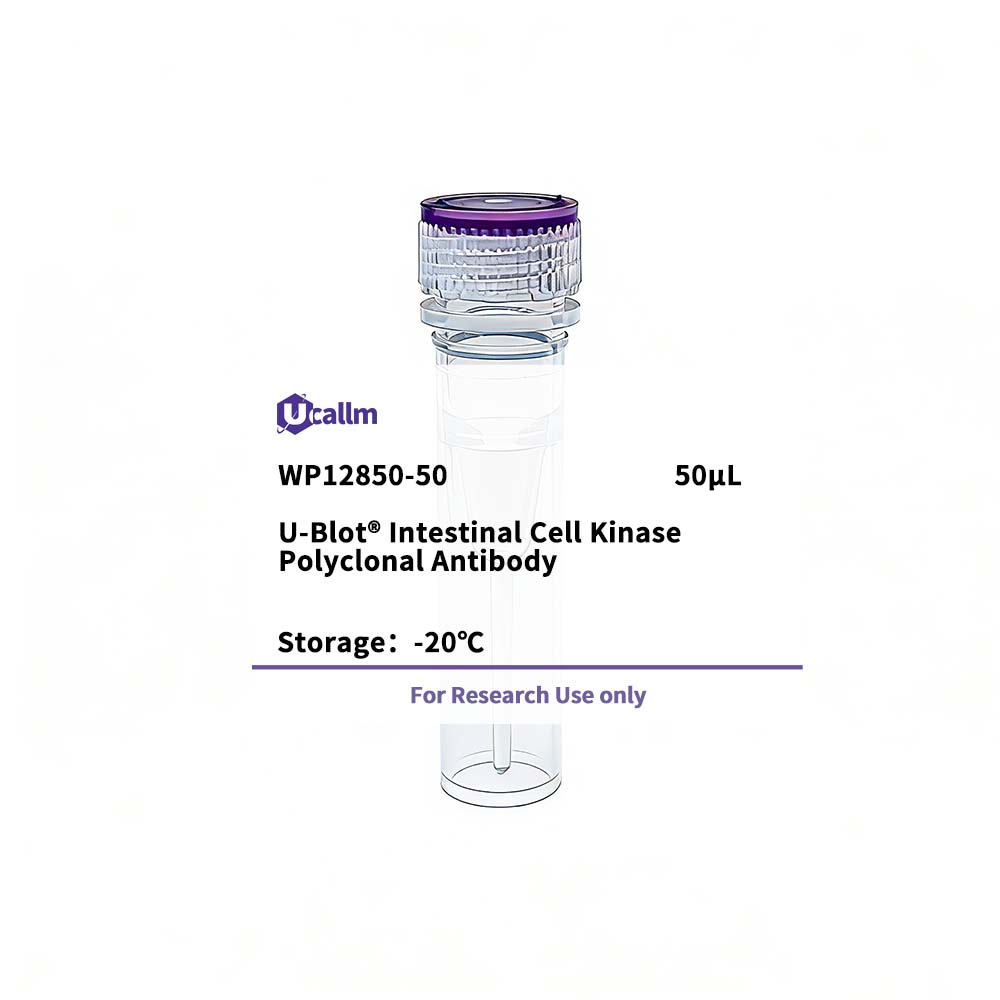
SKU: WP12850 Categories: ,

Intestinal Cell Kinase Polyclonal Antibody

Price range: $268.00 through $328.00

SKU: WP12850-100
Enter the quantity you would like, or drag the panel to find the quantity and price that best for you
Bulk QuoteAuthorize OEM & ODM

Product details

Background:

Eukaryotic protein kinases are enzymes that belong to a very extensive family of proteins which share a conserved catalytic core common with both serine/threonine and tyrosine protein kinases. This gene encodes an intestinal serine/threonine kinase harboring a dual phosphorylation site found in mitogen-activating protein (MAP) kinases. The protein localizes to the intestinal crypt region and is thought to be important in intestinal epithelial cell proliferation and differentiation. Alternative splicing has been observed at this locus and two variants, encoding the same isoform, have been identified. [provided by RefSeq, Jul 2008],


Specifications

Size50μL/100μL
TargetIntestinal Cell Kinase
ReactivityHuman, Mouse, Rat
ApplicationsWB, IHC, IF, ELISA
MW(Calculated)
MW(Observed)65kD
Host SpeciesRabbit
IsotypeIgG
Conjugate/ModificationUnmodified
Recommended Dilution RatioWB 1:500-1:2000; IHC 1:100-1:300; ELISA 1:20000; IF 1:50-200 / Note: For IHC, we suggest antigen retrieval with TE buffer pH 9.0 (Cat#WT1004)
FormulationLiquid in PBS containing 50% glycerol, 0.5% BSA and 0.02% sodium azide.
PurificationThe antibody was affinity-purified from rabbit antiserum by affinity-chromatography using epitope-specific immunogen.
Storage-15°C to -25°C/1 year(Do not lower than -25°C)
Concentration1 mg/ml
ClonalityPolyclonal
Clone Number
ImmunogenThe antiserum was produced against synthesized peptide derived from human ICK. AA range:125-174
SpecificityIntestinal Cell Kinase Polyclonal Antibody detects endogenous levels of Intestinal Cell Kinase protein.
Gene NameICK
Protein NameSerine/threonine-protein kinase ICK
Other NameICK; / KIAA0936; / Serine/threonine-protein kinase ICK; / Intestinal cell kinase; / hICK; / Laryngeal cancer kinase 2; / LCK2; / MAK-related kinase; / MRK
SpeciesHuman
Gene ID22858
UniprotQ9UPZ9,
Species.1Mouse
Gene ID.156542
Uniprot.1Q9JKV2,
Species.2Rat
Gene ID.284411
Uniprot.2Q62726
Cellular LocalizationNucleus . Cytoplasm, cytosol . Cell projection, cilium . Cytoplasm, cytoskeleton, cilium basal body . Also found at the ciliary tip (PubMed:24797473). Nuclear localization has been observed with a GFP-tagged construct in transfected HeLa cells (PubMed:12103360, PubMed:19185282). .; [Isoform 2]: Cytoplasm . Predominant cytoplasmic localization has been observed with a N-terminally GFP-tagged construct. .
Tissue ExpressionExpressed in heart, brain, placenta, pancreas, thymus, prostate, testis, ovary, small intestine and colon, with highest levels in placenta and testis. Not detected in spleen. Also expressed in many cancer cell lines.
Signaling_pathway
Research Areas
FunctionCatalytic activity:ATP + a protein = ADP + a phosphoprotein.,cofactor:Magnesium.,Disease:Defects in ICK are the cause of endocrine-cerebroosteodysplasia (ECO) [MIM:612651]. ECO is a previously unidentified neonatal lethal recessive disorder with multiple anomalies involving the endocrine, cerebral, and skeletal systems.,Function:May play a key role in the development of multiple organ systems and particularly in cardiac development.,PTM:Autophosphorylated on serine and threonine residues. May play a role in enzyme activation.,similarity:Belongs to the protein kinase superfamily.,similarity:Belongs to the protein kinase superfamily. CMGC Ser/Thr protein kinase family. CDC2/CDKX subfamily.,similarity:Contains 1 protein kinase domain.,subcellular location:Nuclear localization has been observed with a GFP-tagged construct in transfected HeLa cells (PubMed:12103360). Cytosolic localization was shown in rat embryonic cardiomyocytes by immunostaining (PubMed:8570168).,tissue specificity:Expressed in heart, brain, placenta, pancreas, thymus, prostate, testis, ovary, small intestine and colon, with highest levels in placenta and testis. Not detected in spleen. Also expressed in many cancer cell lines.,
Please login to post questions
Back to Top
Product has been added to your cart

