

IP-10 Polyclonal Antibody
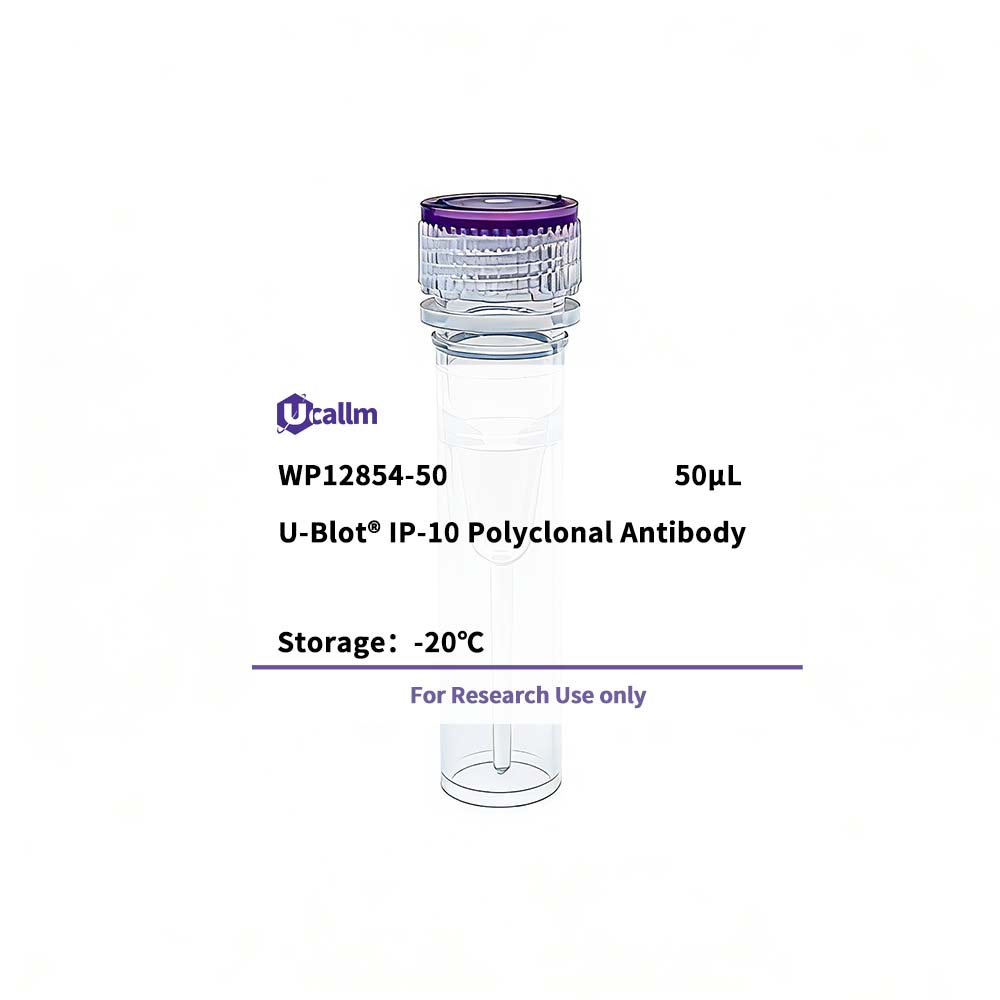
Ucallm_WP12854-50
Price range: $268.00 through $328.00
Product details
Background:
C-X-C motif chemokine ligand 10(CXCL10) Homo sapiens This antimicrobial gene encodes a chemokine of the CXC subfamily and ligand for the receptor CXCR3. Binding of this protein to CXCR3 results in pleiotropic effects, including stimulation of monocytes, natural killer and T-cell migration, and modulation of adhesion molecule expression. [provided by RefSeq, Sep 2014],
Specifications
| Size | 50μL/100μL |
| Target | IP-10 |
| Reactivity | Human, Pig, chiken |
| Applications | IHC, IF, ELISA |
| MW(Calculated) | 11kD |
| MW(Observed) | |
| Host Species | Rabbit |
| Isotype | IgG |
| Conjugate/Modification | Unmodified |
| Recommended Dilution Ratio | IHC 1:100-1:300; ELISA 1:40000; IF 1:50-200 / Note: For IHC, we suggest antigen retrieval with TE buffer pH 9.0 (Cat#WT1004) |
| Formulation | Liquid in PBS containing 50% glycerol, 0.5% BSA and 0.02% sodium azide. |
| Purification | The antibody was affinity-purified from rabbit antiserum by affinity-chromatography using epitope-specific immunogen. |
| Storage | -15°C to -25°C/1 year(Do not lower than -25°C) |
| Concentration | 1 mg/ml |
| Clonality | Polyclonal |
| Clone Number | |
| Immunogen | Synthesized peptide derived from IP-10 . at AA range: 20-100 |
| Specificity | IP-10 Polyclonal Antibody detects endogenous levels of IP-10 protein. |
| Gene Name | CXCL10 |
| Protein Name | C-X-C motif chemokine 10 |
| Other Name | CXCL10; / INP10; / SCYB10; / C-X-C motif chemokine 10; / 10 kDa interferon gamma-induced protein; / Gamma-IP10; / IP-10; / Small-inducible cytokine B10 |
| Species | Human |
| Gene ID | 3627 |
| Uniprot | P02778, |
| Species.1 | Mouse |
| Gene ID.1 | |
| Uniprot.1 | P17515 |
| Species.2 | |
| Gene ID.2 | |
| Uniprot.2 | |
| Cellular Localization | Secreted . |
| Tissue Expression | Mainly secreted by monocytes, endothelial cells as well as fibroblasts. Expressed by epithelial cells in thymus (PubMed:11157474). Microglial cells produce CXCL10 in response to viral stimulation (PubMed:12663757). |
| Signaling_pathway | Organismal Systems >> Immune system >> Toll-like receptor signaling pathway;Organismal Systems >> Immune system >> RIG-I-like receptor signaling pathway;Organismal Systems >> Immune system >> Cytosolic DNA-sensing pathway;Organismal Systems >> Immune system >> IL-17 signaling pathway;Organismal Systems >> Immune system >> Chemokine signaling pathway;Environmental Information Processing >> Signal transduction >> TNF signaling pathway;Environmental Information Processing >> Signaling molecules and interaction >> Cytokine-cytokine receptor interaction;Environmental Information Processing >> Signaling molecules and interaction >> Viral protein interaction with cytokine and cytokine receptor |
| Research Areas | >>Cytokine-cytokine receptor interaction; / >>Viral protein interaction with cytokine and cytokine receptor; / >>Chemokine signaling pathway; / >>Toll-like receptor signaling pathway; / >>RIG-I-like receptor signaling pathway; / >>Cytosolic DNA-sensing pathway; / >>IL-17 signaling pathway; / >>TNF signaling pathway; / >>Hepatitis C; / >>Influenza A; / >>Epstein-Barr virus infection; / >>Coronavirus disease - COVID-19 |
| Function | Function:Chemotactic for monocytes and T-lymphocytes. Binds to CXCR3.,induction:By interferon gamma. A diverse population of cell types rapidly increases transcription of mRNA encoding this protein. This suggests that gamma-induced protein may be a key mediator of the interferon gamma response.,mass spectrometry: PubMed:11559369,online information:CXCL10 entry,PTM:CXCL10(1-73) is produced by proteolytic cleavage after secretion from keratinocytes.,similarity:Belongs to the intercrine alpha (chemokine CxC) family., |
Please login to post questions
Related products





