


ISG15 Polyclonal Antibody
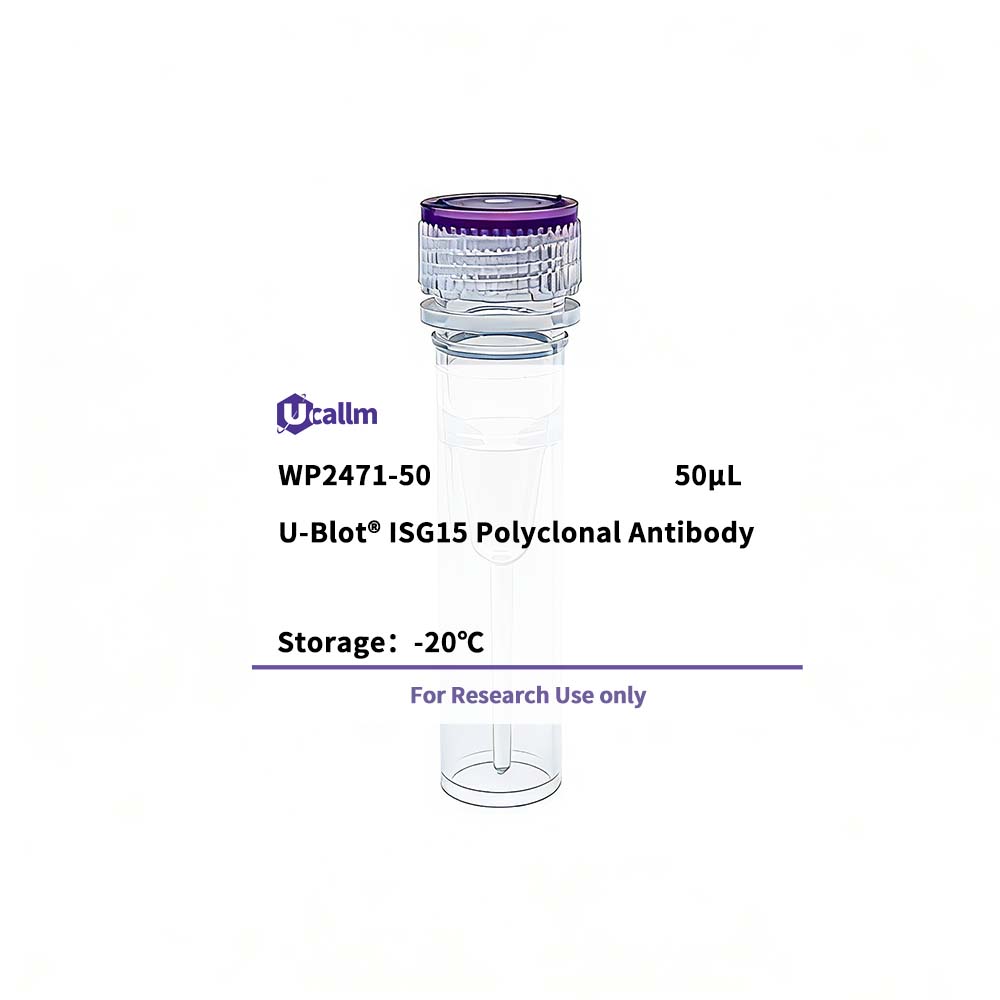
Ucallm_WP2471-50
Price range: $268.00 through $328.00
Product details
Background:
The protein encoded by this gene is a ubiquitin-like protein that is conjugated to intracellular target proteins upon activation by interferon-alpha and interferon-beta. Several functions have been ascribed to the encoded protein, including chemotactic activity towards neutrophils, direction of ligated target proteins to intermediate filaments, cell-to-cell signaling, and antiviral activity during viral infections. While conjugates of this protein have been found to be noncovalently attached to intermediate filaments, this protein is sometimes secreted. [provided by RefSeq, Dec 2012],
Specifications
| Size | 50μL/100μL |
| Target | ISG15 |
| Reactivity | Human, Mouse |
| Applications | WB, IHC, IF, ELISA |
| MW(Calculated) | |
| MW(Observed) | 18kD |
| Host Species | Rabbit |
| Isotype | IgG |
| Conjugate/Modification | Unmodified |
| Recommended Dilution Ratio | WB 1:500-1:2000; IHC 1:100-1:300; ELISA 1:5000; IF 1:50-200 / Note: For IHC, we suggest antigen retrieval with TE buffer pH 9.0 (Cat#WT1004) |
| Formulation | Liquid in PBS containing 50% glycerol,0.5% BSA and 0.02% sodium azide. |
| Purification | The antibody was affinity-purified from rabbit antiserum by affinity-chromatography using epitope-specific immunogen. |
| Storage | -15°C to -25°C/1 year(Do not lower than -25°C) |
| Concentration | 1 mg/ml |
| Clonality | Polyclonal |
| Clone Number | |
| Immunogen | Synthesized peptide derived from part region of human protein |
| Specificity | ISG15 Polyclonal Antibody detects endogenous levels of protein. |
| Gene Name | ISG15 G1P2 UCRP |
| Protein Name | Ubiquitin-like protein ISG15 (Interferon-induced 15 kDa protein) (Interferon-induced 17 kDa protein) (IP17) (Ubiquitin cross-reactive protein) (hUCRP) |
| Other Name | |
| Species | Human |
| Gene ID | 9636 |
| Uniprot | P05161, |
| Species.1 | Mouse |
| Gene ID.1 | |
| Uniprot.1 | Q64339 |
| Species.2 | |
| Gene ID.2 | |
| Uniprot.2 | |
| Cellular Localization | Cytoplasm . Secreted . Exists in three distinct states: free within the cell, released into the extracellular space, or conjugated to target proteins. |
| Tissue Expression | Detected in lymphoid cells, striated and smooth muscle, several epithelia and neurons. Expressed in neutrophils, monocytes and lymphocytes. Enhanced expression seen in pancreatic adenocarcinoma, endometrial cancer, and bladder cancer, as compared to non-cancerous tissue. In bladder cancer, the increase in expression exhibits a striking positive correlation with more advanced stages of the disease. |
| Signaling_pathway | Organismal Systems >> Immune system >> RIG-I-like receptor signaling pathway |
| Research Areas | >>RIG-I-like receptor signaling pathway; / >>Human papillomavirus infection; / >>Epstein-Barr virus infection; / >>Coronavirus disease - COVID-19 |
| Function | Function:In response to IFN-tau secreted by the conceptus, may ligate to and regulate proteins involved in the release of prostaglandin F2-alpha (PGF), and thus prevent lysis of the corpus luteum and maintain the pregnancy.,Function:Ubiquitin-like protein that is conjugated to intracellular target proteins after IFN-alpha or IFN-beta stimulation. Its enzymatic pathway is partially distinct from that of ubiquitin, differing in substrate specificity and interaction with ligating enzymes. ISG15 conjugation pathway uses a dedicated E1 enzyme, but seems to converge with the Ub conjugation pathway at the level of a specific E2 enzyme. Targets include STAT1, SERPINA3G/SPI2A, JAK1, MAPK3/ERK1, PLCG1, EIF2AK2/PKR, MX1/MxA, and RIG-1. Deconjugated by USP18/UBP43. Shows specific chemotactic activity towards neutrophils and activates them to induce release of eosinophil chemotactic factors. May serve as a trans-acting binding factor directing the association of ligated target proteins to intermediate filaments. May also be involved in autocrine, paracrine and endocrine mechanisms, as in cell-to-cell signaling, possibly partly by inducing IFN-gamma secretion by monocytes and macrophages. Seems to display antiviral activity during viral infections.,induction:By type I interferons.,similarity:Contains 2 ubiquitin-like domains.,subcellular location:UCRP conjugates seem to be noncovalently associated with the intermediate filaments and distributed in a punctate pattern. Also secreted.,subunit:Interacts with, and is conjugated to its targets by the UBE1L (E1 enzyme) and UBE2E2 (E2 enzyme) (Probable). Interaction with influenza B NS1 protein inhibits this conjugation.,tissue specificity:Detected in lymphoid cells, striated and smooth muscle, several epithelia and neurons., |
Please login to post questions
Related products





