

Product details
Background:
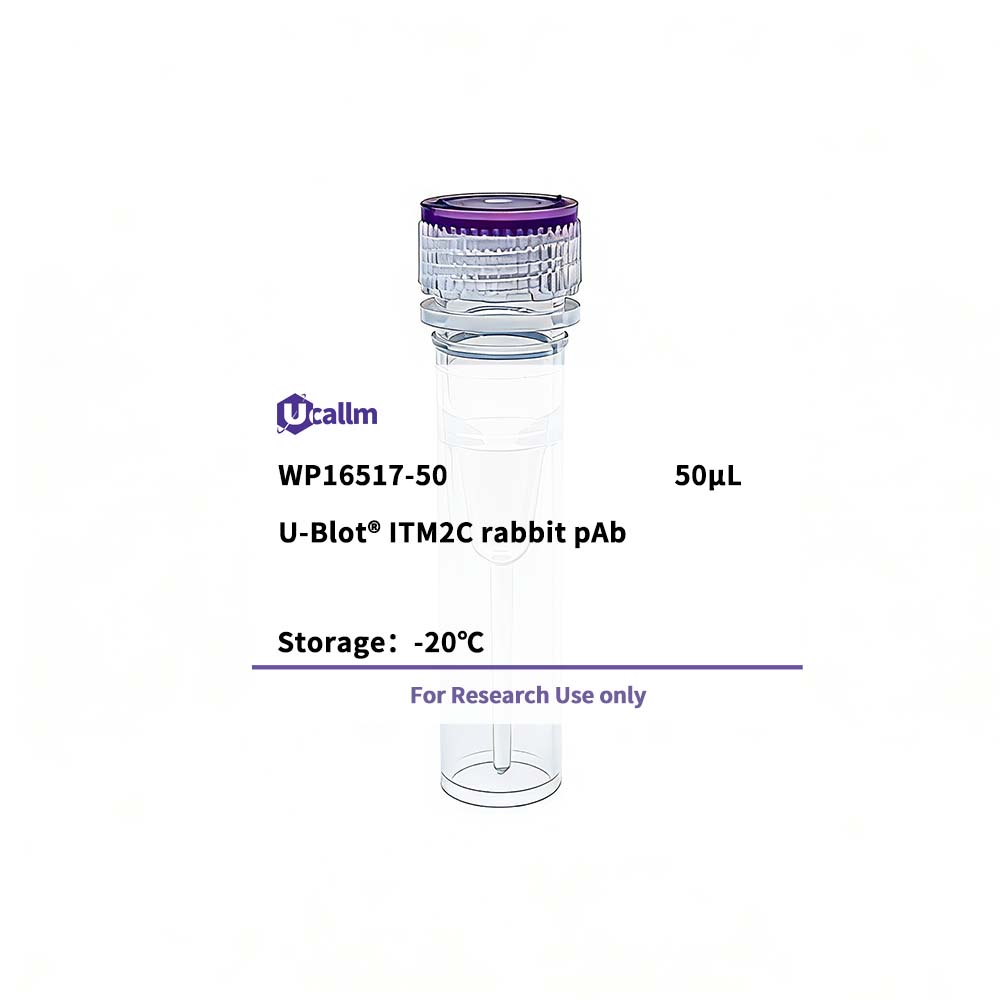
Price range: $268.00 through $328.00
Background:
| Size | 50μL/100μL |
| Target | ITM2C |
| Reactivity | Human, Mouse, Rat |
| Applications | WB, IHC |
| MW(Calculated) | 29kD |
| MW(Observed) | |
| Host Species | Rabbit |
| Isotype | IgG |
| Conjugate/Modification | Unmodified |
| Recommended Dilution Ratio | WB 1:500-2000; IHC 1:50-300 / Note: For IHC, we suggest antigen retrieval with TE buffer pH 9.0 (Cat#WT1004) |
| Formulation | Liquid in PBS containing 50% glycerol, 0.5% BSA and 0.02% sodium azide. |
| Purification | The antibody was affinity-purified from rabbit antiserum by affinity-chromatography using epitope-specific immunogen. |
| Storage | -15°C to -25°C/1 year(Do not lower than -25°C) |
| Concentration | 1 mg/ml |
| Clonality | Polyclonal |
| Clone Number | |
| Immunogen | Synthesized peptide derived from human ITM2C AA range: 1-51 |
| Specificity | This antibody detects endogenous levels of ITM2C at Human/Mouse/Rat |
| Gene Name | ITM2C BRI3 hucep-14 NPD018 PSEC0047 |
| Protein Name | ITM2C |
| Other Name | |
| Species | Human |
| Gene ID | 81618 |
| Uniprot | Q9NQX7, |
| Species.1 | Mouse |
| Gene ID.1 | 64294 |
| Uniprot.1 | Q91VK4, |
| Species.2 | Rat |
| Gene ID.2 | 301575 |
| Uniprot.2 | Q5PQL7 |
| Cellular Localization | Lysosome membrane; Single-pass type II membrane protein . Cell membrane; Single-pass type II membrane protein . |
| Tissue Expression | High levels in the brain, specifically in the cerebral cortex, medulla, amygdala, hippocampus, thalamus, caudate nucleus, cerebellum, olfactory lobe and spinal cord. Very low levels in other organs. |
| Signaling_pathway | |
| Research Areas | |
| Function | PTM:Type I membrane-bound, as well as soluble, furin has a pre-eminent role in ITM2C proteolytic processing. PCSK7 and PCSK5 may also be involved although to a lesser extent. The soluble form of PCSK7 is incapable of processing ITM2C.,similarity:Belongs to the ITM2 family.,similarity:Contains 1 BRICHOS domain.,subunit:Interacts with BACE1.,tissue specificity:High levels in the brain, specifically in the cerebral cortex, medulla, amygdala, hippocampus, thalamus, caudate nucleus, cerebellum, olfactory lobe and spinal cord. Very low levels in other organs., |





