

Product details
Background:
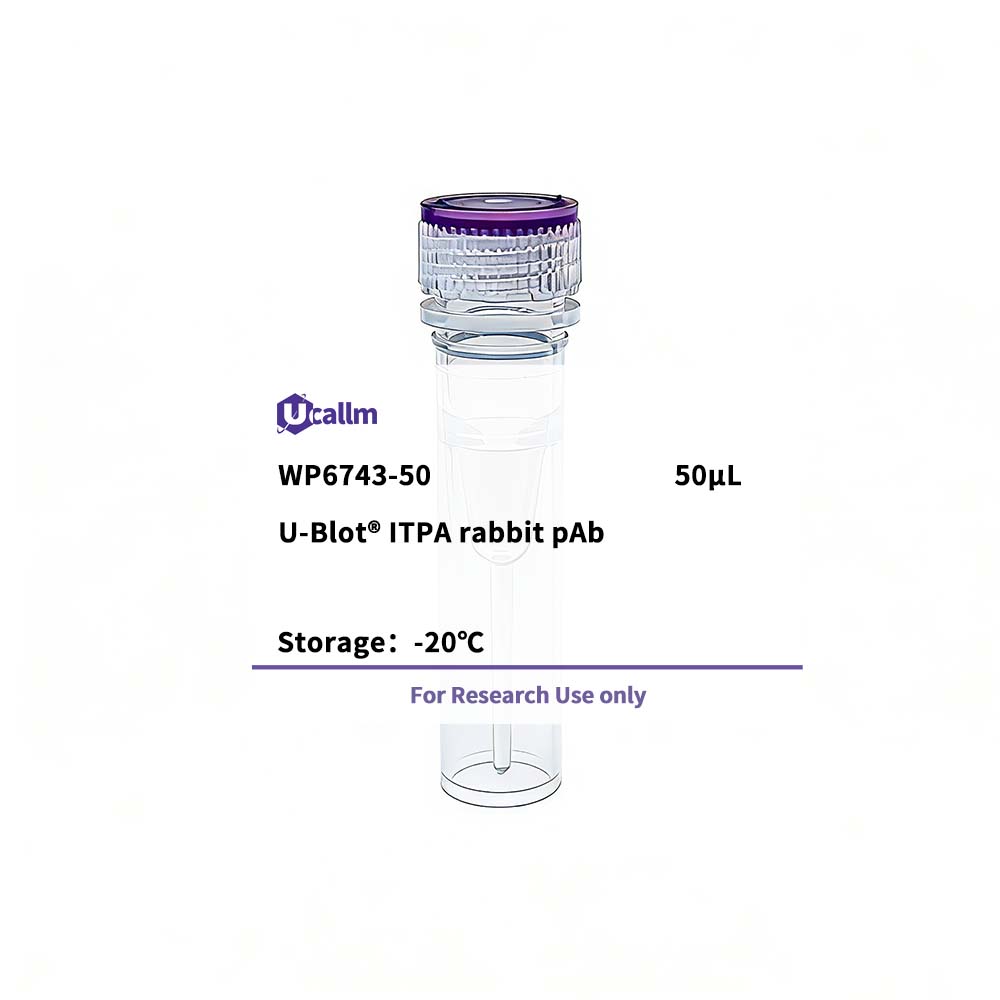
Price range: $268.00 through $328.00
Background:
| Size | 50μL/100μL |
| Target | ITPA |
| Reactivity | Human, Mouse, Rat |
| Applications | WB |
| MW(Calculated) | 21kD |
| MW(Observed) | |
| Host Species | Rabbit |
| Isotype | IgG |
| Conjugate/Modification | Unmodified |
| Recommended Dilution Ratio | WB 1:500-2000 |
| Formulation | Liquid in PBS containing 50% glycerol, 0.5% BSA and 0.02% sodium azide. |
| Purification | The antibody was affinity-purified from rabbit antiserum by affinity-chromatography using epitope-specific immunogen. |
| Storage | -15°C to -25°C/1 year(Do not lower than -25°C) |
| Concentration | 1 mg/ml |
| Clonality | Polyclonal |
| Clone Number | |
| Immunogen | Synthesized peptide derived from human ITPA |
| Specificity | This antibody detects endogenous levels of ITPA at Human, Mouse,Rat |
| Gene Name | ITPA C20orf37 My049 OK/SW-cl.9 |
| Protein Name | Inosine triphosphate pyrophosphatase (ITPase) (Inosine triphosphatase) (Non-canonical purine NTP pyrophosphatase) (Non-standard purine NTP pyrophosphatase) (Nucleoside-triphosphate diphosphatase) (Nucleoside-triphosphate pyrophosphatase) (NTPase) (Putative oncogene protein hlc14-06-p) |
| Other Name | |
| Species | Human |
| Gene ID | 3704 |
| Uniprot | Q9BY32, |
| Species.1 | Mouse |
| Gene ID.1 | 16434 |
| Uniprot.1 | Q9D892, |
| Species.2 | Rat |
| Gene ID.2 | 311422 |
| Uniprot.2 | D3ZW55 |
| Cellular Localization | Cytoplasm . |
| Tissue Expression | Ubiquitous. Highly expressed in heart, liver, sex glands, thyroid and adrenal gland. |
| Signaling_pathway | |
| Research Areas | |
| Function | Pyrophosphatase that hydrolyzes the non-canonical purine nucleotides inosine triphosphate (ITP), deoxyinosine triphosphate (dITP) as well as 2'-deoxy-N-6-hydroxylaminopurine triphosphate (dHAPTP) and xanthosine 5'-triphosphate (XTP) to their respective monophosphate derivatives. The enzyme does not distinguish between the deoxy- and ribose forms. Probably excludes non-canonical purines from RNA and DNA precursor pools, thus preventing their incorporation into RNA and DNA and avoiding chromosomal lesions. |





