

Jun D Polyclonal Antibody
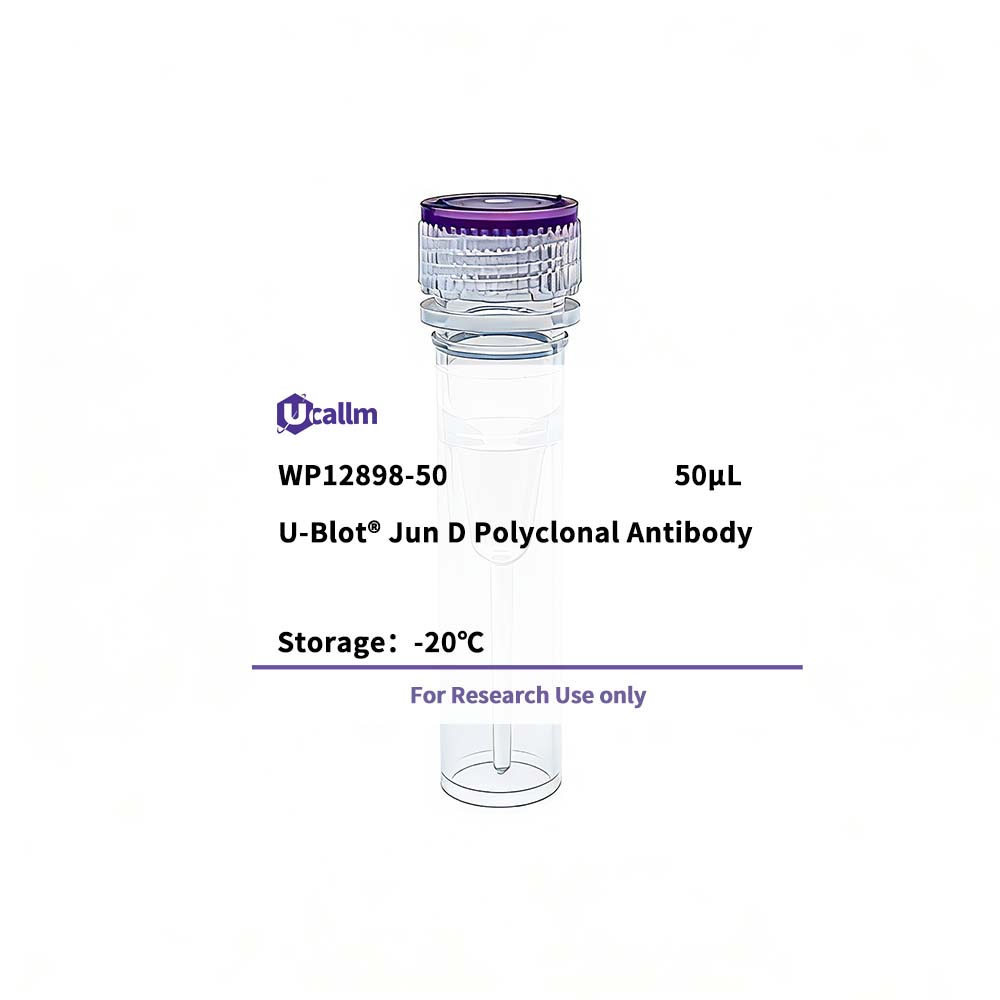
Ucallm_WP12898-50
Price range: $268.00 through $328.00
Product details
Background:
The protein encoded by this intronless gene is a member of the JUN family, and a functional component of the AP1 transcription factor complex. This protein has been proposed to protect cells from p53-dependent senescence and apoptosis. Alternative translation initiation site usage results in the production of different isoforms (PMID:12105216). [provided by RefSeq, Nov 2013],
Specifications
| Size | 50μL/100μL |
| Target | Jun D |
| Reactivity | Human, Mouse, Rat |
| Applications | WB, IHC, IF, IP, ELISA |
| MW(Calculated) | |
| MW(Observed) | 38kD |
| Host Species | Rabbit |
| Isotype | IgG |
| Conjugate/Modification | Unmodified |
| Recommended Dilution Ratio | WB 1:500-1:2000; IHC 1:100-1:300; IP 2-5 ug/mg lysate; ELISA 1:20000; IF 1:50-200 / Note: For IHC, we suggest antigen retrieval with TE buffer pH 9.0 (Cat#WT1004) |
| Formulation | Liquid in PBS containing 50% glycerol, 0.5% BSA and 0.02% sodium azide. |
| Purification | The antibody was affinity-purified from rabbit antiserum by affinity-chromatography using epitope-specific immunogen. |
| Storage | -15°C to -25°C/1 year(Do not lower than -25°C) |
| Concentration | 1 mg/ml |
| Clonality | Polyclonal |
| Clone Number | |
| Immunogen | The antiserum was produced against synthesized peptide derived from human JunD. AA range:222-271 |
| Specificity | Jun D Polyclonal Antibody detects endogenous levels of Jun D protein. |
| Gene Name | JUND |
| Protein Name | Transcription factor jun-D |
| Other Name | JUND; / Transcription factor jun-D |
| Species | Human |
| Gene ID | 3727 |
| Uniprot | P17535, |
| Species.1 | Mouse |
| Gene ID.1 | 16478 |
| Uniprot.1 | P15066, |
| Species.2 | Rat |
| Gene ID.2 | 24518 |
| Uniprot.2 | P52909 |
| Cellular Localization | Nucleus. |
| Tissue Expression | Epithelium,Spleen, |
| Signaling_pathway | Organismal Systems >> Immune system >> IL-17 signaling pathway;Organismal Systems >> Development and regeneration >> Osteoclast differentiation;Environmental Information Processing >> Signal transduction >> MAPK signaling pathway |
| Research Areas | >>MAPK signaling pathway; / >>Osteoclast differentiation; / >>IL-17 signaling pathway; / >>Parathyroid hormone synthesis, secretion and action |
| Function | Function:Binds an AP-1 site and upon cotransfection stimulates the activity of a promoter that bears an AP-1 site.,similarity:Belongs to the bZIP family. Jun subfamily.,similarity:Contains 1 bZIP domain.,subunit:Binds DNA as a dimer., |
Please login to post questions
Related products





