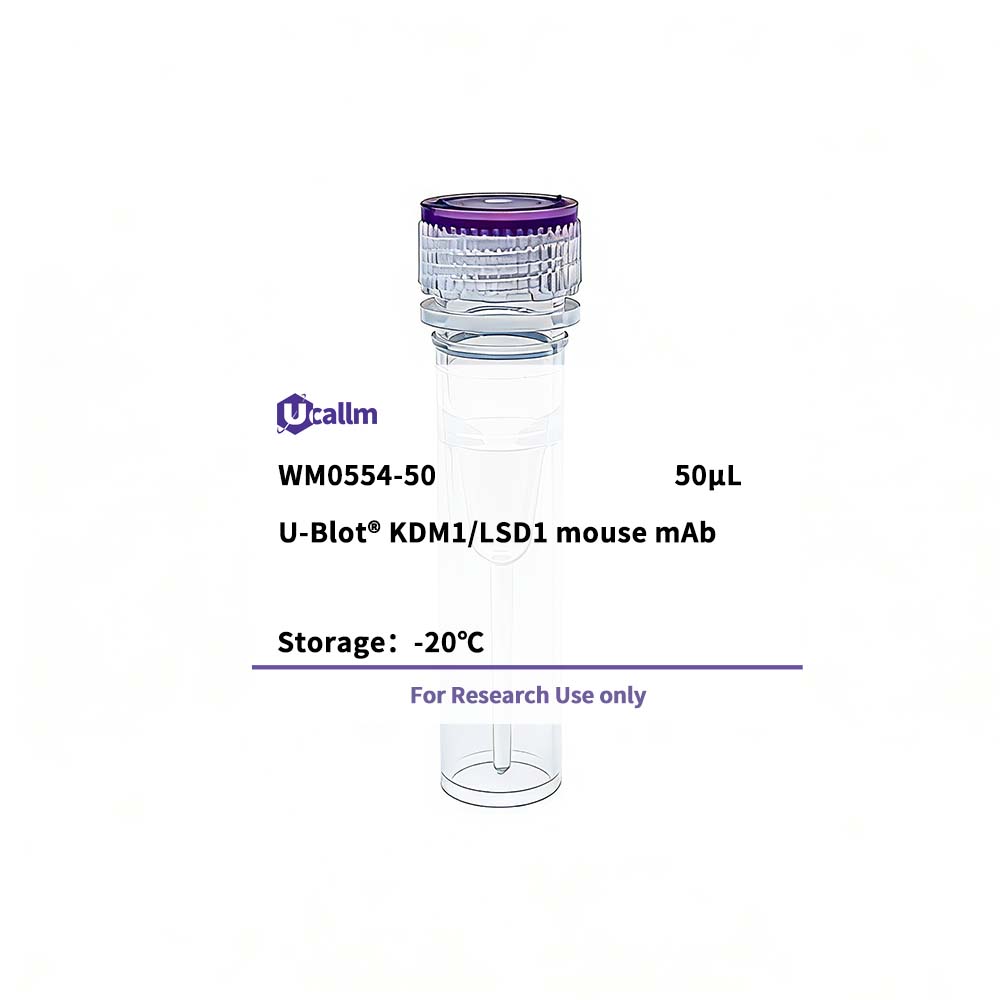
SKU: WM0554 Categories: ,

KDM1/LSD1 mouse mAb

Price range: $268.00 through $328.00

SKU: WM0554-50
Enter the quantity you would like, or drag the panel to find the quantity and price that best for you
Bulk QuoteAuthorize OEM & ODM

Product details

Background:
This gene encodes a nuclear protein containing a SWIRM domain, a FAD-binding motif, and an amine oxidase domain. This protein is a component of several histone deacetylase complexes, though it silences genes by functioning as a histone demethylase. Alternative splicing results in multiple transcript variants. [provided by RefSeq, Apr 2009],


Specifications

Size50μL/100μL
TargetLSD1
ReactivityHuman, Monkey
ApplicationsWB, ICC, IP
MW(Calculated)
MW(Observed)110kD
Host SpeciesMouse
Isotype
Conjugate/ModificationUnmodified
Recommended Dilution RatioWB 1:1000; ICC 1:100
FormulationLiquid in PBS containing 50% glycerol, 0.5% BSA and 0.02% sodium azide.
PurificationThe antibody was affinity-purified from mouse ascites by affinity-chromatography using epitope-specific immunogen.
Storage-15°C to -25°C/1 year(Do not lower than -25°C)
Concentration
ClonalityMonoclonal
Clone Number3E4
ImmunogenPurified recombinant human KDM1/LSD1 protein fragments expressed in E.coli.
SpecificityThis antibody detects endogenous levels of KDM1/LSD1 and does not cross-react with related proteins.
Gene NameKDM1A AOF2 KDM1 KIAA0601 LSD1
Protein NameLysine-specific histone demethylase 1A
Other NameKDM1A; / AOF2; / KDM1; / KIAA0601; / LSD1; / Lysine-specific histone demethylase 1A; / BRAF35-HDAC complex protein BHC110; / Flavin-containing amine oxidase domain-containing protein 2
SpeciesHuman
Gene ID23028
UniprotO60341
Species.1
Gene ID.1
Uniprot.1
Species.2
Gene ID.2
Uniprot.2
Cellular LocalizationNucleus .
Tissue ExpressionUbiquitously expressed.
Signaling_pathway
Research Areas>>Thermogenesis
Functioncofactor:FAD.,Domain:The SWIRN domain may act as an anchor site for a histone tail.,Function:Histone demethylase that demethylates 'Lys-4' of histone H3, a specific tag for epigenetic transcriptional activation, thereby acting as a corepressor. Acts by oxidizing the substrate by FAD to generate the corresponding imine that is subsequently hydrolyzed. Demethylates both mono- and di-methylated 'Lys-4' of histone H3. May play a role in the repression of neuronal genes. Alone, it is unable to demethylate H3 'Lys-4' on nucleosomes and requires the presence of RCOR1/CoREST to achieve such activity. May also demethylate 'Lys-9' of histone H3, a specific tag for epigenetic transcriptional repression, thereby leading to derepression of androgen receptor target genes. Demethylates di-methylated 'Lys-370' of p53/TP53 which prevents interaction of p53/TP53 with TP53BP1 and represses p53/TP53-mediated transcriptional activation. Demethylates and stabilizes the DNA methylase DNMT1. Required for gastrulation during embryogenesis.,similarity:Belongs to the flavin monoamine oxidase family.,similarity:Contains 1 SWIRM domain.,subunit:Component of a BHC histone deacetylase complex that contains HDAC1, HDAC2, HMG20B/BRAF35, KDM1, RCOR1/CoREST and PHF21A/BHC80. The BHC complex may also contain ZMYM2, ZNF217, ZMYM3, GSE1 and GTF2I. In the complex, RCOR1/CoREST strongly enhances the demethylase activity and protects it from the proteasome while PHF21A/BHC80 inhibits the demethylase activity. Interacts with the androgen receptor (AR).,tissue specificity:Ubiquitously expressed.,
Please login to post questions
Back to Top
Product has been added to your cart
