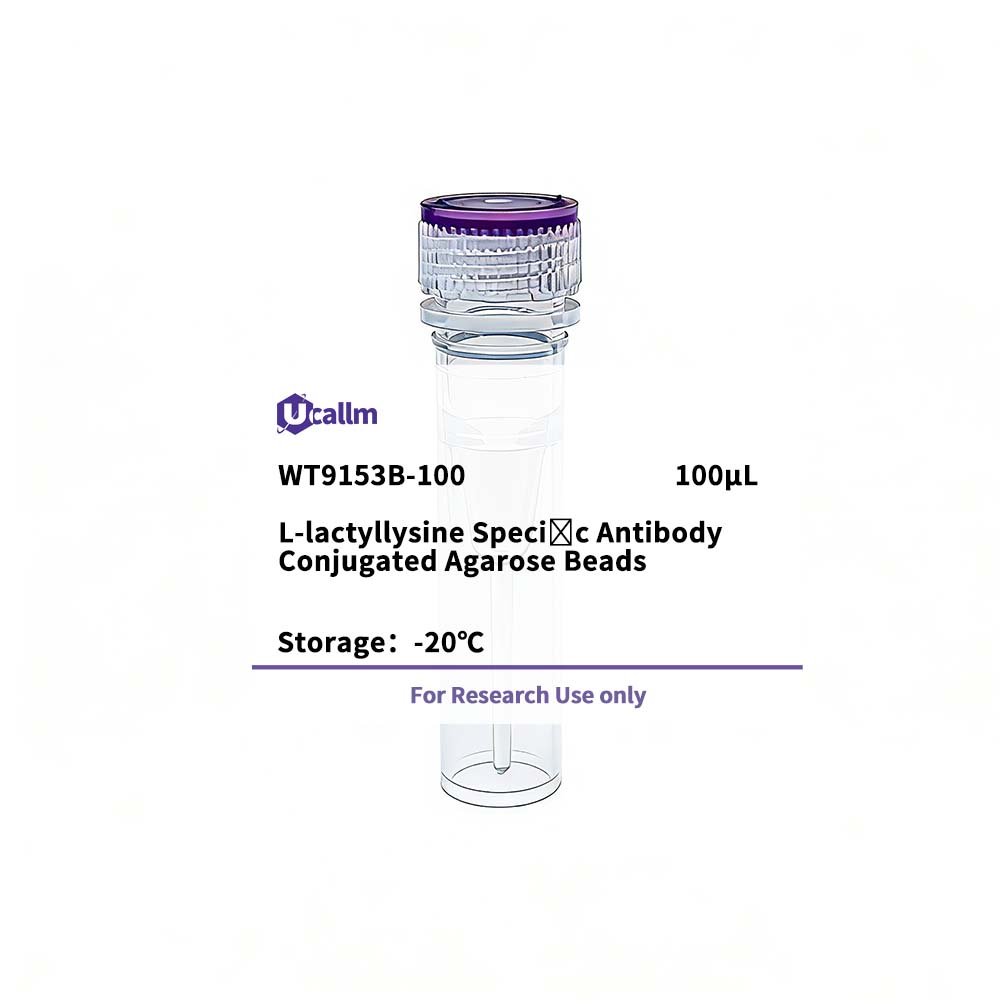
L-lactyllysine Specific Antibody Conjugated Agarose Beads

$999.00

SKU: WT9153B-300
Enter the quantity you would like, or drag the panel to find the quantity and price that best for you
Bulk QuoteAuthorize OEM & ODM

Product details

L-lactyllysine Specific Antibody Conjugated Agarose Beads is an immunoaffinity enrichment tool for L-lactyllysine peptides in mass spectrometry-based proteomics. The highly specific antibody selectively captures target modified peptides without cross-reactivity, is applicable to all species, efficiently enriches low-abundance peptides and reduces background interference, delivering stable and reliable results for L-lactyllysine modification research.

Specifications

TargetL-Lactyllysine
ReactivitySpecies Independent
ApplicationIAC, IAP, IP
MW(Calculated)
MW(Observed)
Host Species
Isotype
ConjugateAgarose Beads
ModificationLysine lactylation
Modified siteLys(K)
Recommended dilution ratio
Composition
Purification processProtein A
Purity
Storage50% slurry in PBS pH7.4, 0.05% Proclin 300. Ensure thorough mixing before each use. Wide-mouth pipette tips are recommended. In case of difficulty in aspiration due to improper operation, additional Storage Buffer can be added at your discretion.
Stability12 months from date of receipt / reconstitution, 2 to 8 °C as supplied
ClonalRecombinant monoclonal
Clone Number
Immunogen
Sequence
Specificity
Gene name
Protein Name
Alternative nameKL-la
Organism-1
GeneID-1
SwissProt-1
Organism-2
GeneID-2
SwissProt-2
Organism-3
GeneID-3
SwissProt-3
Organism-4
GeneID-4
SwissProt-4
BackgroundL-Lactyllysine (abbreviated as Kla) is a novel lysine acylation-type post-translational modification. It is formed by the covalent attachment of an L-lactyl group to lysine residues, mainly mediated by lactoyl-CoA. Kla is widely distributed on both histone and non-histone proteins, and participates in chromatin remodeling, gene transcription regulation, cellular metabolism, and inflammatory responses. Studies have shown that L-lactylation is closely associated with tumor metabolic reprogramming, hypoxia stress, immune regulation, and various disease processes, serving as a key mechanism linking cellular metabolism and epigenetic regulation.
Cellular Localization
Please login to post questions
Back to Top
Product has been added to your cart
