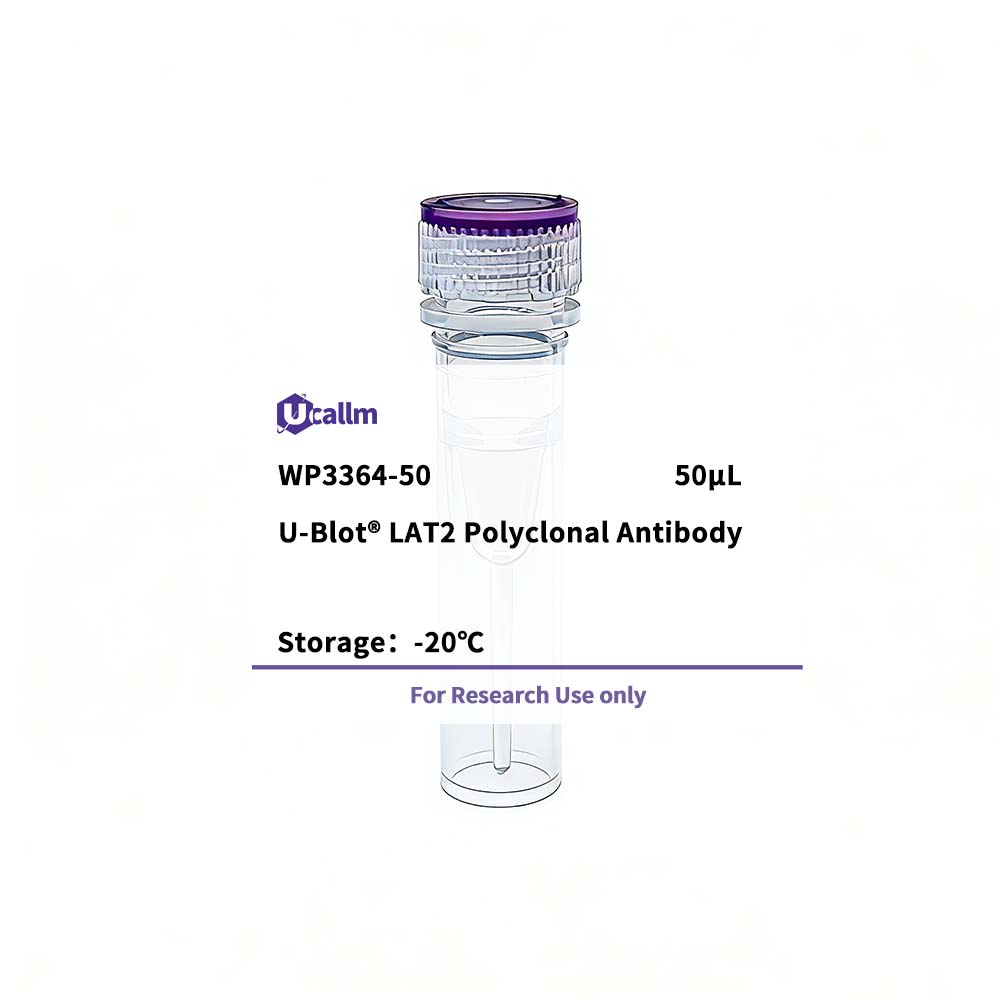
SKU: WP3364 Categories: ,

LAT2 Polyclonal Antibody

Price range: $268.00 through $328.00

SKU: WP3364-100
Enter the quantity you would like, or drag the panel to find the quantity and price that best for you
Bulk QuoteAuthorize OEM & ODM

Product details

Background:

caution:The sequence shown here is derived from an Ensembl automatic analysis pipeline and should be considered as preliminary data., function:Sodium-independent, high-affinity transport of small and large neutral amino acids such as alanine, serine, threonine, cysteine, phenylalanine, tyrosine, leucine, arginine and tryptophan, when associated with SLC3A2/4F2hc. Acts as an amino acid exchanger. Has higher affinity for L-phenylalanine than LAT1 but lower affinity for glutamine and serine. L-alanine is transported at physiological concentrations. Plays a role in basolateral (re)absorption of neutral amino acids. Involved in the uptake of methylmercury (MeHg) when administered as the L-cysteine or D, L-homocysteine complexes, and hence plays a role in metal ion homeostasis and toxicity. Involved in the cellular activity of small molecular weight nitrosothiols, via the stereoselective transport of L-nitrosocysteine (L-CNSO) across the transmembrane. Plays an essential role in the reabsorption of neutral amino acids from the epithelial cells to the bloodstream in the kidney., induction:Activity in polarized intestinal cells is regulated by the association between SLC3A2/4F2 (in the SLC3A2/4F2-LAT2 heterodimer) and ICAM1., miscellaneous:L-leucine transport activity inhibited by small zwitterionic amino acids (i.e. glycine, alanine, serine, threonine asparginine, glutamine, methionine, leucine, isoleucine, valine, phenylalanine, tyrosine, tryptophan, histidine and cysteine) and by glutamine and asparginine. Methionine uptake was inhibited by the L-system substrates L-leucine, 2-amino-bicyclo-(2, 2, 1)-heptane-2-carboxylate (BCH), L-cysteine and by the MeHg-L-cysteine complex and structurally related S-ethyl-L-cysteine. MeHg-L-cysteine uptake is inhibited by L-methionine, L-leucine, BCH and S-ethyl-L-cysteine. L-leucine uptake was inhibited by L-CNSO., similarity:Belongs to the amino acid-polyamine-organocation (APC) superfamily. L-type amino acid transporter (LAT) (TC 2.A.3.8) family., subcellular location:Localized to the cytoplasm when expressed alone but when coexpressed with SLC3A2/4F2hc, is localized to the plasma membrane. Colocalized with SLC3A2/4F2hc at the basolateral membrane of kidney cortex proximal tubules and small intestine epithelia of the villi., subunit:Disulfide-linked heterodimer with the amino acid transport protein SLC3A2/4F2hc., tissue specificity:Strongest expression is observed in kidney and moderate expression in placenta and brain, followed by liver, prostate, testis, ovary, lymph node, thymus, spleen, skeletal muscle and heart. Also expressed in fetal liver as well as in the retinal pigment epithelial cell line ARPE-19 and the intestinal epithelial cell line Caco-2.,

Specifications

Size50μL/100μL
TargetLAT2
ReactivityHuman, Mouse, Rat
ApplicationsWB, ELISA
MW(Calculated)
MW(Observed)58kD
Host SpeciesRabbit
IsotypeIgG
Conjugate/ModificationUnmodified
Recommended Dilution RatioWB 1:500-2000; ELISA 1:5000-20000
FormulationLiquid in PBS containing 50% glycerol,0.5% BSA and 0.02% sodium azide.
PurificationThe antibody was affinity-purified from rabbit antiserum by affinity-chromatography using epitope-specific immunogen.
Storage-15°C to -25°C/1 year(Do not lower than -25°C)
Concentration1 mg/ml
ClonalityPolyclonal
Clone Number
ImmunogenSynthesized peptide derived from part region of human protein
SpecificityLAT2 Polyclonal Antibody detects endogenous levels of protein.
Gene NameSLC7A8 LAT2
Protein NameLarge neutral amino acids transporter small subunit 2 (L-type amino acid transporter 2) (hLAT2) (Solute carrier family 7 member 8)
Other Name
SpeciesHuman
Gene ID23428
UniprotQ9UHI5,
Species.1Mouse
Gene ID.1
Uniprot.1Q9QXW9,
Species.2Rat
Gene ID.2
Uniprot.2Q9WVR6
Cellular LocalizationCytoplasm. Basolateral cell membrane; Multi-pass membrane protein. Localized to the cytoplasm when expressed alone but when coexpressed with SLC3A2/4F2hc, is localized to the plasma membrane. Colocalized with SLC3A2/4F2hc at the basolateral membrane of kidney cortex proximal tubules and small intestine epithelia of the villi.
Tissue ExpressionStrongest expression is observed in kidney and moderate expression in placenta and brain, followed by liver, prostate, testis, ovary, lymph node, thymus, spleen, skeletal muscle and heart. Also expressed in fetal liver as well as in the retinal pigment epithelial cell line ARPE-19 and the intestinal epithelial cell line Caco-2.
Signaling_pathway
Research Areas>>Protein digestion and absorption
FunctionCaution:The sequence shown here is derived from an Ensembl automatic analysis pipeline and should be considered as preliminary data.,Function:Sodium-independent, high-affinity transport of small and large neutral amino acids such as alanine, serine, threonine, cysteine, phenylalanine, tyrosine, leucine, arginine and tryptophan, when associated with SLC3A2/4F2hc. Acts as an amino acid exchanger. Has higher affinity for L-phenylalanine than LAT1 but lower affinity for glutamine and serine. L-alanine is transported at physiological concentrations. Plays a role in basolateral (re)absorption of neutral amino acids. Involved in the uptake of methylmercury (MeHg) when administered as the L-cysteine or D,L-homocysteine complexes, and hence plays a role in metal ion homeostasis and toxicity. Involved in the cellular activity of small molecular weight nitrosothiols, via the stereoselective transport of L-nitrosocysteine (L-CNSO) across the transmembrane. Plays an essential role in the reabsorption of neutral amino acids from the epithelial cells to the bloodstream in the kidney.,induction:Activity in polarized intestinal cells is regulated by the association between SLC3A2/4F2 (in the SLC3A2/4F2-LAT2 heterodimer) and ICAM1.,miscellaneous:L-leucine transport activity inhibited by small zwitterionic amino acids (i.e. glycine, alanine, serine, threonine asparginine, glutamine, methionine, leucine, isoleucine, valine, phenylalanine, tyrosine, tryptophan, histidine and cysteine) and by glutamine and asparginine. Methionine uptake was inhibited by the L-system substrates L-leucine, 2-amino-bicyclo-(2,2,1)-heptane-2-carboxylate (BCH), L-cysteine and by the MeHg-L-cysteine complex and structurally related S-ethyl-L-cysteine. MeHg-L-cysteine uptake is inhibited by L-methionine, L-leucine, BCH and S-ethyl-L-cysteine. L-leucine uptake was inhibited by L-CNSO.,similarity:Belongs to the amino acid-polyamine-organocation (APC) superfamily. L-type amino acid transporter (LAT) (TC 2.A.3.8) family.,subcellular location:Localized to the cytoplasm when expressed alone but when coexpressed with SLC3A2/4F2hc, is localized to the plasma membrane. Colocalized with SLC3A2/4F2hc at the basolateral membrane of kidney cortex proximal tubules and small intestine epithelia of the villi.,subunit:Disulfide-linked heterodimer with the amino acid transport protein SLC3A2/4F2hc.,tissue specificity:Strongest expression is observed in kidney and moderate expression in placenta and brain, followed by liver, prostate, testis, ovary, lymph node, thymus, spleen, skeletal muscle and heart. Also expressed in fetal liver as well as in the retinal pigment epithelial cell line ARPE-19 and the intestinal epithelial cell line Caco-2.,
Please login to post questions
Back to Top
Product has been added to your cart
