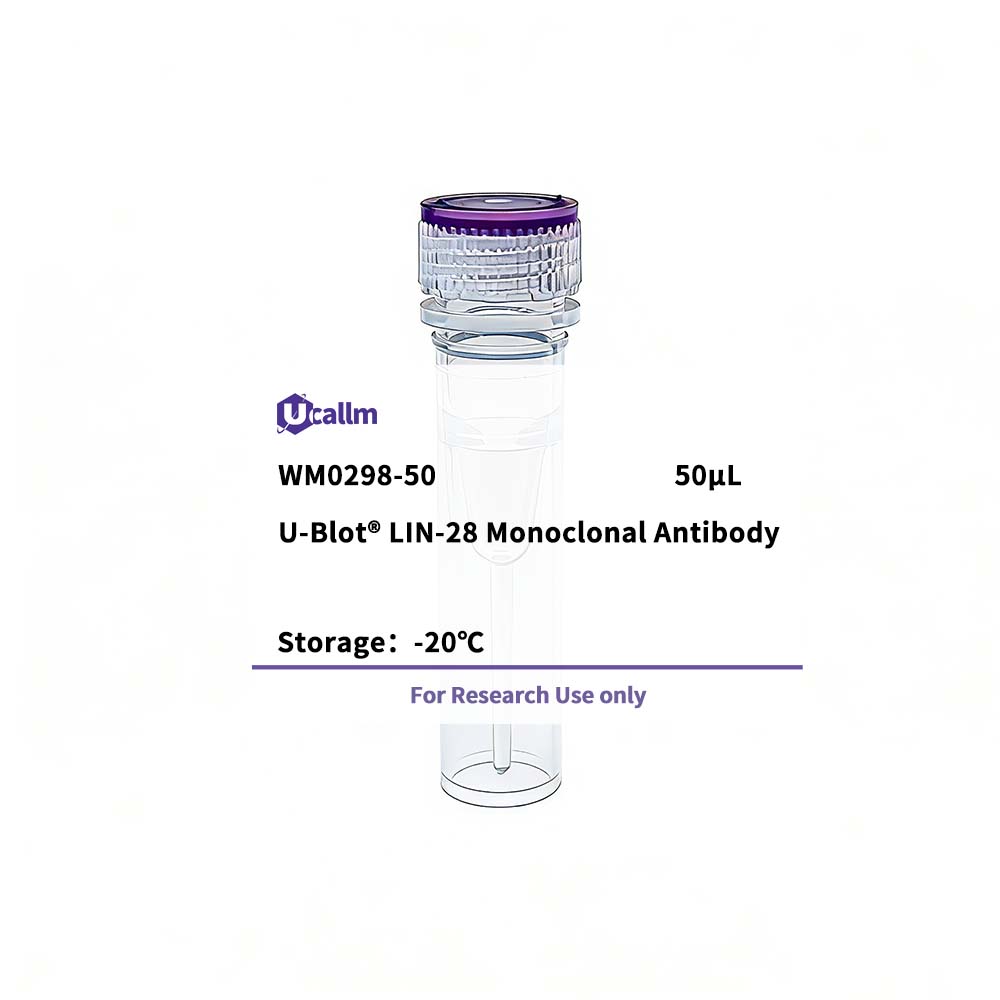
SKU: WM0298 Categories: ,

LIN-28 Monoclonal Antibody

Price range: $268.00 through $328.00

SKU: WM0298-50
Enter the quantity you would like, or drag the panel to find the quantity and price that best for you
Bulk QuoteAuthorize OEM & ODM

Product details

Background:
This gene encodes a LIN-28 family RNA-binding protein that acts as a posttranscriptional regulator of genes involved in developmental timing and self-renewal in embryonic stem cells. The encoded protein functions through direct interaction with target mRNAs and by disrupting the maturation of certain miRNAs involved in embryonic development. This protein prevents the terminal processing of the LET7 family of microRNAs which are major regulators of cellular growth and differentiation. Aberrant expression of this gene is associated with cancer progression in multiple tissues. [provided by RefSeq, Sep 2015],

Specifications

Size50μL/100μL
TargetLIN28A
ReactivityHuman
ApplicationsWB, IF, ELISA
MW(Calculated)23kD
MW(Observed)
Host SpeciesMouse
Isotype
Conjugate/ModificationUnmodified
Recommended Dilution RatioWB 1:500-1:2000; IF 1:200-1:1000; ELISA 1:10000; Not yet tested in other applications.
FormulationLiquid in PBS containing 50% glycerol, 0.5% BSA and 0.02% sodium azide.
PurificationAffinity purification
Storage-15°C to -25°C/1 year(Do not lower than -25°C)
Concentration
ClonalityMonoclonal
Clone Number17A10
ImmunogenPurified recombinant fragment of LIN-28 (aa93-209) expressed in E. Coli.
SpecificityLIN-28 Monoclonal Antibody detects endogenous levels of LIN-28 protein.
Gene NameLIN28A CSDD1 LIN28 ZCCHC1
Protein NameProtein lin-28 homolog A
Other NameCSDD1; / FLJ12457; / LIN 28; / Lin-28A; / LIN28; / LIN28A; / LN28A_HUMAN; / Protein lin-28 homolog A; / ZCCHC1; / Zinc finger CCHC domain-containing protein 1.
SpeciesHuman
Gene ID79727
UniprotQ9H9Z2
Species.1
Gene ID.1
Uniprot.1
Species.2
Gene ID.2
Uniprot.2
Cellular LocalizationCytoplasm . Rough endoplasmic reticulum . Cytoplasm, P-body . Cytoplasm, Stress granule . Nucleus, nucleolus . Predominantly cytoplasmic (PubMed:22118463). In the cytoplasm, localizes to peri-endoplasmic reticulum regions and detected in the microsomal fraction derived from rough endoplasmic reticulum (RER) following subcellular fractionation. May be bound to the cytosolic surface of RER on which ER-associated mRNAs are translated (By similarity). Shuttle from the nucleus to the cytoplasm requires RNA-binding (PubMed:17617744). Nucleolar localization is observed in 10-15% of the nuclei in differentiated myotubes (By similarity). .
Tissue ExpressionExpressed in embryonic stem cells, placenta and testis. Tends to be up-regulated in HER2-overexpressing breast tumors.
Signaling_pathway
Research Areas
Functiondevelopmental stage:Expressed in fetal liver. Expression decreases during differentiation of ES cells or upon induction of neuronal differentiation by retinoic acid.,Domain:The CSD domain is required for function in muscle differentiation.,Function:Acts as a 'translational enhancer', driving specific mRNAs to polysomes and thus increasing the efficiency of protein synthesis. Its association with the translational machinery and target mRNAs results in an increased number of initiation events per molecule of mRNA and, indirectly, in stabilizing the mRNAs. Binds IGF2 mRNA, MYOD1 mRNA, ARBP/36B4 ribosomal protein mRNA and its own mRNA. Essential for skeletal muscle differentiation program through the translational up-regulation of IGF2 expression.,induction:Can be negatively regulated by the interaction of microRNAs miR-125a and miR-125b with at least two miRNA responsive elements (miREs) in the 3'-UTR of this gene. These interactions may reduce both translation efficiency and mRNA abundance. Negatively regulated by retinoic acid.,similarity:Belongs to the lin-28 family.,similarity:Contains 1 CSD (cold-shock) domain.,similarity:Contains 2 CCHC-type zinc fingers.,subcellular location:Nucleolar localization observed in 10 - 15% of the nuclei in differentiated myotubes.,subunit:During skeletal muscle differentiation, associated with translation initiation complexes in the polysomal compartment. Directly interacts with EIF3S2. Interaction with NCL is RNA-dependent.,tissue specificity:Expressed in embryonic stem cells (ES cells), placenta and testis.,
Please login to post questions
Back to Top
Product has been added to your cart
