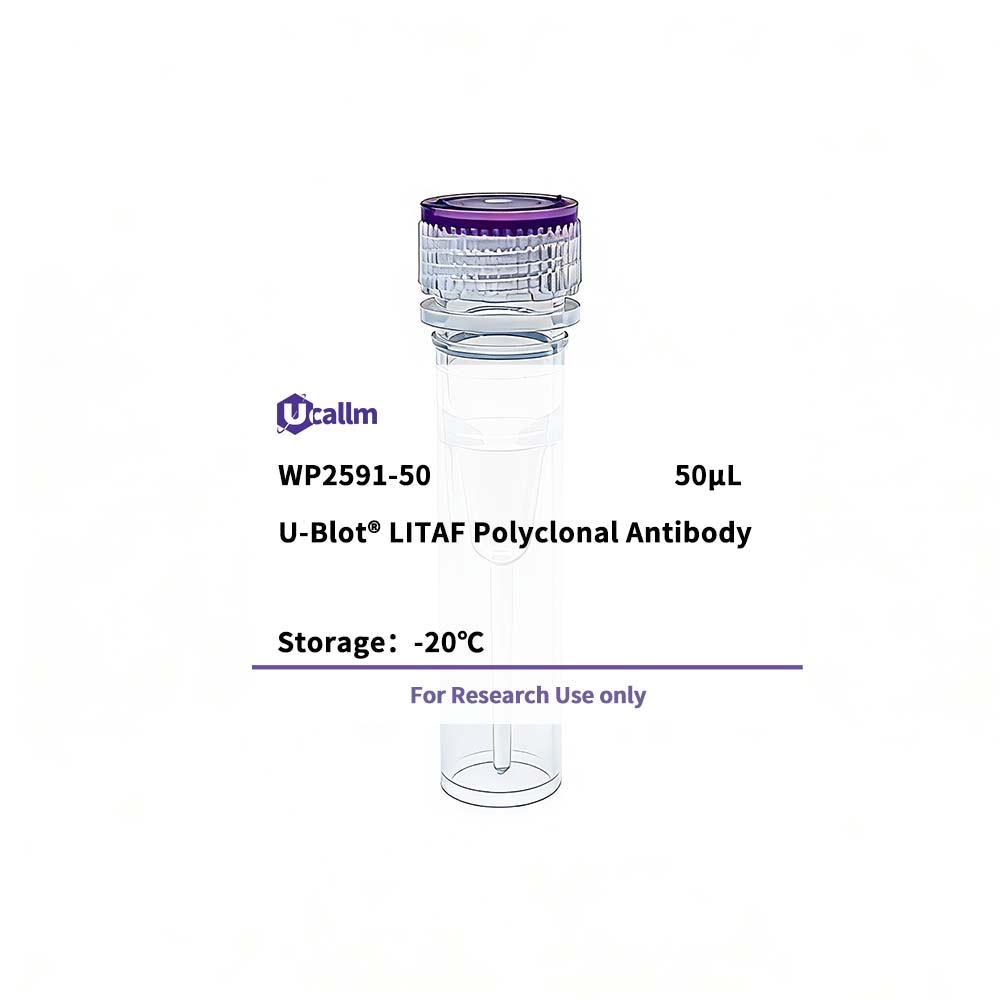
SKU: WP2591 Categories: ,

LITAF Polyclonal Antibody

Price range: $268.00 through $328.00

SKU: WP2591-100
Enter the quantity you would like, or drag the panel to find the quantity and price that best for you
Bulk QuoteAuthorize OEM & ODM

Product details

Background:

Lipopolysaccharide is a potent stimulator of monocytes and macrophages, causing secretion of tumor necrosis factor-alpha (TNF-alpha) and other inflammatory mediators. This gene encodes lipopolysaccharide-induced TNF-alpha factor, which is a DNA-binding protein and can mediate the TNF-alpha expression by direct binding to the promoter region of the TNF-alpha gene. The transcription of this gene is induced by tumor suppressor p53 and has been implicated in the p53-induced apoptotic pathway. Mutations in this gene cause Charcot-Marie-Tooth disease type 1C (CMT1C) and may be involved in the carcinogenesis of extramammary Paget's disease (EMPD). Multiple alternatively spliced transcript variants have been found for this gene. [provided by RefSeq, Dec 2014],

Specifications

Size50μL/100μL
TargetLITAF
ReactivityHuman, Mouse, Rat
ApplicationsWB, ELISA
MW(Calculated)
MW(Observed)17kD
Host SpeciesRabbit
IsotypeIgG
Conjugate/ModificationUnmodified
Recommended Dilution RatioWB 1:500-2000; ELISA 1:5000-20000
FormulationLiquid in PBS containing 50% glycerol,0.5% BSA and 0.02% sodium azide.
PurificationThe antibody was affinity-purified from rabbit antiserum by affinity-chromatography using epitope-specific immunogen.
Storage-15°C to -25°C/1 year(Do not lower than -25°C)
Concentration1 mg/ml
ClonalityPolyclonal
Clone Number
ImmunogenSynthesized peptide derived from part region of human protein
SpecificityLITAF Polyclonal Antibody detects endogenous levels of protein.
Gene NameLITAF PIG7 SIMPLE
Protein NameLipopolysaccharide-induced tumor necrosis factor-alpha factor (LPS-induced TNF-alpha factor) (Small integral membrane protein of lysosome/late endosome) (p53-induced gene 7 protein)
Other Name
SpeciesHuman
Gene ID9516
UniprotQ99732,
Species.1Mouse
Gene ID.1
Uniprot.1Q9JLJ0,
Species.2Rat
Gene ID.2
Uniprot.2P0C0T0
Cellular LocalizationCytoplasm . Nucleus . Lysosome membrane; Peripheral membrane protein; Cytoplasmic side . Early endosome membrane . Late endosome membrane . Endosome membrane; Peripheral membrane protein; Cytoplasmic side . Cell membrane; Peripheral membrane protein; Cytoplasmic side . Golgi apparatus membrane . Associated with membranes of lysosomes, early and late endosomes (PubMed:11274176, PubMed:27927196, PubMed:27582497). Can translocate from the cytoplasm into the nucleus (PubMed:15793005). Detected at Schmidt-Lanterman incisures and in nodal regions of myelinating Schwann cells (By similarity). .
Tissue ExpressionUbiquitously and abundantly expressed. Expressed predominantly in the placenta, peripheral blood leukocytes, lymph nodes and spleen.
Signaling_pathwayCellular Processes >> Transport and catabolism >> Lysosome
Research Areas>>Lysosome
FunctionDisease:Defects in LITAF are the cause of Charcot-Marie-Tooth disease type 1C (CMT1C) [MIM:601098]. CMT1C is a form of Charcot-Marie-Tooth disease, the most common inherited disorder of the peripheral nervous system. Charcot-Marie-Tooth disease is classified in two main groups on the basis of electrophysiologic properties and histopathology: primary peripheral demyelinating neuropathy or CMT1, and primary peripheral axonal neuropathy or CMT2. Neuropathies of the CMT1 group are characterized by severely reduced nerve conduction velocities (less than 38 m/sec), segmental demyelination and remyelination with onion bulb formations on nerve biopsy, slowly progressive distal muscle atrophy and weakness, absent deep tendon reflexes, and hollow feet.,Disease:Defects in LITAF may be involved in extramammary Paget disease (EMPD) carcinogenesis. EMPD is a cancerous disease representing about 8% of all malignant skin cancers; it usually appears in the anogenital area and can be fatal by metastasizing to internal organs when left untreated for a long time. The clinical features are usually those of eczematous eruptions with weeping and crust formation.,Domain:The WW-binding motif mediates interaction with WWOX and, probably NEDD4.,Function:Probable role in regulating transcription of specific genes. May regulate through NFKB1 the expression of the CCL2/MCP-1 chemokine. May play a role in tumor necrosis factor alpha (TNF-alpha) gene expression.,induction:By lipopolysaccharides (LPS) or TP53/p53. In monocytes by the Bacillus Calmette-Guerin (BCG).,subcellular location:Associated with membranes of lysosomes.,subunit:Interacts with NEDD4 (By similarity). Interacts with WWOX. Isoform 2 may interact with STAT6.,tissue specificity:Ubiquitously and abundantly expressed. Expressed predominantly in the placenta, peripheral blood leukocytes, lymph nodes and spleen.,
Please login to post questions
Back to Top
Product has been added to your cart
