

LRC26 rabbit pAb
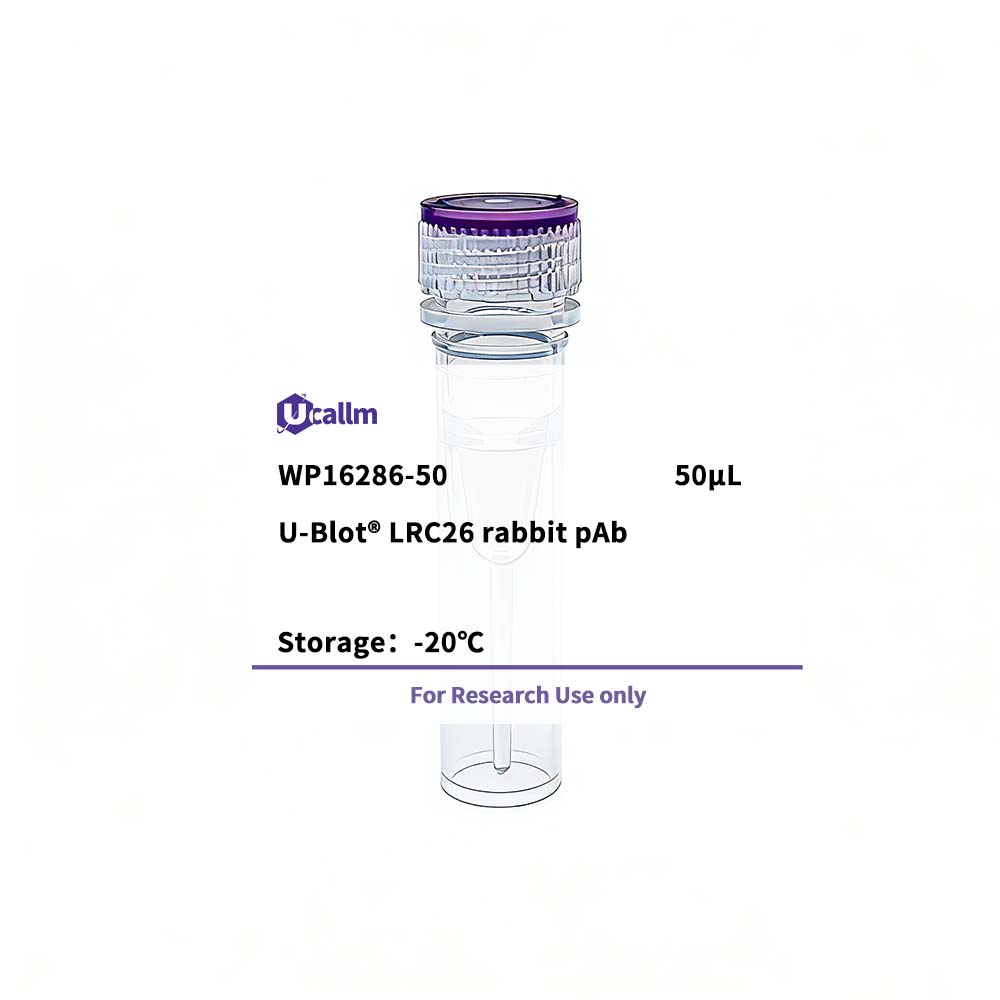
Ucallm_WP16286-50
Price range: $268.00 through $328.00
Product details
Background:
Specifications
| Size | 50μL/100μL |
| Target | LRC26 |
| Reactivity | Human, Mouse, Rat |
| Applications | WB, IHC |
| MW(Calculated) | 37kD |
| MW(Observed) | |
| Host Species | Rabbit |
| Isotype | IgG |
| Conjugate/Modification | Unmodified |
| Recommended Dilution Ratio | WB 1:500-2000; IHC 1:50-300 / Note: For IHC, we suggest antigen retrieval with TE buffer pH 9.0 (Cat#WT1004) |
| Formulation | Liquid in PBS containing 50% glycerol, 0.5% BSA and 0.02% sodium azide. |
| Purification | The antibody was affinity-purified from rabbit antiserum by affinity-chromatography using epitope-specific immunogen. |
| Storage | -15°C to -25°C/1 year(Do not lower than -25°C) |
| Concentration | 1 mg/ml |
| Clonality | Polyclonal |
| Clone Number | |
| Immunogen | Synthesized peptide derived from human LRC26 AA range: 163-213 |
| Specificity | This antibody detects endogenous levels of LRC26 at Human/Mouse/Rat |
| Gene Name | LRRC26 CAPC |
| Protein Name | LRC26 |
| Other Name | |
| Species | Human |
| Gene ID | 389816 |
| Uniprot | Q2I0M4, |
| Species.1 | Mouse |
| Gene ID.1 | 227618 |
| Uniprot.1 | Q91W20, |
| Species.2 | Rat |
| Gene ID.2 | 311803 |
| Uniprot.2 | Q6P7C4 |
| Cellular Localization | Cell membrane; Single-pass type I membrane protein. Cytoplasm, cytoskeleton. Localizes to the cytoplasm when expressed at high levels. . |
| Tissue Expression | Isoform 1 is expressed highly in normal prostate and salivary gland, very weakly in colon, pancreas, and intestine, and not at all in other tissues. Isoform 1 is expressed highly in many cancer cell lines and in breast cancer, pancreatic cancer and colon cancer. Isoform 2 is expressed in cancer cell lines. |
| Signaling_pathway | |
| Research Areas | |
| Function | similarity:Contains 6 LRR (leucine-rich) repeats.,subcellular location:Although predicted to be a single-pass type I membrane protein, this protein localizes to the cytoplasm when expressed at high levels (PubMed:15164053).,tissue specificity:Expressed highly in normal prostate and salivary gland, very weakly in colon, pancreas, and intestine, and not at all in other tissues. Expressed highly in many cancer cell lines and in breast cancer, pancreatic cancer and colon cancer., |
Please login to post questions
Related products




