


LRRC32 rabbit pAb
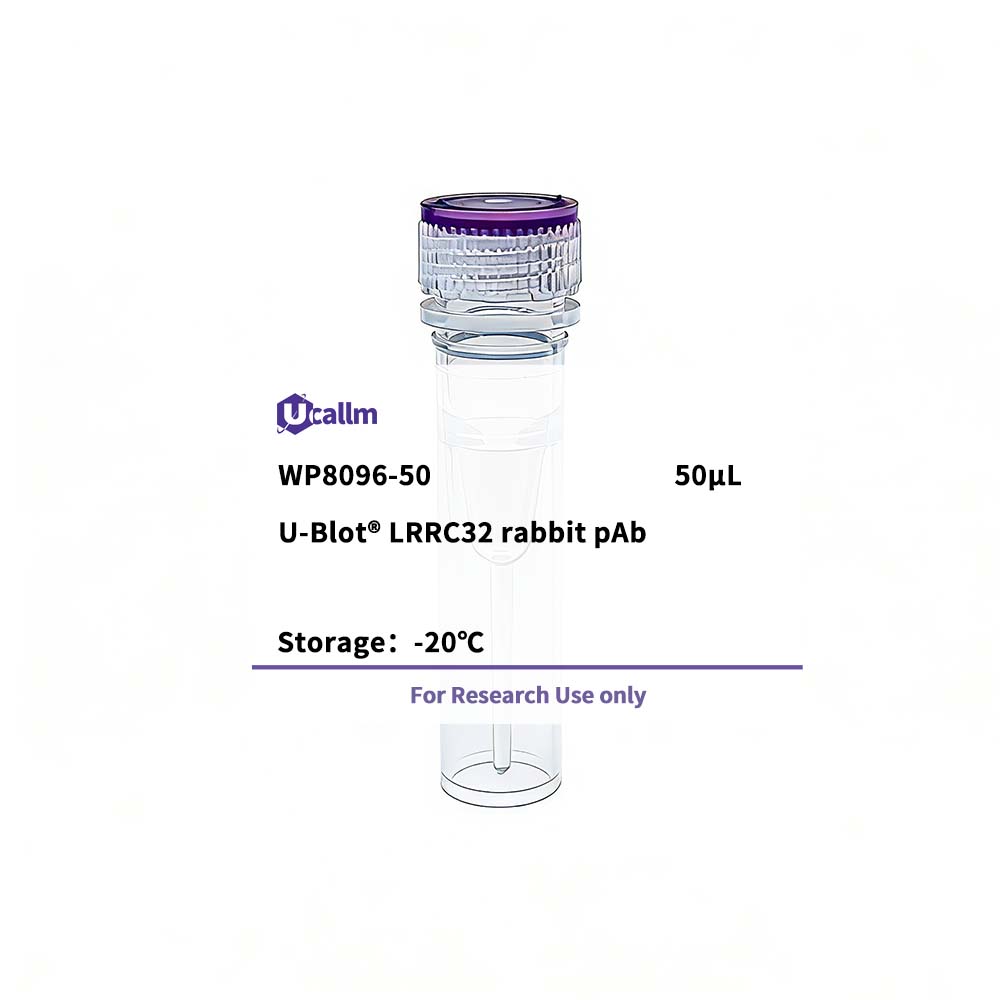
Ucallm_WP8096-50
Price range: $268.00 through $328.00
Product details
Background:
Specifications
| Size | 50μL/100μL |
| Target | LRRC32 |
| Reactivity | Human |
| Applications | WB |
| MW(Calculated) | 73kD |
| MW(Observed) | |
| Host Species | Rabbit |
| Isotype | IgG |
| Conjugate/Modification | Unmodified |
| Recommended Dilution Ratio | WB 1:500-2000 |
| Formulation | Liquid in PBS containing 50% glycerol, 0.5% BSA and 0.02% sodium azide. |
| Purification | The antibody was affinity-purified from rabbit antiserum by affinity-chromatography using epitope-specific immunogen. |
| Storage | -15°C to -25°C/1 year(Do not lower than -25°C) |
| Concentration | 1 mg/ml |
| Clonality | Polyclonal |
| Clone Number | |
| Immunogen | Synthesized peptide derived from human LRRC32 |
| Specificity | This antibody detects endogenous levels of LRRC32 at Human |
| Gene Name | LRRC32 D11S833E GARP |
| Protein Name | Leucine-rich repeat-containing protein 32 (Garpin) (Glycoprotein A repetitions predominant) (GARP) |
| Other Name | |
| Species | Human |
| Gene ID | 2615 |
| Uniprot | Q14392 |
| Species.1 | |
| Gene ID.1 | |
| Uniprot.1 | |
| Species.2 | |
| Gene ID.2 | |
| Uniprot.2 | |
| Cellular Localization | Cell membrane; Single-pass type I membrane protein . Cell surface . |
| Tissue Expression | Preferentially expressed in regulatory T-cells (Tregs). |
| Signaling_pathway | Environmental Information Processing >> Signal transduction >> TGF-beta signaling pathway |
| Research Areas | |
| Function | Key regulator of transforming growth factor beta (TGFB1, TGFB2 and TGFB3) that controls TGF-beta activation by maintaining it in a latent state during storage in extracellular space . Associates specifically via disulfide bonds with the Latency-associated peptide (LAP), which is the regulatory chain of TGF-beta, and regulates integrin-dependent activation of TGF-beta . Able to outcompete LTBP1 for binding to LAP regulatory chain of TGF-beta . Controls activation of TGF-beta-1 (TGFB1) on the surface of activated regulatory T-cells (Tregs) . Required for epithelial fusion during palate development by regulating activation of TGF-beta-3 (TGFB3) (By similarity). |
Please login to post questions
Related products





