


M-CSF Polyclonal Antibody
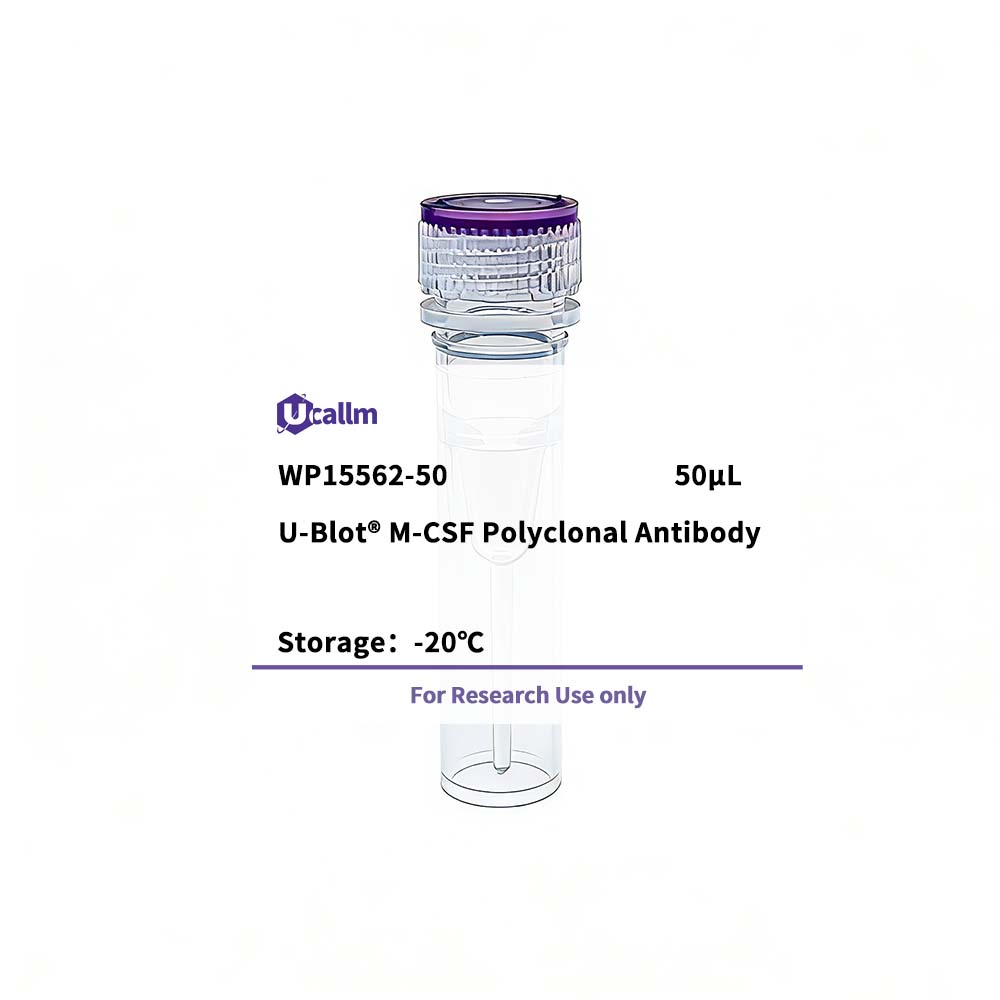
Ucallm_WP15562-50
Price range: $268.00 through $328.00
Product details
Background:
The protein encoded by this gene is a cytokine that controls the production, differentiation, and function of macrophages. The active form of the protein is found extracellularly as a disulfide-linked homodimer, and is thought to be produced by proteolytic cleavage of membrane-bound precursors. The encoded protein may be involved in development of the placenta. Alternate splicing results in multiple transcript variants. [provided by RefSeq, Sep 2011],
Specifications
| Size | 50μL/100μL |
| Target | M-CSF |
| Reactivity | Human, Mouse, Rat |
| Applications | WB, IHC, IF, ELISA |
| MW(Calculated) | |
| MW(Observed) | 48kD |
| Host Species | Rabbit |
| Isotype | IgG |
| Conjugate/Modification | Unmodified |
| Recommended Dilution Ratio | WB 1:500-1:2000; IHC: 1:100-1:300; ELISA 1:10000; IF 1:50-200 / Note: For IHC, we suggest antigen retrieval with TE buffer pH 9.0 (Cat#WT1004) |
| Formulation | Liquid in PBS containing 50% glycerol, 0.5% BSA and 0.02% sodium azide. |
| Purification | The antibody was affinity-purified from rabbit antiserum by affinity-chromatography using epitope-specific immunogen. |
| Storage | -15°C to -25°C/1 year(Do not lower than -25°C) |
| Concentration | 1 mg/ml |
| Clonality | Polyclonal |
| Clone Number | |
| Immunogen | The antiserum was produced against synthesized peptide derived from the C-terminal region of human CSF1. AA range:505-554 |
| Specificity | M-CSF Polyclonal Antibody detects endogenous levels of M-CSF protein. |
| Gene Name | CSF1 |
| Protein Name | Macrophage colony-stimulating factor 1 |
| Other Name | CSF1; / Macrophage colony-stimulating factor 1; / CSF-1; / M-CSF; / MCSF; / Lanimostim |
| Species | Human |
| Gene ID | 1435 |
| Uniprot | P09603, |
| Species.1 | Mouse |
| Gene ID.1 | |
| Uniprot.1 | P07141 |
| Species.2 | |
| Gene ID.2 | |
| Uniprot.2 | |
| Cellular Localization | Cell membrane; Single-pass type I membrane protein .; [Processed macrophage colony-stimulating factor 1]: Secreted, extracellular space. |
| Tissue Expression | Endometrium,Kidney,Pancreatic carcinoma,T lymphoblast,Trophoblast,Urine, |
| Signaling_pathway | Organismal Systems >> Immune system >> Hematopoietic cell lineage;Organismal Systems >> Development and regeneration >> Osteoclast differentiation;Human Diseases >> Immune disease >> Rheumatoid arthritis;Human Diseases >> Neurodegenerative disease >> Alzheimer disease;Human Diseases >> Neurodegenerative disease >> Pathways of neurodegeneration - multiple diseases;Environmental Information Processing >> Signal transduction >> MAPK signaling pathway;Environmental Information Processing >> Signal transduction >> Ras signaling pathway;Environmental Information Processing >> Signal transduction >> Rap1 signaling pathway;Environmental Information Processing >> Signal transduction >> TNF signaling pathway;Environmental Information Processing >> Signal transduction >> PI3K-Akt signaling pathway;Environmental Information Processing >> Signaling molecules and interaction >> Cytokine-cytokine receptor interaction;Environmental Information Processing >> Signaling molecules and interaction >> Viral protein interaction with cytokine and cytokine receptor |
| Research Areas | >>MAPK signaling pathway; / >>Ras signaling pathway; / >>Rap1 signaling pathway; / >>Cytokine-cytokine receptor interaction; / >>Viral protein interaction with cytokine and cytokine receptor; / >>PI3K-Akt signaling pathway; / >>Osteoclast differentiation; / >>Hematopoietic cell lineage; / >>TNF signaling pathway; / >>Alzheimer disease; / >>Pathways of neurodegeneration - multiple diseases; / >>Rheumatoid arthritis |
| Function | Function:Granulocyte/macrophage colony-stimulating factors are cytokines that act in hematopoiesis by controlling the production, differentiation, and function of 2 related white cell populations of the blood, the granulocytes and the monocytes-macrophages. CSF-1 induces cells of the monocyte/macrophage lineage. It plays a role in immunological defenses, bone metabolism, lipoproteins clearance, fertility and pregnancy.,PTM:Glycosylation and proteolytic cleavage yield different soluble forms. A high molecular weight soluble form is a proteoglycan containing chondroitin sulfate.,PTM:Isoform 1 is N- and O-glycosylated. Isoform 3 is N-glycosylated.,subunit:Homodimer or heterodimer; disulfide-linked., |
Please login to post questions
Related products





