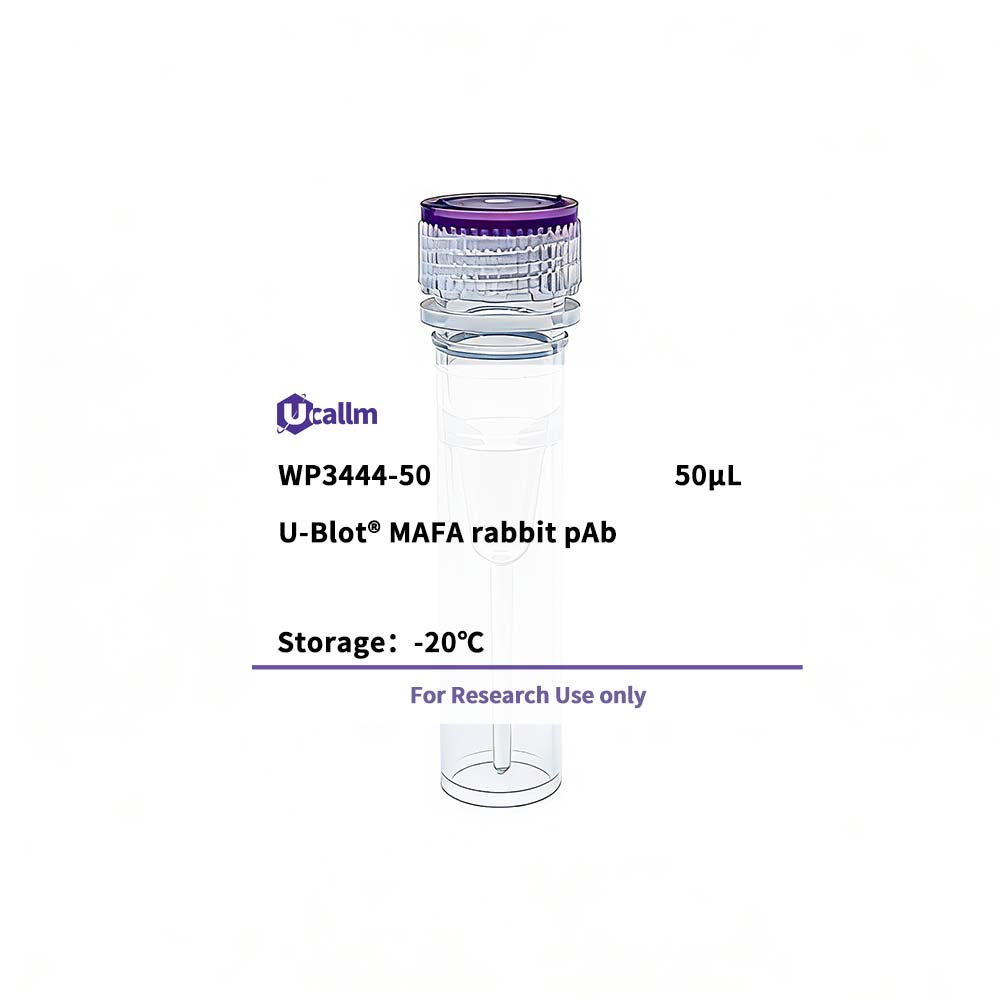
SKU: WP3444 Categories: ,

MAFA rabbit pAb

Price range: $268.00 through $328.00

SKU: WP3444-100
Enter the quantity you would like, or drag the panel to find the quantity and price that best for you
Bulk QuoteAuthorize OEM & ODM

Product details

Background:

MAFA is a transcription factor that binds RIPE3b, a conserved enhancer element that regulates pancreatic beta cell-specific expression of the insulin gene (INS; MIM 176730) (Olbrot et al., 2002 [PubMed 12011435]).[supplied by OMIM, Mar 2008],


Specifications

Size50μL/100μL
TargetMAFA
ReactivityHuman, Mouse
ApplicationsWB
MW(Calculated)
MW(Observed)38kD
Host SpeciesRabbit
IsotypeIgG
Conjugate/ModificationUnmodified
Recommended Dilution RatioWB 1:500-2000
FormulationLiquid in PBS containing 50% glycerol, 0.5% BSA and 0.02% sodium azide.
PurificationThe antibody was affinity-purified from rabbit antiserum by affinity-chromatography using epitope-specific immunogen.
Storage-15°C to -25°C/1 year(Do not lower than -25°C)
Concentration1 mg/ml
ClonalityPolyclonal
Clone Number
ImmunogenSynthesized peptide derived from human MAFA AA range: 204-254
SpecificityThis antibody detects endogenous levels of MAFA at Human/Mouse
Gene NameMAFA
Protein NameMAFA
Other NameTranscription factor MafA; / Pancreatic beta-cell-specific transcriptional activator; / Transcription factor RIPE3b1; / V-maf musculoaponeurotic fibrosarcoma oncogene homolog A
SpeciesHuman
Gene ID389692
UniprotQ8NHW3,
Species.1Mouse
Gene ID.1378435
Uniprot.1Q8CF90
Species.2
Gene ID.2
Uniprot.2
Cellular LocalizationNucleus .
Tissue ExpressionExpressed in the islets of Langerhans (at protein level).
Signaling_pathway
Research Areas>>Type II diabetes mellitus; / >>Maturity onset diabetes of the young
FunctionFunction:Acts as a transcriptional factor. Specifically binds the insulin enhancer element RIPE3b and activates insulin gene expression. Cooperates synergistically with NEUROD1 and PDX1. Phosphorylation by GSK3 increases its transcriptional activity and is required for its oncogenic activity. Involved either as an oncogene or as a tumor suppressor, depending on the cell context.,induction:Up-regulated by glucose.,PTM:Ser-14 and Ser-65 appear to be the major phosphorylation sites. Phosphorylated by MAPK13 on serine and threonine residues (Probable). Phosphorylation by GSK3 requires prior phosphorylation of Ser-65 by another kinase. Phosphorylation proceeds then from Ser-61 to Thr-57, Thr-53 and Ser-49. GSK3-mediated phosphorylation increases its transcriptional activity through the recruitment of the coactivator PCAF, is required for its transforming activity and leads to its degradation through an ubiquitin/proteasome-dependent pathway.,PTM:Ubiquitinated, leading to its degradation by the proteasome.,similarity:Belongs to the bZIP family. Maf subfamily.,similarity:Contains 1 bZIP domain.,subcellular location:Detected in nuclei of pancreas islet beta cells.,subunit:Binds DNA as a homodimer (Probable). Interacts with NEUROD1, PCAF and PDX1.,
Please login to post questions
Back to Top
Product has been added to your cart

