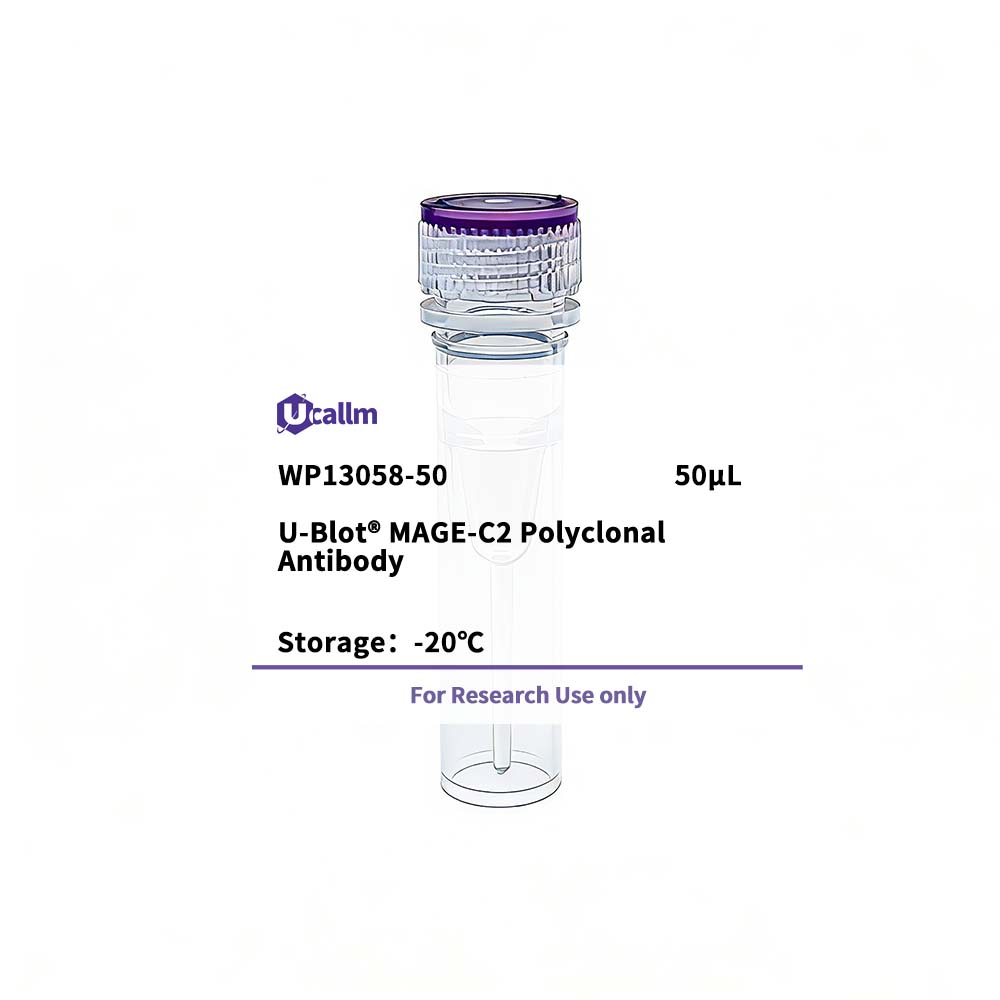
SKU: WP13058 Categories: ,

MAGE-C2 Polyclonal Antibody

Price range: $268.00 through $328.00

SKU: WP13058-100
Enter the quantity you would like, or drag the panel to find the quantity and price that best for you
Bulk QuoteAuthorize OEM & ODM

Product details

Background:

This gene is a member of the MAGEC gene family. It is not expressed in normal tissues, except for testis, and is expressed in tumors of various histological types. This gene and the other MAGEC genes are clustered on chromosome Xq26-q27. [provided by RefSeq, Oct 2009],


Specifications

Size50μL/100μL
TargetMAGE-C2
ReactivityHuman
ApplicationsWB, ELISA
MW(Calculated)
MW(Observed)41kD
Host SpeciesRabbit
IsotypeIgG
Conjugate/ModificationUnmodified
Recommended Dilution RatioWB 1:500-1:2000; ELISA 1:5000; Not yet tested in other applications.
FormulationLiquid in PBS containing 50% glycerol, 0.5% BSA and 0.02% sodium azide.
PurificationThe antibody was affinity-purified from rabbit antiserum by affinity-chromatography using epitope-specific immunogen.
Storage-15°C to -25°C/1 year(Do not lower than -25°C)
Concentration1 mg/ml
ClonalityPolyclonal
Clone Number
ImmunogenSynthesized peptide derived from MAGE-C2 . at AA range: 160-240
SpecificityMAGE-C2 Polyclonal Antibody detects endogenous levels of MAGE-C2 protein.
Gene NameMAGEC2
Protein NameMelanoma-associated antigen C2
Other NameMAGEC2; / HCA587; / MAGEE1; / Melanoma-associated antigen C2; / Cancer/testis antigen 10; / CT10; / Hepatocellular carcinoma-associated antigen 587; / MAGE-C2 antigen; / MAGE-E1 antigen
SpeciesHuman
Gene ID51438
UniprotQ9UBF1
Species.1
Gene ID.1
Uniprot.1
Species.2
Gene ID.2
Uniprot.2
Cellular LocalizationCytoplasm . Nucleus . Nuclear in germ cells. Cytoplasmic in well-differentiated hepatocellular carcinoma, nuclear in moderately- and poorly-differentiated hepatocellular carcinoma.
Tissue ExpressionNot expressed in normal tissues, except in germ cells in the seminiferous tubules and in Purkinje cells of the cerebellum. Expressed in various tumors, including melanoma, lymphoma, as well as pancreatic cancer, mammary gland cancer, non-small cell lung cancer and liver cancer. In hepatocellular carcinoma, there is an inverse correlation between tumor differentiation and protein expression, i.e. the lower the differentiation, the higher percentage of expression.
Signaling_pathway
Research Areas
Functiondevelopmental stage:Strongly expressed in spermatogonia and primary spermatocytes. At later stages of maturation, expression gradually decreases and becomes undetectable in mature spermatids.,similarity:Contains 1 MAGE domain.,subcellular location:Nuclear in germ cells. Cytoplasmic in well-differentiated hepatocellular carcinoma, nuclear in moderately- and poorly-differentiated hepatocellular carcinoma.,tissue specificity:Not expressed in normal tissues, except in germ cells in the seminiferous tubules and in Purkinje cells of the cerebellum. Expressed in various tumors, including melanoma, lymphoma, as well as pancreatic cancer, mammary gland cancer, non-small cell lung cancer and liver cancer. In hepatocellular carcinoma, there is a inverse correlation between tumor differentiation and protein expression, i.e. the lower the differentiation, the higher percentage of expression.,
Please login to post questions
Back to Top
Product has been added to your cart
