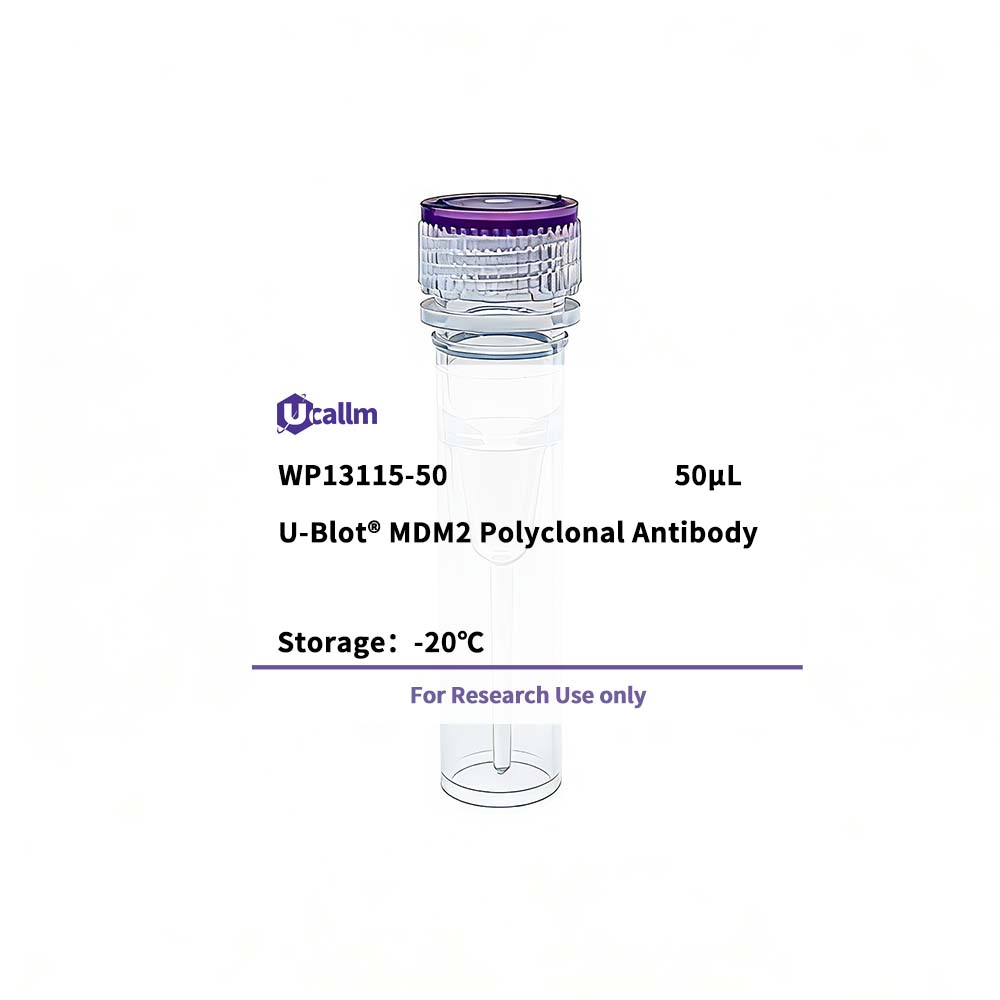
SKU: WP13115 Categories: ,

MDM2 Polyclonal Antibody

Price range: $268.00 through $328.00

SKU: WP13115-100
Enter the quantity you would like, or drag the panel to find the quantity and price that best for you
Bulk QuoteAuthorize OEM & ODM

Product details

Background:

This gene encodes a nuclear-localized E3 ubiquitin ligase. The encoded protein can promote tumor formation by targeting tumor suppressor proteins, such as p53, for proteasomal degradation. This gene is itself transcriptionally-regulated by p53. Overexpression or amplification of this locus is detected in a variety of different cancers. There is a pseudogene for this gene on chromosome 2. Alternative splicing results in a multitude of transcript variants, many of which may be expressed only in tumor cells. [provided by RefSeq, Jun 2013],


Specifications

Size50μL/100μL
TargetMDM2
ReactivityHuman, Mouse
ApplicationsIHC, IF, WB, ELISA
MW(Calculated)55kD
MW(Observed)
Host SpeciesRabbit
IsotypeIgG
Conjugate/ModificationUnmodified
Recommended Dilution RatioWB 1:500-2000; IHC 1:100-1:300; IF 1:200-1:1000; ELISA 1:5000; Not yet tested in other applications. / Note: For IHC, we suggest antigen retrieval with TE buffer pH 9.0 (Cat#WT1004)
FormulationLiquid in PBS containing 50% glycerol, 0.5% BSA and 0.02% sodium azide.
PurificationThe antibody was affinity-purified from rabbit antiserum by affinity-chromatography using epitope-specific immunogen.
Storage-15°C to -25°C/1 year(Do not lower than -25°C)
Concentration1 mg/ml
ClonalityPolyclonal
Clone Number
ImmunogenThe antiserum was produced against synthesized peptide derived from human MDM2. AA range:151-200
SpecificityMDM2 Polyclonal Antibody detects endogenous levels of MDM2 protein.
Gene NameMDM2
Protein NameE3 ubiquitin-protein ligase Mdm2
Other NameMDM2; / E3 ubiquitin-protein ligase Mdm2; / Double minute 2 protein; / Hdm2; / Oncoprotein Mdm2; / p53-binding protein Mdm2
SpeciesHuman
Gene ID4193
UniprotQ00987,
Species.1Mouse
Gene ID.117246
Uniprot.1P23804
Species.2
Gene ID.2
Uniprot.2
Cellular LocalizationNucleus, nucleoplasm. Cytoplasm . Nucleus, nucleolus. Nucleus . Expressed predominantly in the nucleoplasm. Interaction with ARF(P14) results in the localization of both proteins to the nucleolus. The nucleolar localization signals in both ARF(P14) and MDM2 may be necessary to allow efficient nucleolar localization of both proteins. Colocalizes with RASSF1 isoform A in the nucleus.
Tissue ExpressionUbiquitous. Isoform Mdm2-A, isoform Mdm2-B, isoform Mdm2-C, isoform Mdm2-D, isoform Mdm2-E, isoform Mdm2-F and isoform Mdm2-G are observed in a range of cancers but absent in normal tissues.
Signaling_pathwayCellular Processes >> Cell growth and death >> Cell cycle;Cellular Processes >> Cell growth and death >> p53 signaling pathway;Cellular Processes >> Cell growth and death >> Cellular senescence;Organismal Systems >> Endocrine system >> Thyroid hormone signaling pathway;Human Diseases >> Cancer: overview >> Pathways in cancer;Human Diseases >> Cancer: overview >> Transcriptional misregulation in cancer;Human Diseases >> Cancer: overview >> MicroRNAs in cancer;Human Diseases >> Cancer: specific types >> Glioma;Human Diseases >> Cancer: specific types >> Chronic myeloid leukemia;Human Diseases >> Cancer: specific types >> Melanoma;Human Diseases >> Cancer: specific types >> Bladder cancer;Human Diseases >> Cancer: specific types >> Prostate cancer;Environmental Information Processing >> Signal transduction >> FoxO signaling pathway;Environmental Information Processing >> Signal transduction >> PI3K-Akt signaling pathway;Genetic Information Processing >> Folding, sorting and degradation >> Ubiquitin mediated proteolysis
Research Areas>>Endocrine resistance; / >>Platinum drug resistance; / >>FoxO signaling pathway; / >>Cell cycle; / >>p53 signaling pathway; / >>Ubiquitin mediated proteolysis; / >>Endocytosis; / >>PI3K-Akt signaling pathway; / >>Cellular senescence; / >>C-type lectin receptor signaling pathway; / >>Thyroid hormone signaling pathway; / >>Shigellosis; / >>Human cytomegalovirus infection; / >>Human papillomavirus infection; / >>Epstein-Barr virus infection; / >>Pathways in cancer; / >>Transcriptional misregulation in cancer; / >>Viral carcinogenesis; / >>Proteoglycans in cancer; / >>MicroRNAs in cancer; / >>Glioma; / >>Prostate cancer; / >>Melanoma; / >>Bladder cancer; / >>Chronic myeloid leukemia
FunctionDisease:Seems to be amplified in certain tumors (including soft tissue sarcomas, osteosarcomas and gliomas). A higher frequency of splice variants lacking p53 binding domain sequences was found in late-stage and high-grade ovarian and bladder carcinomas. Four of the splice variants show loss of p53 binding.,Domain:Region I is sufficient for binding p53 and inhibiting its G1 arrest and apoptosis functions. It also binds p73 and E2F1. Region II contains most of a central acidic region required for interaction with ribosomal protein L5 and a putative C4-type zinc finger. The RING finger domain which coordinates two molecules of zinc interacts specifically with RNA whether or not zinc is present and mediates the heterooligomerization with MDM4. It is also essential for its ubiquitin ligase E3 activity toward p53 and itself.,Function:Inhibits TP53/p53- and TP73/p73-mediated cell cycle arrest and apoptosis by binding its transcriptional activation domain. Functions as a ubiquitin ligase E3, in the presence of E1 and E2, toward p53 and itself. Permits the nuclear export of p53 and targets it for proteasome-mediated proteolysis.,induction:By DNA damage.,miscellaneous:MDM2 RING finger mutations that failed to ubiquitinate p53 in vitro did not target p53 for degradation when expressed in cells.,online information:Mdm2 entry,PTM:Auto-ubiquitinated; which leads to proteasomal degradation.,PTM:Phosphorylated in response to ionizing radiation in an ATM-dependent manner.,similarity:Belongs to the MDM2/MDM4 family.,similarity:Contains 1 RanBP2-type zinc finger.,similarity:Contains 1 RING-type zinc finger.,similarity:Contains 1 SWIB domain.,subcellular location:Expressed predominantly in the nucleoplasm. Interaction with ARF(P14) results in the localization of both proteins to the nucleolus. The nucleolar localization signals in both ARF(P14) and MDM2 may be necessary to allow efficient nucleolar localization of both proteins.,subunit:Binds p53, p73, ARF(P14), ribosomal protein L5 and specifically to RNA. Can interact also with retinoblastoma protein (RB), E1A-associated protein EP300 and the E2F1 transcription factor. Forms a ternary complex with TP53/p53 and WWOX. Interacts with CDKN2AIP, MTBP, TBRG1, USP7, PYHIN1 and UBXN6. Isoform Mdm2-F does not interact with TP53/p53. Interacts with and ubiquitinates HIV-1 Tat.,tissue specificity:Ubiquitous. Isoform Mdm2-A, isoform Mdm2-B, isoform Mdm2-C, isoform Mdm2-D, isoform Mdm2-E, isoform Mdm2-F and isoform Mdm2-G are observed in a range of cancers but absent in normal tissues.,
Please login to post questions
Back to Top
Product has been added to your cart

