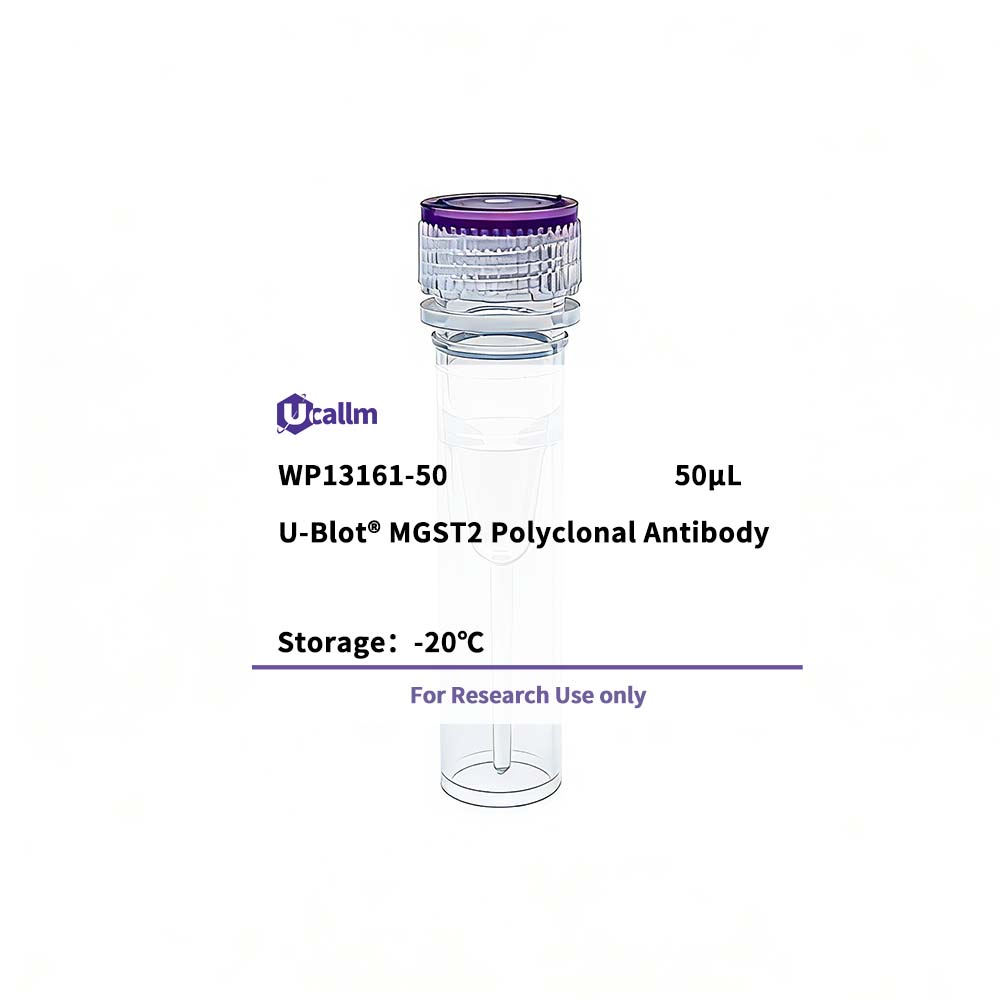
SKU: WP13161 Categories: ,

MGST2 Polyclonal Antibody

Price range: $268.00 through $328.00

SKU: WP13161-100
Enter the quantity you would like, or drag the panel to find the quantity and price that best for you
Bulk QuoteAuthorize OEM & ODM

Product details

Background:

The MAPEG (Membrane Associated Proteins in Eicosanoid and Glutathione metabolism) family consists of six human proteins, several of which are involved in the production of leukotrienes and prostaglandin E, important mediators of inflammation. This gene encodes a protein which catalyzes the conjugation of leukotriene A4 and reduced glutathione to produce leukotriene C4. Alternatively spliced transcript variants encoding different isoforms have been identified in this gene. [provided by RefSeq, Feb 2011],


Specifications

Size50μL/100μL
TargetMGST2
ReactivityHuman, Mouse
ApplicationsWB, ELISA, IHC
MW(Calculated)
MW(Observed)17kD
Host SpeciesRabbit
IsotypeIgG
Conjugate/ModificationUnmodified
Recommended Dilution RatioWB 1:500-2000; IHC 1:50-300; ELISA 1:2000-20000 / Note: For IHC, we suggest antigen retrieval with TE buffer pH 9.0 (Cat#WT1004)
FormulationLiquid in PBS containing 50% glycerol, 0.5% BSA and 0.02% sodium azide.
PurificationThe antibody was affinity-purified from rabbit antiserum by affinity-chromatography using epitope-specific immunogen.
Storage-15°C to -25°C/1 year(Do not lower than -25°C)
Concentration1 mg/ml
ClonalityPolyclonal
Clone Number
ImmunogenSynthesized peptide derived from MGST2 . at AA range: 370-450
SpecificityMGST2 Polyclonal Antibody detects endogenous levels of MGST2 protein.
Gene NameMGST2
Protein NameMicrosomal glutathione S-transferase 2
Other NameMGST2; / GST2; / Microsomal glutathione S-transferase 2; / Microsomal GST-2; / Microsomal GST-II
SpeciesHuman
Gene ID4258
UniprotQ99735
Species.1
Gene ID.1
Uniprot.1
Species.2
Gene ID.2
Uniprot.2
Cellular LocalizationEndoplasmic reticulum membrane; Multi-pass membrane protein . Microsome membrane; Multi-pass membrane protein .
Tissue ExpressionLiver, spleen, skeletal muscle, heart, adrenals, pancreas, prostate, testis, fetal liver, and fetal spleen. Very low expression in lung, brain, placenta and bone marrow (PubMed:8703034). Abundantly expressed in human umbilical vein endothelial cells (at protein level) (PubMed:11322876).
Signaling_pathwayHuman Diseases >> Cancer: overview >> Pathways in cancer;Human Diseases >> Cancer: specific types >> Hepatocellular carcinoma
Research Areas>>Glutathione metabolism; / >>Metabolism of xenobiotics by cytochrome P450; / >>Drug metabolism - cytochrome P450; / >>Drug metabolism - other enzymes; / >>Metabolic pathways; / >>Platinum drug resistance; / >>Pathways in cancer; / >>Chemical carcinogenesis - DNA adducts; / >>Chemical carcinogenesis - receptor activation; / >>Chemical carcinogenesis - reactive oxygen species; / >>Hepatocellular carcinoma; / >>Fluid shear stress and atherosclerosis
FunctionCatalytic activity:RX + glutathione = HX + R-S-glutathione.,Function:Can catalyze the production of LTC4 from LTA4 and reduced glutathione. Can catalyze the conjugation of 1-chloro-2,4-dinitrobenzene with reduced glutathione.,similarity:Belongs to the MAPEG family.,subunit:Homotrimer.,tissue specificity:Liver, spleen, skeletal muscle, heart, adrenals, pancreas, prostate, testis, fetal liver, and fetal spleen. Very low expression in lung, brain, placenta and bone marrow.,
Please login to post questions
Back to Top
Product has been added to your cart


