


- Please choose product options by visiting U-Blot® Human CD42b/GP1BA Antibody (5G6), FITC.
MK Polyclonal Antibody
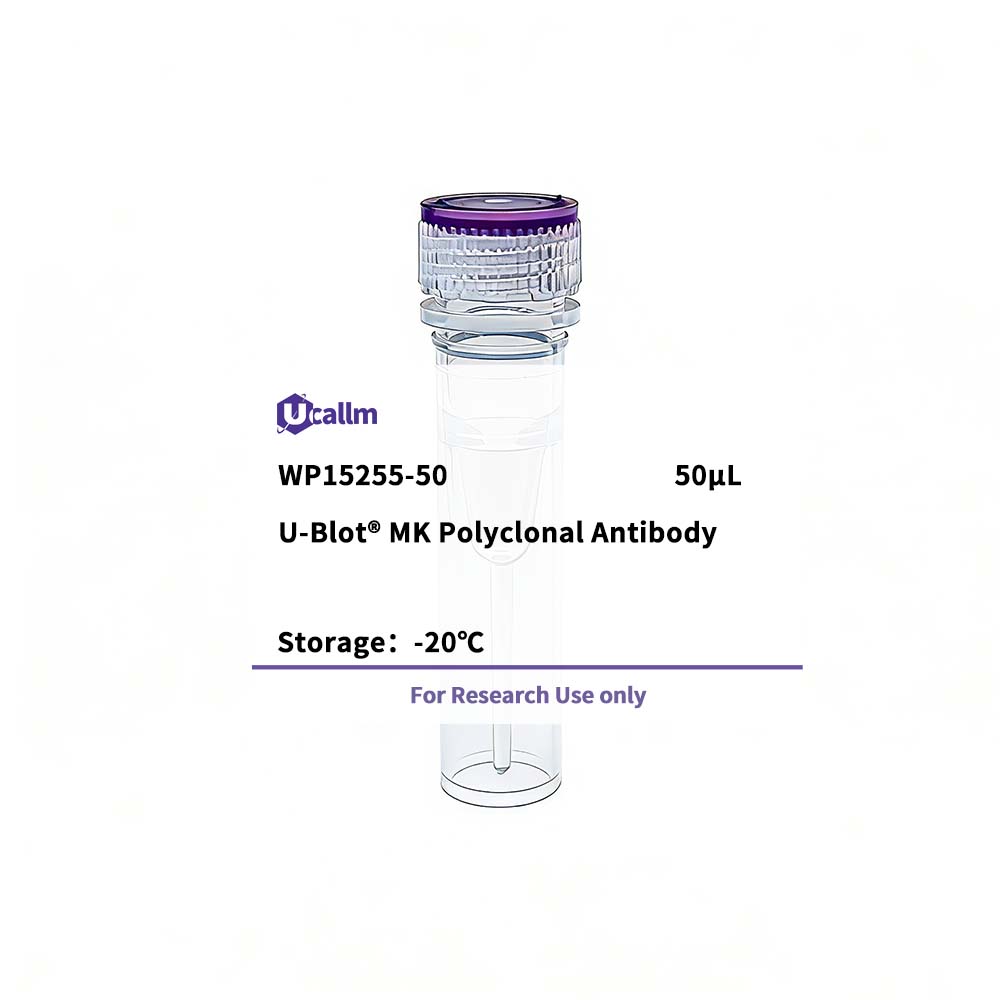
Ucallm_WP15255-50
Price range: $268.00 through $328.00
Product details
Background:
This gene encodes a member of a small family of secreted growth factors that binds heparin and responds to retinoic acid. The encoded protein promotes cell growth, migration, and angiogenesis, in particular during tumorigenesis. This gene has been targeted as a therapeutic for a variety of different disorders. Alternatively spliced transcript variants encoding multiple isoforms have been observed. [provided by RefSeq, Jul 2012],
Specifications
| Size | 50μL/100μL |
| Target | Midkine |
| Reactivity | Human, Rat |
| Applications | WB, IHC, IF, ELISA |
| MW(Calculated) | |
| MW(Observed) | 18kD |
| Host Species | Rabbit |
| Isotype | IgG |
| Conjugate/Modification | Unmodified |
| Recommended Dilution Ratio | WB 1:500-1:2000; IHC: 1:100-300; ELISA 1:20000; IF 1:50-200 / Note: For IHC, we suggest antigen retrieval with TE buffer pH 9.0 (Cat#WT1004) |
| Formulation | Liquid in PBS containing 50% glycerol, 0.5% BSA and 0.02% sodium azide. |
| Purification | The antibody was affinity-purified from rabbit antiserum by affinity-chromatography using epitope-specific immunogen. |
| Storage | -15°C to -25°C/1 year(Do not lower than -25°C) |
| Concentration | 1 mg/ml |
| Clonality | Polyclonal |
| Clone Number | |
| Immunogen | The antiserum was produced against synthesized peptide derived from the Internal region of human Midkine. AA range:94-143 |
| Specificity | Midkine Polyclonal Antibody detects endogenous levels of MK protein. |
| Gene Name | MDK |
| Protein Name | Midkine |
| Other Name | MDK; / MK1; / NEGF2; / Midkine; / MK; / Amphiregulin-associated protein; / ARAP; / Midgestation and kidney protein; / Neurite outgrowth-promoting factor 2; / Neurite outgrowth-promoting protein |
| Species | Human |
| Gene ID | 4192 |
| Uniprot | P21741, |
| Species.1 | |
| Gene ID.1 | |
| Uniprot.1 | |
| Species.2 | Rat |
| Gene ID.2 | 81517 |
| Uniprot.2 | Q9R1S9 |
| Cellular Localization | Secreted. |
| Tissue Expression | Expressed in various tumor cell lines. In insulinoma tissue predominantly expressed in precancerous lesions. |
| Signaling_pathway | |
| Research Areas | |
| Function | Function:Has heparin binding activity, and growth promoting activity. Involved in neointima formation after arterial injury, possibly by mediating leukocyte recruitment. Also involved in early fetal adrenal gland development.,induction:By heparin and retinoic acid.,similarity:Belongs to the pleiotrophin family.,subunit:Homodimer., |
Please login to post questions
Related products





