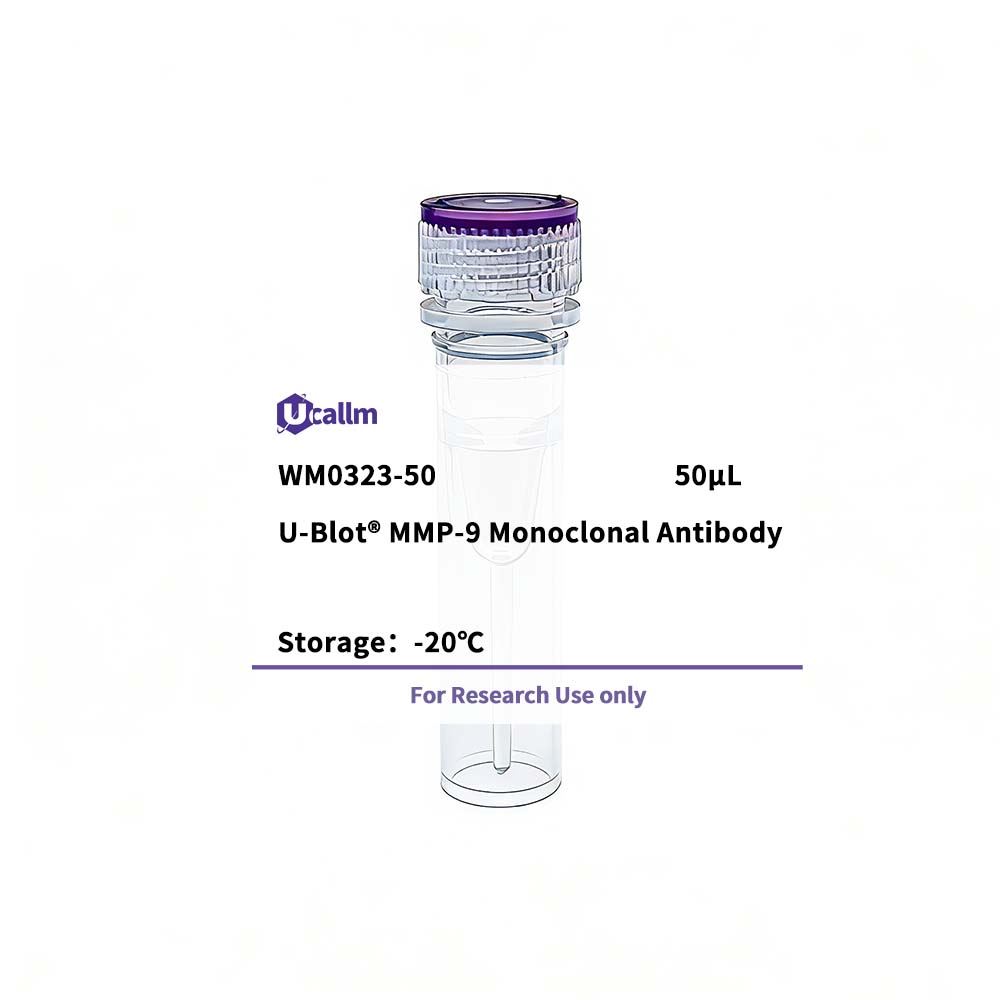
SKU: WM0323 Categories: ,

MMP-9 Monoclonal Antibody

Price range: $268.00 through $328.00

SKU: WM0323-50
Enter the quantity you would like, or drag the panel to find the quantity and price that best for you
Bulk QuoteAuthorize OEM & ODM

Product details

Background:
matrix metallopeptidase 9(MMP9) Homo sapiens Proteins of the matrix metalloproteinase (MMP) family are involved in the breakdown of extracellular matrix in normal physiological processes, such as embryonic development, reproduction, and tissue remodeling, as well as in disease processes, such as arthritis and metastasis. Most MMP's are secreted as inactive proproteins which are activated when cleaved by extracellular proteinases. The enzyme encoded by this gene degrades type IV and V collagens. Studies in rhesus monkeys suggest that the enzyme is involved in IL-8-induced mobilization of hematopoietic progenitor cells from bone marrow, and murine studies suggest a role in tumor-associated tissue remodeling. [provided by RefSeq, Jul 2008],

Specifications

Size50μL/100μL
TargetMMP-9
ReactivityHuman
ApplicationsWB, IHC, IF, FC, ELISA
MW(Calculated)78kD
MW(Observed)
Host SpeciesMouse
Isotype
Conjugate/ModificationUnmodified
Recommended Dilution RatioWB 1:500-1:2000; IHC 1:200-1:1000; IF 1:200-1:1000; Flow Cyt 1:200-1:400; ELISA 1:10000; Not yet tested in other applications. / Note: For IHC, we suggest antigen retrieval with TE buffer pH 9.0 (Cat#WT1004)
FormulationLiquid in PBS containing 50% glycerol, 0.5% BSA and 0.02% sodium azide.
PurificationAffinity purification
Storage-15°C to -25°C/1 year(Do not lower than -25°C)
Concentration
ClonalityMonoclonal
Clone Number3F5
ImmunogenPurified recombinant fragment of human MMP-9 expressed in E. Coli.
SpecificityMMP-9 Monoclonal Antibody detects endogenous levels of MMP-9 protein.
Gene NameMMP9
Protein NameMatrix metalloproteinase-9
Other NameMMP9; / CLG4B; / Matrix metalloproteinase-9; / MMP-9; / 92 kDa gelatinase; / 92 kDa type IV collagenase; / Gelatinase B; / GELB
SpeciesHuman
Gene ID4318
UniprotP14780,
Species.1Mouse
Gene ID.1
Uniprot.1P41245
Species.2
Gene ID.2
Uniprot.2
Cellular LocalizationSecreted, extracellular space, extracellular matrix .
Tissue ExpressionDetected in neutrophils (at protein level) (PubMed:7683678). Produced by normal alveolar macrophages and granulocytes.
Signaling_pathwayOrganismal Systems >> Immune system >> IL-17 signaling pathway;Organismal Systems >> Immune system >> Leukocyte transendothelial migration;Organismal Systems >> Endocrine system >> Estrogen signaling pathway;Organismal Systems >> Endocrine system >> Relaxin signaling pathway;Human Diseases >> Cancer: overview >> Pathways in cancer;Human Diseases >> Cancer: overview >> Transcriptional misregulation in cancer;Human Diseases >> Cancer: overview >> MicroRNAs in cancer;Human Diseases >> Cancer: specific types >> Bladder cancer;Human Diseases >> Cancer: specific types >> Prostate cancer;Environmental Information Processing >> Signal transduction >> TNF signaling pathway
Research Areas>>Endocrine resistance; / >>IL-17 signaling pathway; / >>TNF signaling pathway; / >>Leukocyte transendothelial migration; / >>Estrogen signaling pathway; / >>Relaxin signaling pathway; / >>Hepatitis B; / >>Pathways in cancer; / >>Transcriptional misregulation in cancer; / >>Proteoglycans in cancer; / >>MicroRNAs in cancer; / >>Prostate cancer; / >>Bladder cancer; / >>Diabetic cardiomyopathy; / >>Lipid and atherosclerosis; / >>Fluid shear stress and atherosclerosis
FunctionCatalytic activity:Cleavage of gelatin types I and V and collagen types IV and V.,cofactor:Binds 2 zinc ions per subunit.,cofactor:Binds 3 calcium ions per subunit.,Disease:Defects in MMP9 may be a cause of susceptibility to lumbar disk herniation (LDH) [MIM:603932]. LDH is the predominant cause of low-back pain and unilateral leg pain.,Domain:The conserved cysteine present in the cysteine-switch motif binds the catalytic zinc ion, thus inhibiting the enzyme. The dissociation of the cysteine from the zinc ion upon the activation-peptide release activates the enzyme.,enzyme regulation:Inhibited by histatin-3 1/24 (histatin-5).,Function:May play an essential role in local proteolysis of the extracellular matrix and in leukocyte migration. Could play a role in bone osteoclastic resorption. Cleaves KiSS1 at a Gly-|-Leu bond. Cleaves type IV and type V collagen into large C-terminal three quarter fragments and shorter N-terminal one quarter fragments. Degrades fibronectin but not laminin or Pz-peptide.,induction:Activated by 4-aminophenylmercuric acetate and phorbol ester.,miscellaneous:In the arthritis patient this enzyme might contribute to the pathogenesis of joint destruction and might constitute a useful marker of disease status.,PTM:N- and O-glycosylated.,PTM:Processing of the precursor yields different active forms of 64, 67 and 82 kDa. Sequentially processing by MMP3 yields the 82 kDa matrix metalloproteinase-9.,similarity:Belongs to the peptidase M10A family.,similarity:Contains 3 fibronectin type-II domains.,similarity:Contains 4 hemopexin-like domains.,subunit:Exists as monomer, disulfide-linked homodimer, and as a heterodimer with a 25 kDa protein. Macrophages and transformed cell lines produce only the monomeric form.,tissue specificity:Produced by normal alveolar macrophages and granulocytes.,
Please login to post questions
Back to Top
Product has been added to your cart

