SKU: WR4076 Categories: ,

U-Blot® MMP13 Rabbit mAb

Price range: $268.00 through $328.00

SKU: WR4076-50
Enter the quantity you would like, or drag the panel to find the quantity and price that best for you
Bulk QuoteAuthorize OEM & ODM

Product details

Background:This gene encodes a member of the peptidase M10 family of matrix metalloproteinases (MMPs). Proteins in this family are involved in the breakdown of extracellular matrix in normal physiological processes, such as embryonic development, reproduction, and tissue remodeling, as well as in disease processes, such as arthritis and metastasis. The encoded preproprotein is proteolytically processed to generate the mature protease. This protease cleaves type II collagen more efficiently than types I and III. It may be involved in articular cartilage turnover and cartilage pathophysiology associated with osteoarthritis. Mutations in this gene are associated with metaphyseal anadysplasia. This gene is part of a cluster of MMP genes on chromosome 11. [provided by RefSeq, Jan 2016],

Specifications

Size50μL/100μL
TargetMMP-13
ReactivityHuman
ApplicationsWB, IHC, IF, ELISA
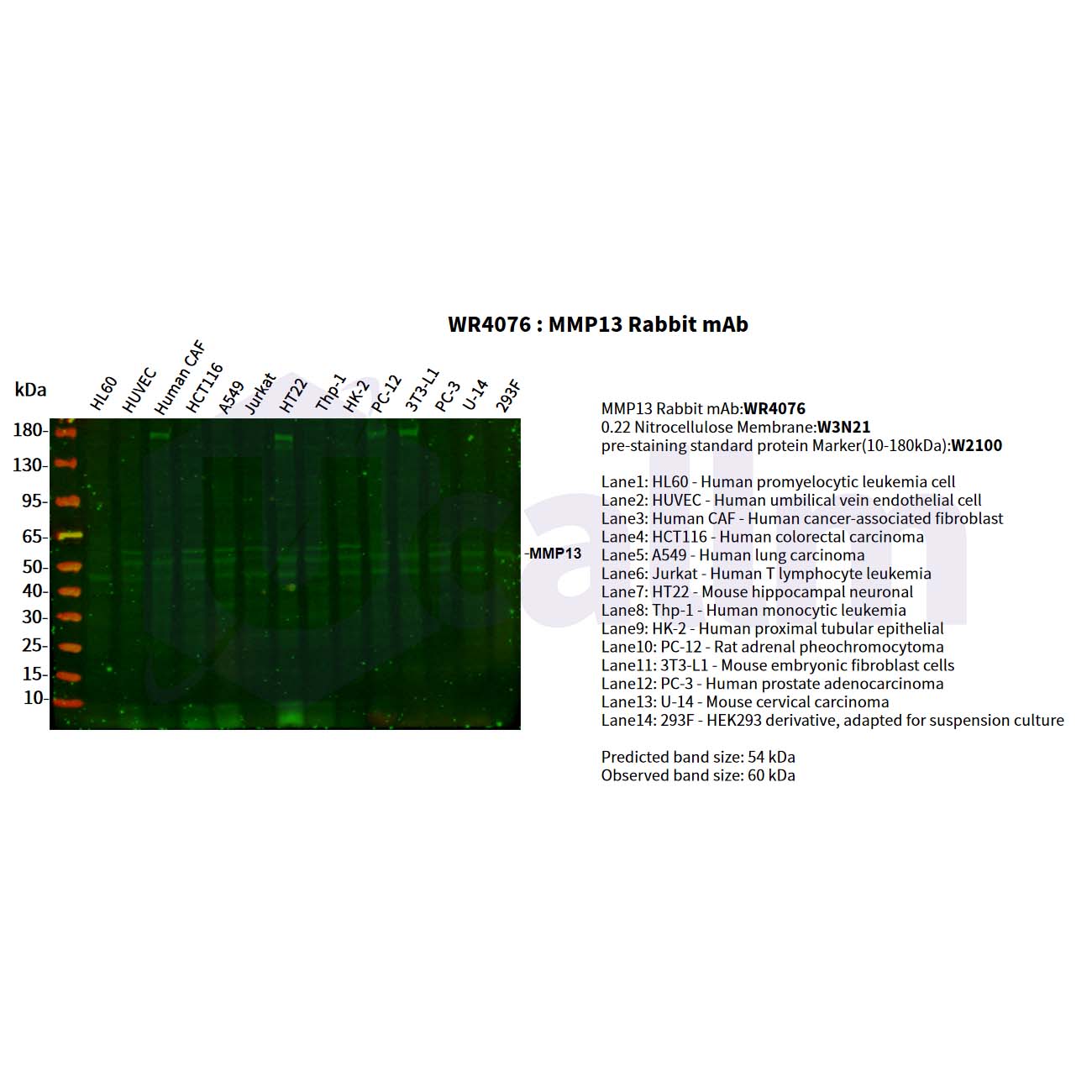
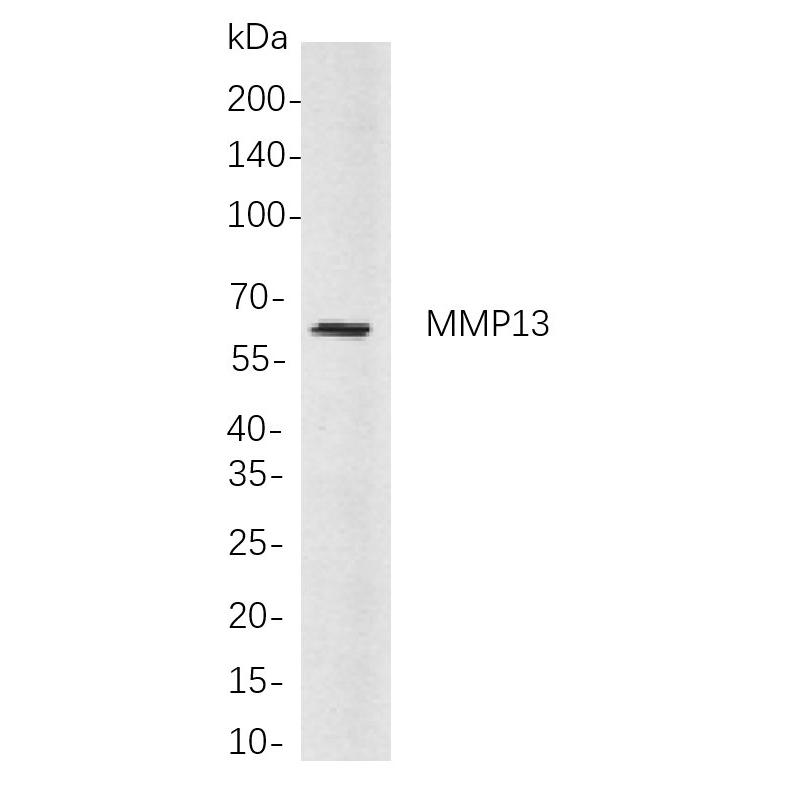
MW(Calculated)54kD
MW(Observed)60kD
Host SpeciesRabbit
IsotypeIgG,Kappa
Conjugate/ModificationUnmodified
Recommended Dilution RatioIHC 1:100-500; WB 1:500-2000; IF 1:200-1000; ELISA 1:5000-20000; / Note: For IHC, we suggest antigen retrieval with TE buffer pH 9.0 (Cat#WT1004)
FormulationPBS, 50% glycerol, 0.05% Proclin 300, 0.05%BSA
PurificationRecombinant Antibody expressed in animal component-free (ACF) media, purified via Protein A affinity chromatography.
Storage-15°C to -25°C/1 year(Do not lower than -25°C)
Concentration
ClonalityMonoclonal
Clone NumberRM0161R
ImmunogenThe specific immunogen used to produce this antibody is proprietary information.
SpecificityEndogenous
Gene NameMMP13
Protein NameCollagenase 3
Other NameMMP13; / Collagenase 3; / Matrix metalloproteinase-13; / MMP-13
SpeciesHuman
Gene ID4322
UniprotP45452,
Species.1Mouse
Gene ID.117386
Uniprot.1P33435
Species.2
Gene ID.2
Uniprot.2
Cellular LocalizationSecreted
Tissue ExpressionDetected in fetal cartilage and calvaria, in chondrocytes of hypertrophic cartilage in vertebrae and in the dorsal end of ribs undergoing ossification, as well as in osteoblasts and periosteal cells below the inner periosteal region of ossified ribs. Detected in chondrocytes from in joint cartilage that have been treated with TNF and IL1B, but not in untreated chondrocytes. Detected in T lymphocytes. Detected in breast carcinoma tissue.
Signaling_pathwayOrganismal Systems >> Immune system >> IL-17 signaling pathway;Organismal Systems >> Endocrine system >> Relaxin signaling pathway
Research Areas>>IL-17 signaling pathway; / >>Relaxin signaling pathway; / >>Parathyroid hormone synthesis, secretion and action
Functioncofactor:Binds 2 zinc ions per subunit.,cofactor:Binds 4 calcium ions per subunit.,Disease:Defects in MMP13 are the cause of spondyloepimetaphyseal dysplasia type 2 (SEMD2) [MIM:602111]; also known as spondyloepimetaphyseal dysplasia type Missouri. SEMDs are a heterogeneous group of skeletal disorders characterized by defective growth and modeling of the spine and long bones. The SEMDs are distinguished from the spondylometaphyseal dysplasias and the spondyloepiphyseal dysplasias by the combined involvement of the epiphyses and metaphyses. The 3 disorders have malformations of the vertebrae in common.,Domain:The conserved cysteine present in the cysteine-switch motif binds the catalytic zinc ion, thus inhibiting the enzyme. The dissociation of the cysteine from the zinc ion upon the activation-peptide release activates the enzyme.,Function:Degrades collagen type I. Does not act on gelatin or casein. Could have a role in tumoral process.,similarity:Belongs to the peptidase M10A family.,similarity:Contains 4 hemopexin-like domains.,tissue specificity:Seems to be specific to breast carcinomas.,
Please login to post questions

Back to Top
Product has been added to your cart