


MOCS3 rabbit pAb
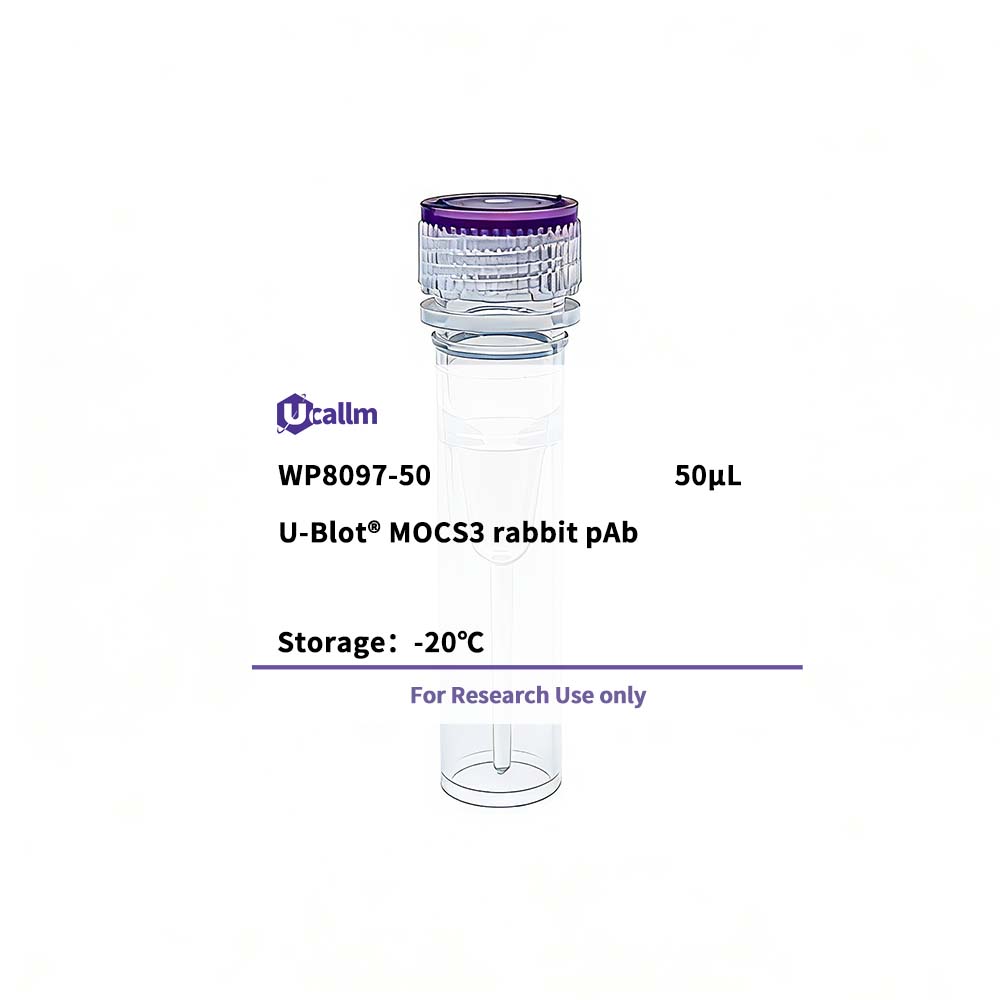
Ucallm_WP8097-50
Price range: $268.00 through $328.00
Product details
Background:
Specifications
| Size | 50μL/100μL |
| Target | MOCS3 |
| Reactivity | Human, Mouse |
| Applications | WB |
| MW(Calculated) | 51kD |
| MW(Observed) | |
| Host Species | Rabbit |
| Isotype | IgG |
| Conjugate/Modification | Unmodified |
| Recommended Dilution Ratio | WB 1:500-2000 |
| Formulation | Liquid in PBS containing 50% glycerol, 0.5% BSA and 0.02% sodium azide. |
| Purification | The antibody was affinity-purified from rabbit antiserum by affinity-chromatography using epitope-specific immunogen. |
| Storage | -15°C to -25°C/1 year(Do not lower than -25°C) |
| Concentration | 1 mg/ml |
| Clonality | Polyclonal |
| Clone Number | |
| Immunogen | Synthesized peptide derived from human MOCS3 |
| Specificity | This antibody detects endogenous levels of MOCS3 at Human, Mouse |
| Gene Name | MOCS3 UBA4 |
| Protein Name | Adenylyltransferase and sulfurtransferase MOCS3 (Molybdenum cofactor synthesis protein 3) (Molybdopterin synthase sulfurylase) (MPT synthase sulfurylase) [Includes: Molybdopterin-synthase adenylyltransferase (Adenylyltransferase MOCS3) (Sulfur carrier protein MOCS2A adenylyltransferase); Molybdopterin-synthase sulfurtransferase (Sulfur carrier protein MOCS2A sulfurtransferase) (Sulfurtransferase MOCS3)] |
| Other Name | |
| Species | Human |
| Gene ID | 27304 |
| Uniprot | O95396, |
| Species.1 | Mouse |
| Gene ID.1 | 69372 |
| Uniprot.1 | A2BDX3 |
| Species.2 | |
| Gene ID.2 | |
| Uniprot.2 | |
| Cellular Localization | Cytoplasm . |
| Tissue Expression | |
| Signaling_pathway | Genetic Information Processing >> Folding, sorting and degradation >> Sulfur relay system |
| Research Areas | |
| Function | Plays a central role in 2-thiolation of mcm(5)S(2)U at tRNA wobble positions of cytosolic tRNA(Lys), tRNA(Glu) and tRNA(Gln). Also essential during biosynthesis of the molybdenum cofactor. Acts by mediating the C-terminal thiocarboxylation of sulfur carriers URM1 and MOCS2A. Its N-terminus first activates URM1 and MOCS2A as acyl-adenylates (-COAMP), then the persulfide sulfur on the catalytic cysteine is transferred to URM1 and MOCS2A to form thiocarboxylation (-COSH) of their C-terminus. The reaction probably involves hydrogen sulfide that is generated from the persulfide intermediate and that acts as nucleophile towards URM1 and MOCS2A. Subsequently, a transient disulfide bond is formed. Does not use thiosulfate as sulfur donor; NFS1 probably acting as a sulfur donor for thiocarboxylation reactions. |
Please login to post questions
Related products




