

MOT2 Polyclonal Antibody
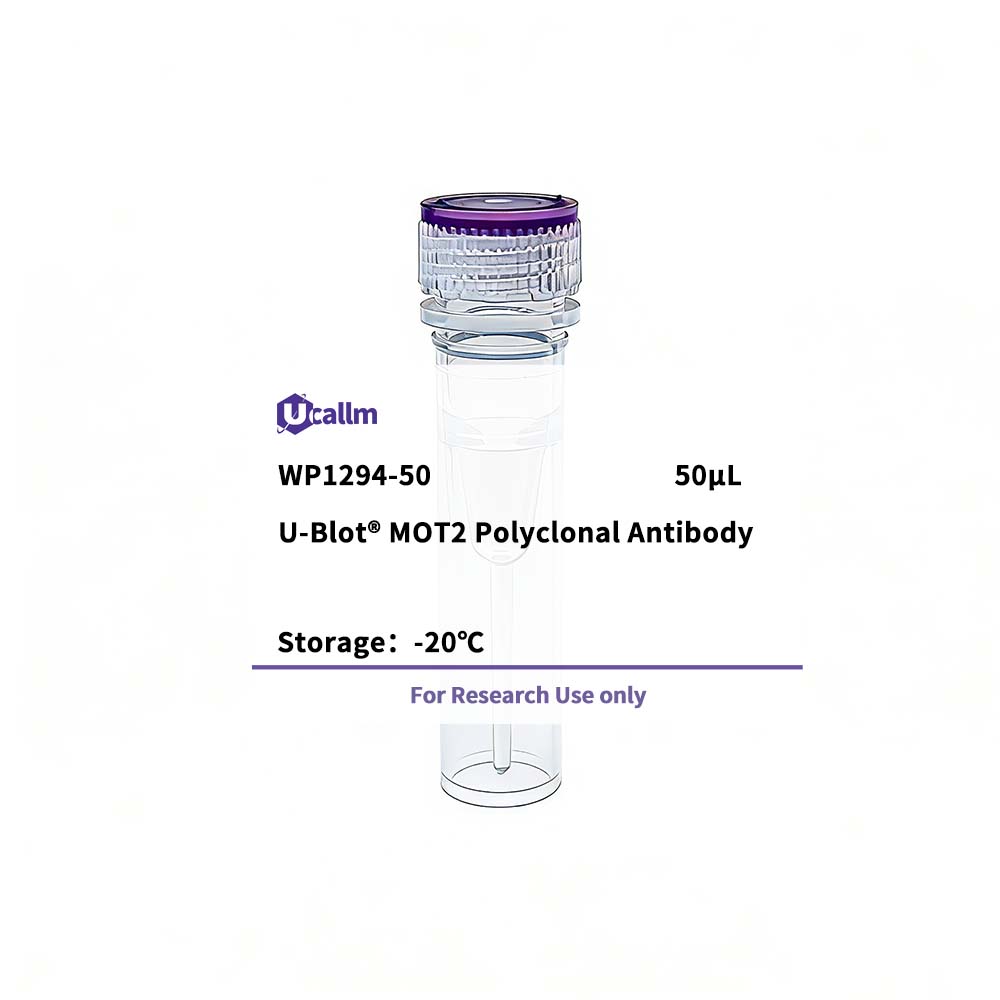
Ucallm_WP1294-50
Price range: $268.00 through $328.00
Product details
Background:
This gene is a member of the monocarboxylate transporter family. Members in this family transport metabolites, such as lactate, pyruvate, and ketone bodies. The protein encoded by this gene catalyzes the proton-linked transport of monocarboxylates and has the highest affinity for pyruvate. This protein has been reported to be more highly expressed in prostate and colorectal cancer specimens when compared to control specimens. Alternative splicing results in multiple transcript variants. [provided by RefSeq, Jul 2012],
Specifications
| Size | 50μL/100μL |
| Target | MOT2 |
| Reactivity | Human, Mouse, Rat |
| Applications | WB, ELISA |
| MW(Calculated) | |
| MW(Observed) | 52kD |
| Host Species | Rabbit |
| Isotype | IgG |
| Conjugate/Modification | Unmodified |
| Recommended Dilution Ratio | WB 1:500-2000; ELISA 1:5000-20000 |
| Formulation | Liquid in PBS containing 50% glycerol,0.5% BSA and 0.02% sodium azide. |
| Purification | The antibody was affinity-purified from rabbit antiserum by affinity-chromatography using epitope-specific immunogen. |
| Storage | -15°C to -25°C/1 year(Do not lower than -25°C) |
| Concentration | 1 mg/ml |
| Clonality | Polyclonal |
| Clone Number | |
| Immunogen | Synthesized peptide derived from human protein . at AA range: 220-300 |
| Specificity | MOT2 Polyclonal Antibody detects endogenous levels of protein. |
| Gene Name | SLC16A7 MCT2 |
| Protein Name | Monocarboxylate transporter 2 (MCT 2) (Solute carrier family 16 member 7) |
| Other Name | |
| Species | Human |
| Gene ID | 9194 |
| Uniprot | O60669, |
| Species.1 | Mouse |
| Gene ID.1 | |
| Uniprot.1 | O70451, |
| Species.2 | Rat |
| Gene ID.2 | |
| Uniprot.2 | Q63344 |
| Cellular Localization | Cell membrane; Multi-pass membrane protein . |
| Tissue Expression | Detected in heart and in blood lymphocytes and monocytes (at protein level). High expression in testis, moderate to low in spleen, heart, kidney, pancreas, skeletal muscle, brain and Leukocyte. Restricted expression in normal tissues, but widely expressed in cancer cells. |
| Signaling_pathway | |
| Research Areas | |
| Function |
Please login to post questions
Related products


