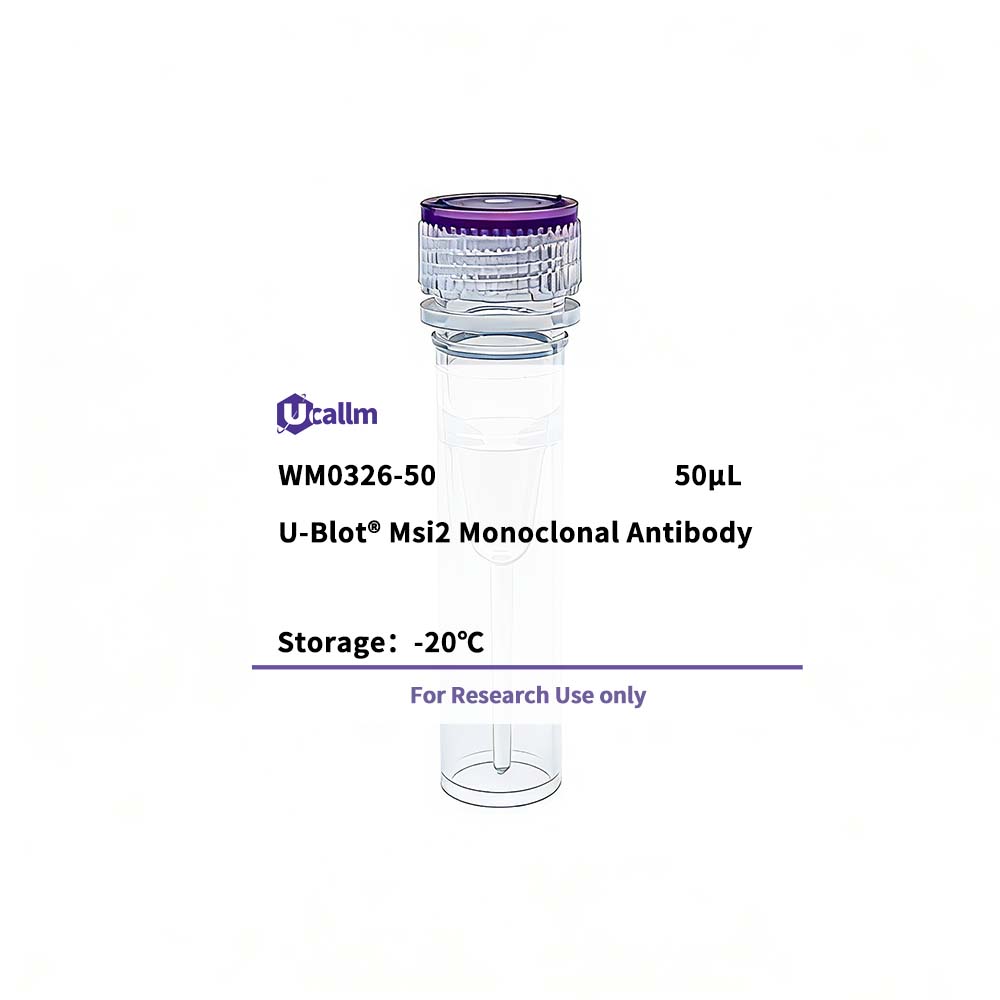
SKU: WM0326 Categories: ,

Msi2 Monoclonal Antibody

Price range: $268.00 through $328.00

SKU: WM0326-50
Enter the quantity you would like, or drag the panel to find the quantity and price that best for you
Bulk QuoteAuthorize OEM & ODM

Product details

Background:
This gene encodes an RNA-binding protein that is a member of the Musashi protein family. The encoded protein is transcriptional regulator that targets genes involved in development and cell cycle regulation. Mutations in this gene are associated with poor prognosis in certain types of cancers. This gene has also been shown to be rearranged in certain cancer cells. [provided by RefSeq, Apr 2016],

Specifications

Size50μL/100μL
TargetMsi2
ReactivityHuman
ApplicationsWB, IHC, IF, ELISA
MW(Calculated)35kD
MW(Observed)
Host SpeciesMouse
Isotype
Conjugate/ModificationUnmodified
Recommended Dilution RatioWB 1:500-1:2000; IHC 1:200-1:1000; ELISA 1:10000; IF 1:50-200 / Note: For IHC, we suggest antigen retrieval with TE buffer pH 9.0 (Cat#WT1004)
FormulationLiquid in PBS containing 50% glycerol, 0.5% BSA and 0.02% sodium azide.
PurificationAffinity purification
Storage-15°C to -25°C/1 year(Do not lower than -25°C)
Concentration
ClonalityMonoclonal
Clone Number9G6
ImmunogenPurified recombinant fragment of human Msi2 expressed in E. Coli.
SpecificityMsi2 Monoclonal Antibody detects endogenous levels of Msi2 protein.
Gene NameMSI2
Protein NameRNA-binding protein Musashi homolog 2
Other NameMSI2; / RNA-binding protein Musashi homolog 2; / Musashi-2
SpeciesHuman
Gene ID124540
UniprotQ96DH6,
Species.1Mouse
Gene ID.1
Uniprot.1Q920Q6
Species.2
Gene ID.2
Uniprot.2
Cellular LocalizationCytoplasm. Associated with polysomes. .
Tissue ExpressionUbiquitous; detected at low levels.
Signaling_pathway
Research Areas>>mRNA surveillance pathway
FunctionDisease:Chromosomal aberrations involving MSI2 may contribute to disease progression in chronic myeloid leukemia. Translocation t(7; 17)(p15; q23) with HOXA9; translocation t(7; 17)(q32-34; q23).,Function:RNA binding protein that regulates the expression of target mRNAs at the translation level. May play a role in the proliferation and maintenance of stem cells in the central nervous system.,induction:Up-regulated in astrocytes after brain injury.,PTM:Phosphorylated.,similarity:Belongs to the Musashi family.,similarity:Contains 2 RRM (RNA recognition motif) domains.,subcellular location:Associated with polysomes.,tissue specificity:Ubiquitous; detected at low levels.,
Please login to post questions
Back to Top
Product has been added to your cart
