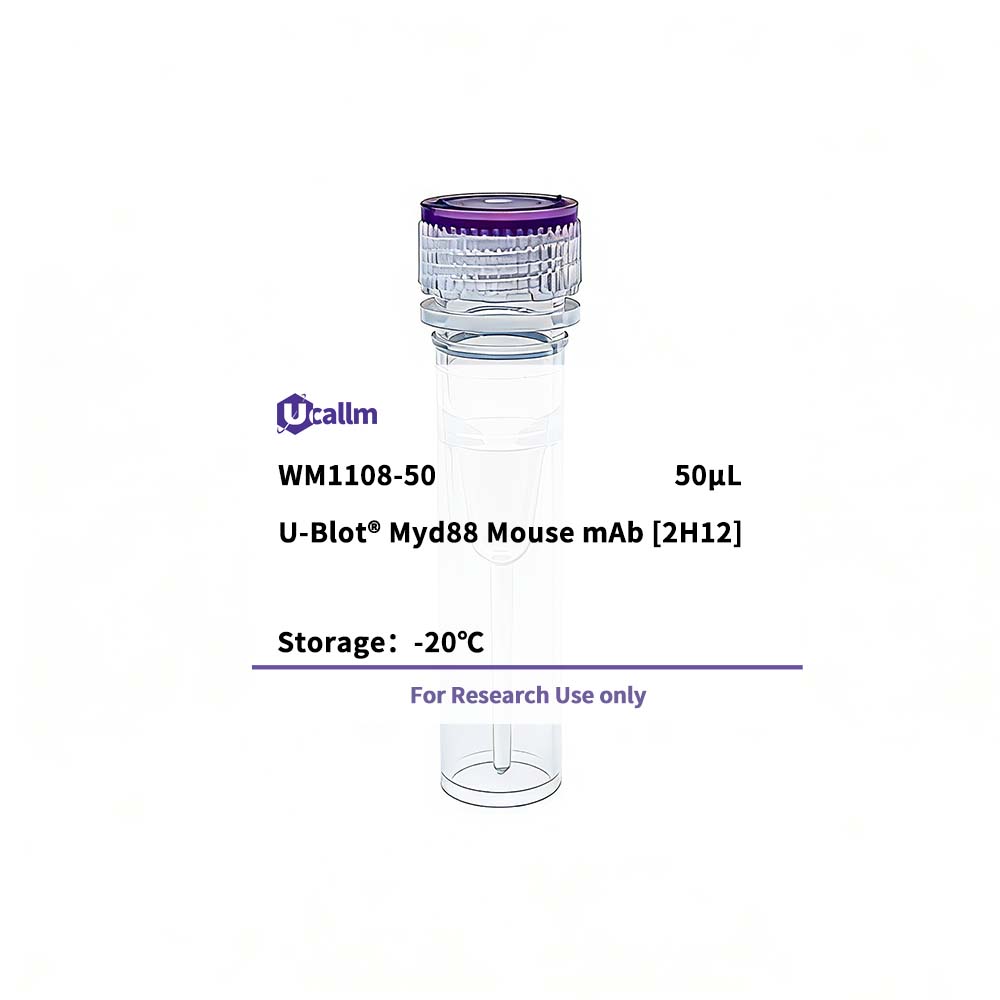
SKU: WM1108 Categories: ,

Myd88 Mouse mAb [2H12]

Price range: $268.00 through $328.00

SKU: WM1108-50
Enter the quantity you would like, or drag the panel to find the quantity and price that best for you
Bulk QuoteAuthorize OEM & ODM

Product details

Background:
This gene encodes a cytosolic adapter protein that plays a central role in the innate and adaptive immune response. This protein functions as an essential signal transducer in the interleukin-1 and Toll-like receptor signaling pathways. These pathways regulate that activation of numerous proinflammatory genes. The encoded protein consists of an N-terminal death domain and a C-terminal Toll-interleukin1 receptor domain. Patients with defects in this gene have an increased susceptibility to pyogenic bacterial infections. Alternate splicing results in multiple transcript variants. [provided by RefSeq, Feb 2010],


Specifications

Size50μL/100μL
TargetMyd88
ReactivityHuman, Mouse, Rat
ApplicationsIHC
MW(Calculated)
MW(Observed)33kD
Host SpeciesMouse
Isotype
Conjugate/ModificationUnmodified
Recommended Dilution RatioIHC 1:50-200 / Note: For IHC, we suggest antigen retrieval with TE buffer pH 9.0 (Cat#WT1004)
FormulationLiquid in PBS containing 50% glycerol, 0.5% BSA and 0.02% sodium azide.
PurificationThe antibody was affinity-purified from mouse ascites by affinity-chromatography using specific immunogen.
Storage-15°C to -25°C/1 year(Do not lower than -25°C)
Concentration1 mg/ml
ClonalityMonoclonal
Clone Number2H12
ImmunogenSynthesized peptide derived from human Myd88
SpecificityThis antibody detects endogenous levels of Myd88 at Human, Mouse,Rat
Gene NameMYD88
Protein NameMyd88
Other NameMyeloid differentiation primary response protein MyD88
SpeciesHuman
Gene ID4615
UniprotQ99836,
Species.1Mouse
Gene ID.117874
Uniprot.1P22366,
Species.2Rat
Gene ID.2301059
Uniprot.2Q6Y1S1
Cellular LocalizationCytoplasm . Nucleus .
Tissue ExpressionUbiquitous.
Signaling_pathwayOrganismal Systems >> Immune system >> Toll-like receptor signaling pathway;Organismal Systems >> Immune system >> NOD-like receptor signaling pathway;Human Diseases >> Cancer: overview >> PD-L1 expression and PD-1 checkpoint pathway in cancer;Environmental Information Processing >> Signal transduction >> MAPK signaling pathway;Environmental Information Processing >> Signal transduction >> NF-kappa B signaling pathway
Research Areas>>MAPK signaling pathway; / >>NF-kappa B signaling pathway; / >>Toll-like receptor signaling pathway; / >>NOD-like receptor signaling pathway; / >>Alcoholic liver disease; / >>Pathogenic Escherichia coli infection; / >>Shigellosis; / >>Salmonella infection; / >>Pertussis; / >>Legionellosis; / >>Yersinia infection; / >>Leishmaniasis; / >>Chagas disease; / >>African trypanosomiasis; / >>Malaria; / >>Toxoplasmosis; / >>Tuberculosis; / >>Hepatitis B; / >>Measles; / >>Influenza A; / >>Herpes simplex virus 1 infection; / >>Epstein-Barr virus infection; / >>Human immunodeficiency virus 1 infection; / >>Coronavirus disease - COVID-19; / >>PD-L1 expression and PD-1 checkpoint pathway in cancer; / >>Lipid and atherosclerosis
FunctionDisease:Defects in MYD88 are the cause of MYD88 deficiency (MYD88D) [MIM:612260]; also called recurrent pyogenic bacterial infections due to MYD88 deficiency. Patients suffer from autosomal recessive, life-threatening, often recurrent pyogenic bacterial infections, including invasive pneumococcal disease, and die between 1 and 11 months of age. Surviving patients are otherwise healthy, with normal resistance to other microbes, and their clinical status improved with age.,Function:Adapter protein involved in the Toll-like receptor and IL-1 receptor signaling pathway in the innate immune response. Acts via IRAK1, IRAK2 and TRAF6, leading to NF-kappa-B activation, cytokine secretion and the inflammatory response. Increases IL-8 transcription. May be involved in myeloid differentiation.,similarity:Contains 1 death domain.,similarity:Contains 1 TIR domain.,subunit:Homodimer. Also forms heterodimers with TIRAP. Binds to TLR2, TLR4, IRAK1 and IRAK2 via their respective TIR domains. Interacts with IL1RL1.,tissue specificity:Ubiquitous.,
Please login to post questions
Back to Top
Product has been added to your cart
