

U-Blot® mTOR Rabbit mAb
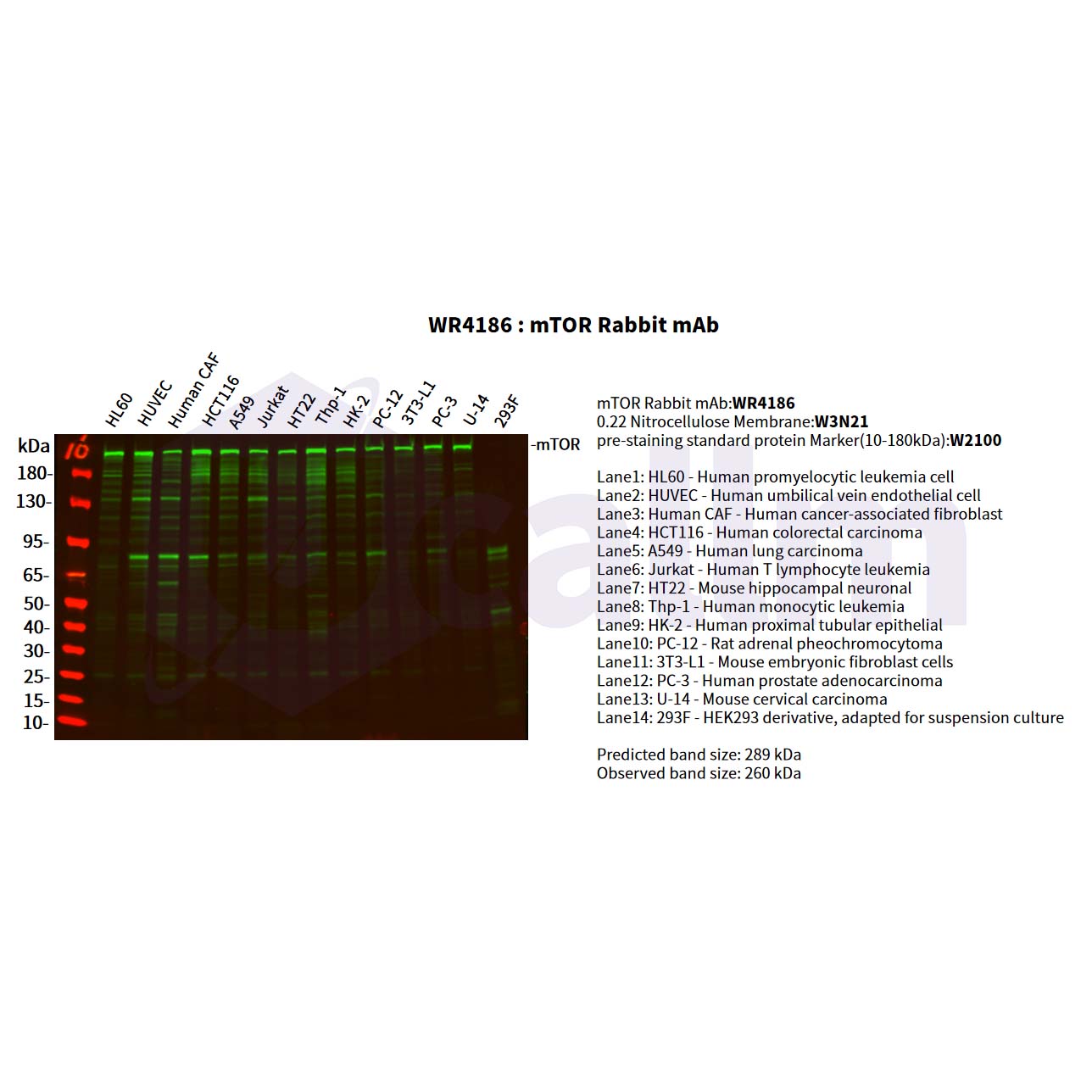
WR4186 Various whole cell lysates were separated by 4-20% SDS-PAGE, and the primary antibody was used at 4°C, over night with a 1:5000 dilution . The Dylight 800-conjugated Goat anti-Rabbit antibody(Cat:WS0446) was used to detect the antibody.

WR4186 Hela whole cell lysates were separated by 10% SDS-PAGE, and the membrane was blotted with primary antibody(1:1000). The HRP-conjugated Goat anti-Rabbit IgG(H + L) antibody was used to detect the antibody.
Price range: $268.00 through $328.00
Product details
Background:The protein encoded by this gene belongs to a family of phosphatidylinositol kinase-related kinases. These kinases mediate cellular responses to stresses such as DNA damage and nutrient deprivation. This protein acts as the target for the cell-cycle arrest and immunosuppressive effects of the FKBP12-rapamycin complex. The ANGPTL7 gene is located in an intron of this gene. [provided by RefSeq, Sep 2008],
Specifications
| Size | 50μL/100μL |
| Target | mTOR |
| Reactivity | Human, Mouse, Rat, Chicken, Bovine, Pig |
| Applications | WB, IHC, IF, IP, ELISA |
| MW(Calculated) | 289kD |
| MW(Observed) | 260kD |
| Host Species | Rabbit |
| Isotype | IgG,Kappa |
| Conjugate/Modification | Unmodified |
| Recommended Dilution Ratio | IHC 1:200-1:1000; WB 1:2000-1:10000; IF 1:200-1:1000; ELISA 1:5000-1:20000; IP 1:50-1:200; / Note: For IHC, we suggest antigen retrieval with TE buffer pH 9.0 (Cat#WT1004) |
| Formulation | PBS, 50% glycerol, 0.05% Proclin 300, 0.05%BSA |
| Purification | Recombinant Antibody expressed in animal component-free (ACF) media, purified via Protein A affinity chromatography. |
| Storage | -15°C to -25°C/1 year(Do not lower than -25°C) |
| Concentration | |
| Clonality | Monoclonal |
| Clone Number | RM0351R |
| Immunogen | The specific immunogen used to produce this antibody is proprietary information. |
| Specificity | Endogenous |
| Gene Name | MTOR |
| Protein Name | Serine/threonine-protein kinase mTOR |
| Other Name | MTOR; / FRAP; / FRAP1; / FRAP2; / RAFT1; / RAPT1; / Serine/threonine-protein kinase mTOR; / FK506-binding protein 12-rapamycin complex-associated protein 1; / FKBP12-rapamycin complex-associated protein; / Mammalian target of rapamycin; / mTOR; / Mechanistic tar |
| Species | Human |
| Gene ID | 2475 |
| Uniprot | P42345, |
| Species.1 | Mouse |
| Gene ID.1 | 56717 |
| Uniprot.1 | Q9JLN9, |
| Species.2 | Rat |
| Gene ID.2 | 56718 |
| Uniprot.2 | P42346 |
| Cellular Localization | Cytoplasm |
| Tissue Expression | Expressed in numerous tissues, with highest levels in testis. |
| Signaling_pathway | Cellular Processes >> Transport and catabolism >> Autophagy - animal;Cellular Processes >> Cell growth and death >> Cellular senescence;Organismal Systems >> Immune system >> Neutrophil extracellular trap formation;Organismal Systems >> Immune system >> Th17 cell differentiation;Organismal Systems >> Endocrine system >> Insulin signaling pathway;Organismal Systems >> Endocrine system >> Adipocytokine signaling pathway;Organismal Systems >> Endocrine system >> Growth hormone synthesis, secretion and action;Organismal Systems >> Endocrine system >> Thyroid hormone signaling pathway;Organismal Systems >> Aging >> Longevity regulating pathway;Organismal Systems >> Aging >> Longevity regulating pathway - multiple species;Human Diseases >> Cancer: overview >> Pathways in cancer;Human Diseases >> Cancer: overview >> MicroRNAs in cancer;Human Diseases >> Cancer: overview >> Central carbon metabolism in cancer;Human Diseases >> Cancer: overview >> PD-L1 expression and PD-1 checkpoint pathway in cancer;Human Diseases >> Cancer: specific types >> Colorectal cancer;Human Diseases >> Cancer: specific types >> Pancreatic cancer;Human Diseases >> Cancer: specific types >> Hepatocellular carcinoma;Human Diseases >> Cancer: specific types >> Gastric cancer;Human Diseases >> Cancer: specific types >> Glioma;Human Diseases >> Cancer: specific types >> Acute myeloid leukemia;Human Diseases >> Cancer: specific types >> Prostate cancer;Human Diseases >> Cancer: specific types >> Breast cancer;Human Diseases >> Neurodegenerative disease >> Alzheimer disease;Human Diseases >> Neurodegenerative disease >> Amyotrophic lateral sclerosis;Human Diseases >> Neurodegenerative disease >> Huntington disease;Human Diseases >> Neurodegenerative disease >> Spinocerebellar ataxia;Human Diseases >> Neurodegenerative disease >> Pathways of neurodegeneration - multiple diseases;Environmental Information Processing >> Signal transduction >> ErbB signaling pathway;Environmental Information Processing >> Signal transduction >> Apelin signaling pathway;Environmental Information Processing >> Signal transduction >> JAK-STAT signaling pathway;Environmental Information Processing >> Signal transduction >> HIF-1 signaling pathway;Environmental Information Processing >> Signal transduction >> Phospholipase D signaling pathway;Environmental Information Processing >> Signal transduction >> PI3K-Akt signaling pathway;Environmental Information Processing >> Signal transduction >> AMPK signaling pathway;Environmental Information Processing >> Signal transduction >> mTOR signaling pathway |
| Research Areas | >>EGFR tyrosine kinase inhibitor resistance; / >>Endocrine resistance; / >>ErbB signaling pathway; / >>HIF-1 signaling pathway; / >>Phospholipase D signaling pathway; / >>Autophagy - other; / >>Autophagy - animal; / >>mTOR signaling pathway; / >>PI3K-Akt signaling pathway; / >>AMPK signaling pathway; / >>Longevity regulating pathway; / >>Longevity regulating pathway - multiple species; / >>Cellular senescence; / >>Apelin signaling pathway; / >>Neutrophil extracellular trap formation; / >>JAK-STAT signaling pathway; / >>Th17 cell differentiation; / >>Thermogenesis; / >>Insulin signaling pathway; / >>Thyroid hormone signaling pathway; / >>Adipocytokine signaling pathway; / >>Type II diabetes mellitus; / >>Insulin resistance; / >>Growth hormone synthesis, secretion and action; / >>Alzheimer disease; / >>Amyotrophic lateral sclerosis; / >>Huntington disease; / >>Spinocerebellar ataxia; / >>Pathways of neurodegeneration - multiple diseases; / >>Shigellosis; / >>Human cytomegalovirus infection; / >>Human papillomavirus infection; / >>Kaposi sarcoma-associated herpesvirus infection; / >>Herpes simplex virus 1 infection; / >>Human immunodeficiency virus 1 infection; / >>Pathways in cancer; / >>Proteoglycans in cancer; / >>MicroRNAs in cancer; / >>Chemical carcinogenesis - receptor activation; / >>Colorectal cancer; / >>Pancreatic cancer; / >>Glioma; / >>Prostate cancer; / >>Acute myeloid leukemia; / >>Breast cancer; / >>Hepatocellular carcinoma; / >>Gastric cancer; / >>Central carbon metabolism in cancer; / >>Choline metabolism in cancer; / >>PD-L1 expression and PD-1 checkpoint pathway in cancer; / >>Diabetic cardiomyopathy |
| Function | Function:Acts as the target for the cell-cycle arrest and immunosuppressive effects of the FKBP12-rapamycin complex. Part of the TORC2 complex which plays a critical role in AKT1 Ser-473 phosphorylation, and may modulate the phosphorylation of PKCA and regulate actin cytoskeleton organization.,similarity:Belongs to the PI3/PI4-kinase family.,similarity:Contains 1 FAT domain.,similarity:Contains 1 FATC domain.,similarity:Contains 1 PI3K/PI4K domain.,similarity:Contains 7 HEAT repeats.,subunit:Interacts with the FKBP12-rapamycin complex. Binds UBQLN1. Forms part of the mammalian target of rapamycin 2 complex (TORC2) comprised of FRAP1, GBL, PRR5, RICTOR and SIN. TORC2 does not bind to and is not sensitive to FKBP12-rapamycin. Binds directly to PRR5 and RICTOR within the TORC2 complex.,tissue specificity:Expressed in numerous tissues, with highest levels in testis., |
Please login to post questions
Related products





