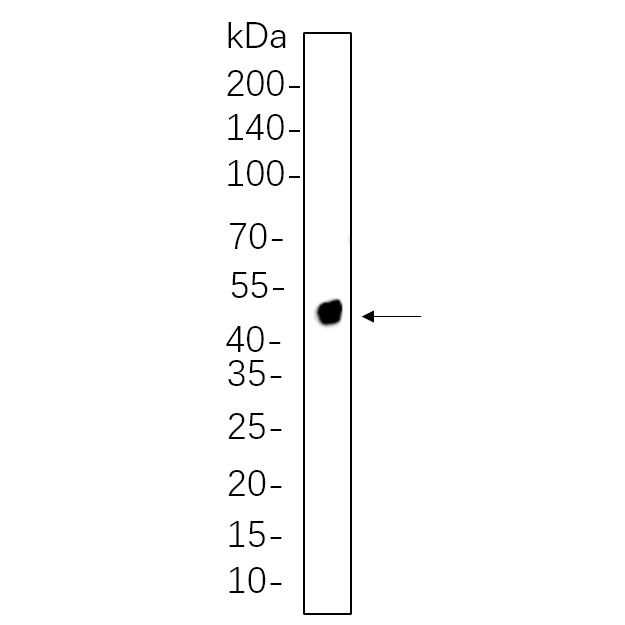
SKU: WR4356 Categories: ,

U-Blot® NDRG1 Rabbit mAb

Price range: $268.00 through $328.00

SKU: WR4356-50
Enter the quantity you would like, or drag the panel to find the quantity and price that best for you
Bulk QuoteAuthorize OEM & ODM

Product details

Background:This gene is a member of the N-myc downregulated gene family which belongs to the alpha/beta hydrolase superfamily. The protein encoded by this gene is a cytoplasmic protein involved in stress responses, hormone responses, cell growth, and differentiation. The encoded protein is necessary for p53-mediated caspase activation and apoptosis. Mutations in this gene are a cause of Charcot-Marie-Tooth disease type 4D, and expression of this gene may be a prognostic indicator for several types of cancer. Alternatively spliced transcript variants encoding multiple isoforms have been observed for this gene. [provided by RefSeq, May 2012],

Specifications

Size50μL/100μL
TargetNDRG1
ReactivityHuman, Mouse, Rat
ApplicationsWB, IHC, IF, IP, ELISA
MW(Calculated)43kD
MW(Observed)48kD
Host SpeciesRabbit
IsotypeIgG,Kappa
Conjugate/ModificationUnmodified
Recommended Dilution RatioIHC 1:2000-1:10000; WB 1:2000-1:10000; IF 1:200-1:1000; ELISA 1:5000-1:20000; IP 1:50-1:200; / Note: For IHC, we suggest antigen retrieval with TE buffer pH 9.0 (Cat#WT1004)
FormulationPBS, 50% glycerol, 0.05% Proclin 300, 0.05%BSA
PurificationRecombinant Antibody expressed in animal component-free (ACF) media, purified via Protein A affinity chromatography.
Storage-15°C to -25°C/1 year(Do not lower than -25°C)
Concentration
ClonalityMonoclonal
Clone NumberRM0568R
ImmunogenThe specific immunogen used to produce this antibody is proprietary information.
SpecificityEndogenous
Gene NameNDRG1 CAP43 DRG1 RTP
Protein NameProtein NDRG1 (Differentiation-related gene 1 protein) (DRG-1) (N-myc downstream-regulated gene 1 protein) (Nickel-specific induction protein Cap43) (Reducing agents and tunicamycin-responsive protein) (RTP) (Rit42)
Other Name
SpeciesHuman
Gene ID10397
UniprotQ92597,
Species.1Mouse
Gene ID.1
Uniprot.1Q62433,
Species.2Rat
Gene ID.2
Uniprot.2Q6JE36
Cellular LocalizationMembrane, Cytoplasm
Tissue ExpressionUbiquitous; expressed most prominently in placental membranes and prostate, kidney, small intestine, and ovary tissues. Also expressed in heart, brain, skeletal muscle, lung, liver and pancreas. Low levels in peripheral blood leukocytes and in tissues of the immune system. Expressed mainly in epithelial cells. Also found in Schwann cells of peripheral neurons. Reduced expression in adenocarcinomas compared to normal tissues. In colon, prostate and placental membranes, the cells that border the lumen show the highest expression.
Signaling_pathway
Research Areas
FunctionDisease:Defects in NDRG1 are the cause of Charcot-Marie-Tooth disease type 4D (CMT4D) [MIM:601455]; also known as hereditary motor and sensory neuropathy Lom type (HMSNL). CMT4D is a recessive form of Charcot-Marie-Tooth disease, the most common inherited disorder of the peripheral nervous system. Charcot-Marie-Tooth disease is classified in two main groups on the basis of electrophysiologic properties and histopathology: primary peripheral demyelinating neuropathy and primary peripheral axonal neuropathy. Demyelinating CMT neuropathies are characterized by severely reduced nerve conduction velocities (less than 38 m/sec), segmental demyelination and remyelination with onion bulb formations on nerve biopsy, slowly progressive distal muscle atrophy and weakness, absent deep tendon reflexes, and hollow feet. By convention, autosomal recessive forms of demyelinating Charcot-Marie-Tooth disease are designated CMT4.,Function:May have a growth inhibitory role.,induction:By homocysteine, 2-mercaptoethanol, tunicamycin in endothelial cells. Induced approximately 20-fold during in vitro differentiation of the colon carcinoma cell lines HT29-D4 and Caco-2. Induced by nickel compounds in all tested cell lines. The primary signal for its induction is an elevation of free intracellular calcium ion caused by nickel ion exposure. Okadaic acid, a serine/threonine phosphatase inhibitor, induced its expression more rapidly and more efficiently than nickel.,similarity:Belongs to the NDRG family.,subcellular location:Whereas in prostate epithelium and placental chorion it is located in both the cytoplasm and the nucleus, nuclear staining is not observed in colon epithelium cells. Instead its localization changes from the cytoplasm to the plasma membrane during differentiation of colon carcinoma cell lines in vitro.,tissue specificity:Ubiquitous; expressed most prominently in placental membranes and prostate, kidney, small intestine, and ovary tissues. Reduced expression in adenocarcinomas compared to normal tissues. In colon, prostate and placental membranes, the cells that border the lumen show the highest expression.,
Please login to post questions

Back to Top
Product has been added to your cart

