


U-Blot® NGFR p75 Rabbit mAb
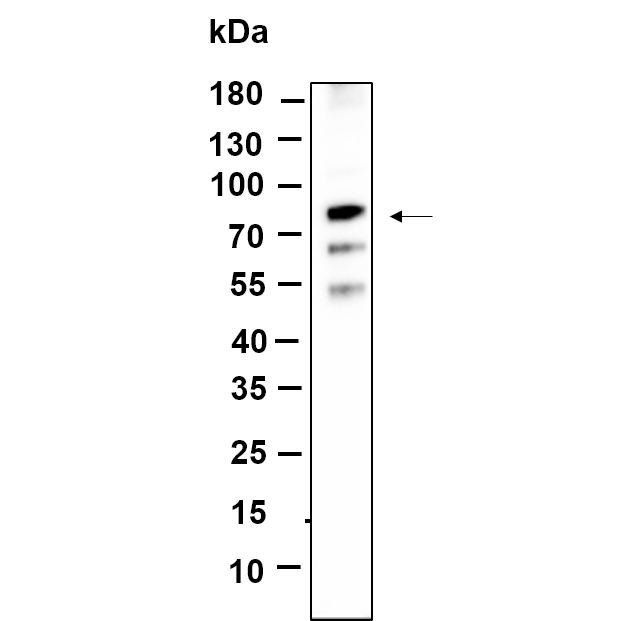
WR4676 Western Blot analysis using SW480 lysates,primary antibody was diluted at 1:1000, 4°over night, Dylight 800 secondary antibody(WS0446)was diluted at 1:10000, 37° 1hour.
Price range: $268.00 through $328.00
Product details
Background:Nerve growth factor receptor contains an extracellular domain containing four 40-amino acid repeats with 6 cysteine residues at conserved positions followed by a serine/threonine-rich region, a single transmembrane domain, and a 155-amino acid cytoplasmic domain. The cysteine-rich region contains the nerve growth factor binding domain. [provided by RefSeq, Jul 2008],
Specifications
| Size | 50μL/100μL |
| Target | NGFR p75 |
| Reactivity | Human, Mouse, Rat |
| Applications | WB, IHC, IF, IP, ELISA |
| MW(Calculated) | 45kD |
| MW(Observed) | 75kD |
| Host Species | Rabbit |
| Isotype | IgG,Kappa |
| Conjugate/Modification | Unmodified |
| Recommended Dilution Ratio | IHC 1:200-1:1000; WB 1:2000-1:10000; IF 1:200-1:1000; ELISA 1:5000-1:20000; IP 1:50-1:200; / Note: For IHC, we suggest antigen retrieval with TE buffer pH 9.0 (Cat#WT1004) |
| Formulation | PBS, 50% glycerol, 0.05% Proclin 300, 0.05%BSA |
| Purification | Recombinant Antibody expressed in animal component-free (ACF) media, purified via Protein A affinity chromatography. |
| Storage | -15°C to -25°C/1 year(Do not lower than -25°C) |
| Concentration | |
| Clonality | Monoclonal |
| Clone Number | RM0968R |
| Immunogen | The specific immunogen used to produce this antibody is proprietary information. |
| Specificity | Endogenous |
| Gene Name | NGFR |
| Protein Name | Tumor necrosis factor receptor superfamily member 16 |
| Other Name | NGFR; / TNFRSF16; / Tumor necrosis factor receptor superfamily member 16; / Gp80-LNGFR; / Low affinity neurotrophin receptor p75NTR; / Low-affinity nerve growth factor receptor; / NGF receptor; / p75 ICD; / CD antigen CD271 |
| Species | Human |
| Gene ID | 4804 |
| Uniprot | P08138, |
| Species.1 | Mouse |
| Gene ID.1 | |
| Uniprot.1 | Q9Z0W1, |
| Species.2 | Rat |
| Gene ID.2 | 24596 |
| Uniprot.2 | P07174 |
| Cellular Localization | Cell membrane; Single-pass type I membrane protein . Perikaryon . Cell projection, growth cone . Cell projection, dendritic spine . |
| Tissue Expression | Brain, |
| Signaling_pathway | Cellular Processes >> Cell growth and death >> Apoptosis - multiple species;Organismal Systems >> Nervous system >> Neurotrophin signaling pathway;Human Diseases >> Cancer: overview >> Transcriptional misregulation in cancer;Environmental Information Processing >> Signal transduction >> MAPK signaling pathway;Environmental Information Processing >> Signal transduction >> Ras signaling pathway;Environmental Information Processing >> Signal transduction >> Rap1 signaling pathway;Environmental Information Processing >> Signal transduction >> PI3K-Akt signaling pathway;Environmental Information Processing >> Signaling molecules and interaction >> Cytokine-cytokine receptor interaction |
| Research Areas | >>MAPK signaling pathway; / >>Ras signaling pathway; / >>Rap1 signaling pathway; / >>Cytokine-cytokine receptor interaction; / >>PI3K-Akt signaling pathway; / >>Apoptosis - multiple species; / >>Neurotrophin signaling pathway; / >>Transcriptional misregulation in cancer |
| Function | Domain:Death domain is responsible for interaction with RANBP9.,Domain:The extracellular domain is responsible for interaction with NTRK1.,Function:Low affinity receptor which can bind to NGF, BDNF, NT-3, and NT-4. Can mediate cell survival as well as cell death of neural cells.,PTM:N- and O-glycosylated.,PTM:O-linked glycans consist of Gal(1-3)GalNAc core elongated by 1 or 2 NeuNAc.,PTM:Phosphorylated on serine residues.,similarity:Contains 1 death domain.,similarity:Contains 4 TNFR-Cys repeats.,subunit:Homodimer; disulfide-linked. Interacts with p75NTR-associated cell death executor. Interacts with TRAF2, TRAF4, TRAF6, PTPN13 and RANBP9. Interacts through TRAF6 with SQSTM1 which bridges NGFR to NTRK1. Interacts with BEX1 and NGFRAP1/BEX3. Interacts with KIDINS220 and NTRK1. Can form a ternary complex with NTRK1 and KIDINS220 and this complex is affected by the expression levels of KIDINS220. An increase in KIDINS220 expression leads to a decreased association of NGFR and NTRK1 (By similarity). Interacts with LINGO1., |
Please login to post questions
Related products




