


NOK Monoclonal Antibody
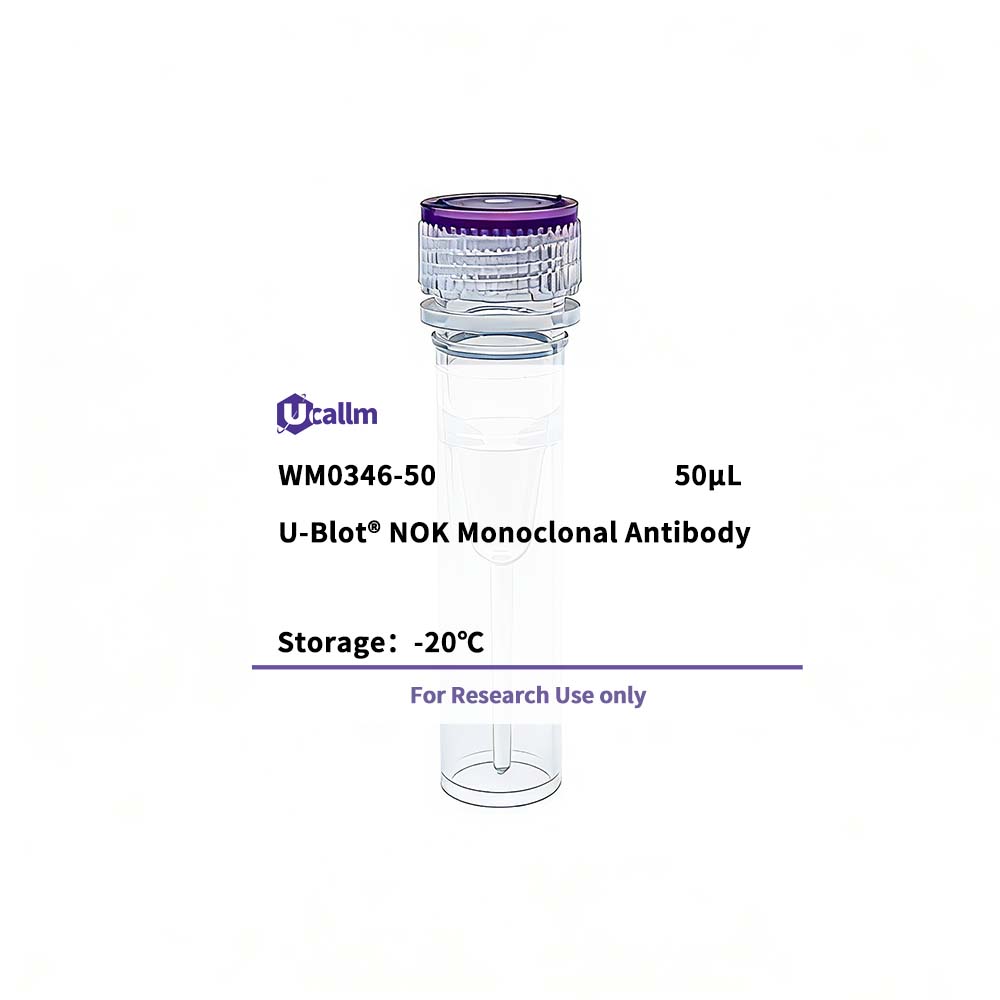
Ucallm_WM0346-50
Price range: $268.00 through $328.00
Product details
Background:
Receptor protein tyrosine kinases, like STYK1, play important roles in diverse cellular and developmental processes, such as cell proliferation, differentiation, and survival (Liu et al., 2004 [PubMed 15150103]).[supplied by OMIM, Mar 2008],
Specifications
| Size | 50μL/100μL |
| Target | STYK1/NOK |
| Reactivity | Human |
| Applications | WB, IHC, IF, ELISA |
| MW(Calculated) | 48kD |
| MW(Observed) | |
| Host Species | Mouse |
| Isotype | |
| Conjugate/Modification | Unmodified |
| Recommended Dilution Ratio | WB 1:500-1:2000; IHC 1:200-1:1000; ELISA 1:10000; IF 1:50-200 / Note: For IHC, we suggest antigen retrieval with TE buffer pH 9.0 (Cat#WT1004) |
| Formulation | Liquid in PBS containing 50% glycerol, 0.5% BSA and 0.02% sodium azide. |
| Purification | Affinity purification |
| Storage | -15°C to -25°C/1 year(Do not lower than -25°C) |
| Concentration | |
| Clonality | Monoclonal |
| Clone Number | 19D12 |
| Immunogen | Purified recombinant fragment of NOK expressed in E. Coli. |
| Specificity | NOK Monoclonal Antibody detects endogenous levels of NOK protein. |
| Gene Name | STYK1 NOK |
| Protein Name | Tyrosine-protein kinase STYK1 |
| Other Name | STYK1; / NOK; / Tyrosine-protein kinase STYK1; / Novel oncogene with kinase domain; / Protein PK-unique; / Serine/threonine/tyrosine kinase 1 |
| Species | Human |
| Gene ID | 55359 |
| Uniprot | Q6J9G0 |
| Species.1 | |
| Gene ID.1 | |
| Uniprot.1 | |
| Species.2 | |
| Gene ID.2 | |
| Uniprot.2 | |
| Cellular Localization | Membrane; Single-pass membrane protein . |
| Tissue Expression | Widely expressed. Highly expressed in brain, placenta and prostate. Expressed in tumor cells such as hepatoma cells L-02, cervix carcinoma cells HeLa, ovary cancer cells Ho8910 and chronic myelogenous leukemia cells K-562, but not in other tumor cells such as epidermoid carcinoma (A-431). Undetectable in most normal lung tissues, widely expressed in lung cancers. |
| Signaling_pathway | |
| Research Areas | |
| Function | Catalytic activity:ATP + a [protein]-L-tyrosine = ADP + a [protein]-L-tyrosine phosphate.,Function:Probable tyrosine protein-kinase, which has strong transforming capabilities on a variety of cell lines. When overexpressed, it can also induce tumor cell invasion as well as metastasis in distant organs. May act by activating both MAP kinase and phosphatidylinositol 3'-kinases (PI3K) pathways.,similarity:Belongs to the protein kinase superfamily. Tyr protein kinase family.,similarity:Contains 1 protein kinase domain.,tissue specificity:Widely expressed. Highly expressed in brain, placenta and prostate. Expressed in tumor cells such as hepatoma cells LO2, cervix carcinoma cells HeLa, ovary cancer cells Ho8910 and chronic myelogenous leukemia cells K562, but not in other tumor cells such as epidermoid carcinoma (A431). Undetectable in most normal lung tissues, widely expressed in lung cancers., |
Please login to post questions
Related products





