


OCLN [PTR1394] mouse mAb
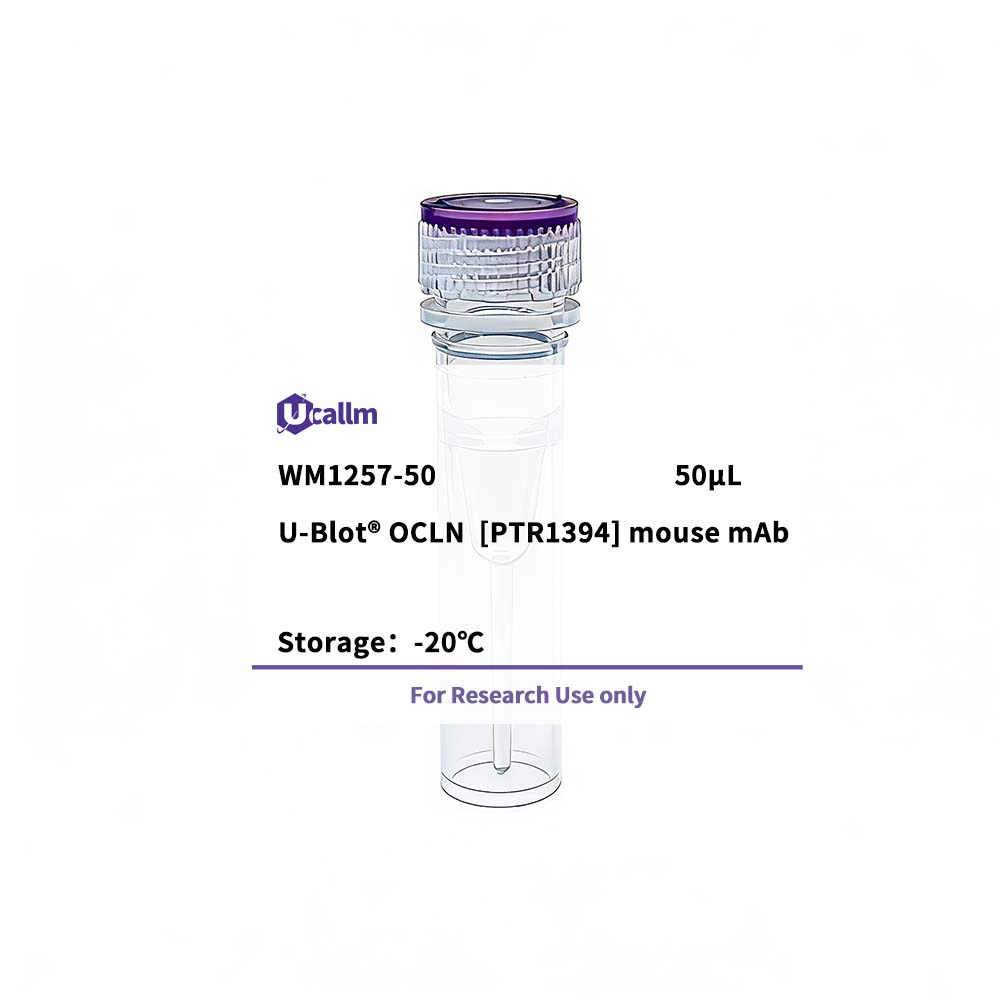
Ucallm_WM1257-50
Price range: $268.00 through $328.00
Product details
Background:
This gene encodes an integral membrane protein that is required for cytokine-induced regulation of the tight junction paracellular permeability barrier. Mutations in this gene are thought to be a cause of band-like calcification with simplified gyration and polymicrogyria (BLC-PMG), an autosomal recessive neurologic disorder that is also known as pseudo-TORCH syndrome. Alternative splicing results in multiple transcript variants. A related pseudogene is present 1.5 Mb downstream on the q arm of chromosome 5. [provided by RefSeq, Apr 2011],
Specifications
| Size | 50μL/100μL |
| Target | OCLN |
| Reactivity | Human, Mouse, Rat |
| Applications | WB, IF, ELISA |
| MW(Calculated) | 59kD |
| MW(Observed) | 59kD |
| Host Species | Mouse |
| Isotype | IgG1, kappa |
| Conjugate/Modification | Unmodified |
| Recommended Dilution Ratio | WB 1:500-2000; IF 1:100-500; ELISA 1:1000-5000 |
| Formulation | PBS, 50% glycerol, 0.05% Proclin 300, 0.05%BSA |
| Purification | The antibody was affinity-purified from ascites by affinity-chromatography using specific immunogen. |
| Storage | -15°C to -25°C/1 year (Do not lower than -25°C) |
| Concentration | |
| Clonality | Monoclonal |
| Clone Number | RMMR1394 |
| Immunogen | AA range: 1-522 |
| Specificity | This antibody detects endogenous levels of OCLN protein. |
| Gene Name | OCLN |
| Protein Name | Occludin; OCN |
| Other Name | |
| Species | Human |
| Gene ID | 100506658 |
| Uniprot | Q16625, |
| Species.1 | Mouse |
| Gene ID.1 | |
| Uniprot.1 | Q61146, |
| Species.2 | Rat |
| Gene ID.2 | |
| Uniprot.2 | Q6P6T5 |
| Cellular Localization | Membrane |
| Tissue Expression | Localized at tight junctions of both epithelial and endothelial cells. Highly expressed in kidney. Not detected in testis. |
| Signaling_pathway | Cellular Processes >> Cellular community - eukaryotes >> Tight junction;Organismal Systems >> Immune system >> Leukocyte transendothelial migration;Environmental Information Processing >> Signaling molecules and interaction >> Cell adhesion molecules |
| Research Areas | >>Cell adhesion molecules; / >>Tight junction; / >>Leukocyte transendothelial migration; / >>Pathogenic Escherichia coli infection; / >>Hepatitis C |
| Function | protein complex assembly , cellular amino acid derivative metabolic process , sulfur metabolic process , nucleoside metabolic process , ribonucleoside metabolic process , purine nucleoside metabolic process , macromolecular complex subunit organization , purine ribonucleoside metabolic process , S-adenosylhomocysteine metabolic process , S-adenosylmethionine metabolic process , macromolecular complex assembly , protein complex biogenesis , |
Please login to post questions
Related products





