

U-Blot® SIGMAR1 Rabbit mAb
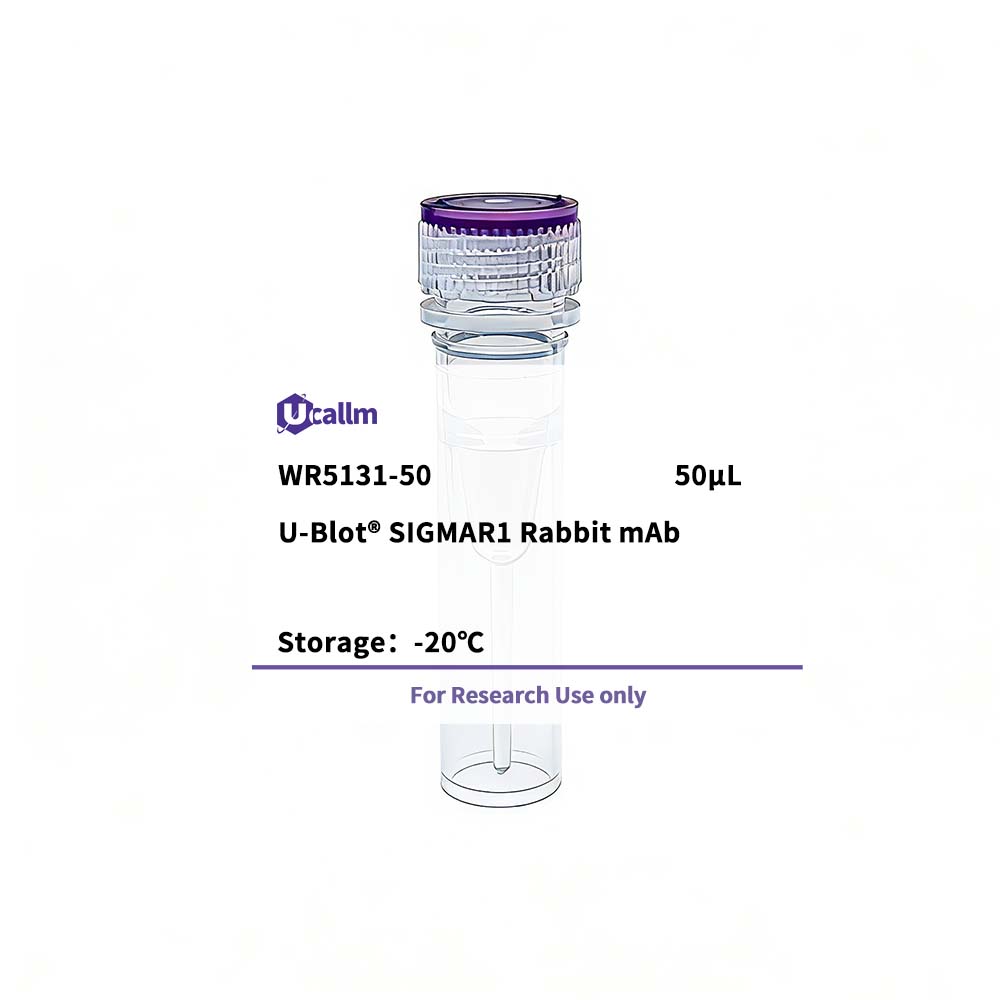
Ucallm_WR5131-50
Price range: $268.00 through $328.00
Product details
Background:This gene encodes a receptor protein that interacts with a variety of psychotomimetic drugs, including cocaine and amphetamines. The receptor is believed to play an important role in the cellular functions of various tissues associated with the endocrine, immune, and nervous systems. As indicated by its previous name, opioid receptor sigma 1 (OPRS1), the product of this gene was erroneously thought to function as an opioid receptor; it is now thought to be a non-opioid receptor. Mutations in this gene has been associated with juvenile amyotrophic lateral sclerosis 16. Alternative splicing of this gene results in transcript variants encoding distinct isoforms. [provided by RefSeq, Aug 2013],
Specifications
| Size | 50μL/100μL |
| Target | SIGMAR1 |
| Reactivity | Human, Mouse, Rat |
| Applications | WB, IHC, IF, IP, ELISA |
| MW(Calculated) | 25kD |
| MW(Observed) | 25kD |
| Host Species | Rabbit |
| Isotype | IgG,Kappa |
| Conjugate/Modification | Unmodified |
| Recommended Dilution Ratio | IHC 1:200-1:1000; WB 1:2000-1:10000; IF 1:200-1:1000; ELISA 1:5000-1:20000; IP 1:50-1:200; / Note: For IHC, we suggest antigen retrieval with TE buffer pH 9.0 (Cat#WT1004) |
| Formulation | PBS, 50% glycerol, 0.05% Proclin 300, 0.05%BSA |
| Purification | Recombinant Antibody expressed in animal component-free (ACF) media, purified via Protein A affinity chromatography. |
| Storage | -15°C to -25°C/1 year(Do not lower than -25°C) |
| Concentration | |
| Clonality | Monoclonal |
| Clone Number | RM1354R |
| Immunogen | The specific immunogen used to produce this antibody is proprietary information. |
| Specificity | Endogenous |
| Gene Name | SIGMAR1 OPRS1 SRBP AAG8 |
| Protein Name | Sigma non-opioid intracellular receptor 1 (Aging-associated gene 8 protein) (SR31747-binding protein) (SR-BP) (Sigma 1-type opioid receptor) (SIG-1R) (Sigma1-receptor) (Sigma1R) (hSigmaR1) |
| Other Name | |
| Species | Human |
| Gene ID | 10280 |
| Uniprot | Q99720, |
| Species.1 | Mouse |
| Gene ID.1 | |
| Uniprot.1 | O55242, |
| Species.2 | Rat |
| Gene ID.2 | |
| Uniprot.2 | Q9R0C9 |
| Cellular Localization | Nucleus inner membrane . Nucleus outer membrane . Nucleus envelope . Cytoplasmic vesicle . Endoplasmic reticulum membrane . Membrane; Single-pass membrane protein . Lipid droplet . Cell junction. Cell membrane . Cell projection, growth cone. Cell junction, synapse, postsynaptic density membrane . During interphase, detected at the inner and outer nuclear membrane and the endoplasmic reticulum. Detected on cytoplasmic vesicles during mitosis (PubMed:10406945). Targeted to lipid droplets, cholesterol and galactosylceramide-enriched domains of the endoplasmic reticulum. Accumulation at the endoplasmic reticulum is prominent in alpha-motor neurons of patients with amyotrophic lateral sclerosis (PubMed:23314020). Enriched at cell-cell communication regions, growth cone and postsynaptic structures. Localization is modulated by ligand-binding. In motor neurons it is enriched at cholinergic postsynaptic densities (By similarity). . |
| Tissue Expression | Widely expressed with higher expression in liver, colon, prostate, placenta, small intestine, heart and pancreas. Expressed in the retina by retinal pigment epithelial cells. Expressed in alpha-motor neurons (PubMed:23314020). |
| Signaling_pathway | Human Diseases >> Neurodegenerative disease >> Amyotrophic lateral sclerosis;Human Diseases >> Neurodegenerative disease >> Pathways of neurodegeneration - multiple diseases |
| Research Areas | >>Amyotrophic lateral sclerosis; / >>Pathways of neurodegeneration - multiple diseases |
| Function | Function:Functions in lipid transport from the endoplasmic reticulum and is involved in a wide array of cellular functions probably through regulation of the biogenesis of lipid microdomains at the plasma membrane. Involved in the regulation of different receptors it plays a role in BDNF signaling and EGF signaling. Also regulates ion channels like the potassium channel and could modulate neurotransmitter release. Plays a role in calcium signaling through modulation together with ANK2 of the ITP3R-dependent calcium efflux at the endoplasmic reticulum. Plays a role in several other cell functions including proliferation, survival and death. Originally identified for its ability to bind various psychoactive drugs it is involved in learning processes, memory and mood alteration.,miscellaneous:Depletion of OPRS1 by RNAi inhibits growth and survival signaling cascades and induces cell death. The OSPR1 antagonist rimcazole produces the same effect.,online information:Sigma-1 receptor entry,similarity:Belongs to the ERG2 family.,subcellular location:Targeted to lipid droplets, cholesterol and galactosylceramide-enriched domains of the endoplasmic reticulum. Enriched at cell-cell communication regions, growth cone and postsynaptic structures. Localization is modulated by ligand-binding.,tissue specificity:Widely expressed with higher expression in liver, colon, prostate, placenta, small intestine, heart and pancreas. Expressed in the retina by retinal pigment epithelial cells., |
Please login to post questions
Related products





