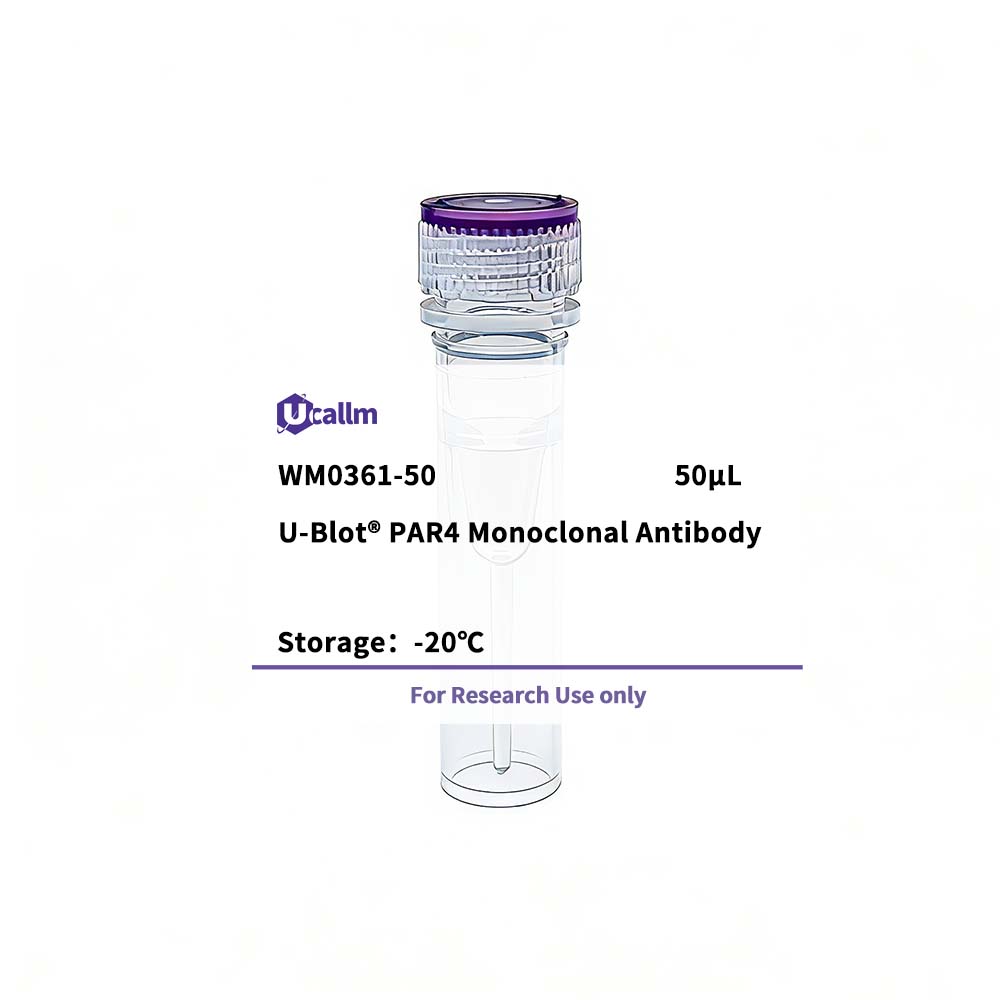
SKU: WM0361 Categories: ,

PAR4 Monoclonal Antibody

Price range: $268.00 through $328.00

SKU: WM0361-50
Enter the quantity you would like, or drag the panel to find the quantity and price that best for you
Bulk QuoteAuthorize OEM & ODM

Product details

Background:
The tumor suppressor WT1 represses and activates transcription. The protein encoded by this gene is a WT1-interacting protein that itself functions as a transcriptional repressor. It contains a putative leucine zipper domain which interacts with the zinc finger DNA binding domain of WT1. This protein is specifically upregulated during apoptosis of prostate cells. [provided by RefSeq, Jul 2008],

Specifications

Size50μL/100μL
TargetPAR4
ReactivityHuman
ApplicationsWB, IHC, IF, ELISA
MW(Calculated)37kD
MW(Observed)
Host SpeciesMouse
Isotype
Conjugate/ModificationUnmodified
Recommended Dilution RatioWB 1:500-1:2000; IHC 1:200-1:1000; ELISA 1:10000; IF 1:50-200 / Note: For IHC, we suggest antigen retrieval with TE buffer pH 9.0 (Cat#WT1004)
FormulationLiquid in PBS containing 50% glycerol, 0.5% BSA and 0.02% sodium azide.
PurificationAffinity purification
Storage-15°C to -25°C/1 year(Do not lower than -25°C)
Concentration
ClonalityMonoclonal
Clone Number20H2
ImmunogenPurified recombinant fragment of PAR4 (aa1-330) expressed in E. Coli.
SpecificityPAR4 Monoclonal Antibody detects endogenous levels of PAR4 protein.
Gene NamePAWR
Protein NamePRKC apoptosis WT1 regulator protein
Other NamePAWR; / PAR4; / PRKC apoptosis WT1 regulator protein; / Prostate apoptosis response 4 protein; / Par-4
SpeciesHuman
Gene ID5074
UniprotQ96IZ0
Species.1
Gene ID.1
Uniprot.1
Species.2
Gene ID.2
Uniprot.2
Cellular LocalizationCytoplasm. Nucleus. Mainly cytoplasmic in absence of apoptosis signal and in normal cells. Nuclear in most cancer cell lines. Nuclear entry seems to be essential but not sufficient for apoptosis (By similarity). Nuclear localization includes nucleoplasm and PML nuclear bodies. .
Tissue ExpressionWidely expressed. Expression is elevated in various neurodegenerative diseases such as amyotrophic lateral sclerosis, Alzheimer, Parkinson and Huntington diseases and stroke. Down-regulated in several cancers.
Signaling_pathway
Research Areas
FunctionDomain:The leucine-zipper domain is not essential for apoptosis, but is required for sensitization of cells to exogenous apoptotic insults and for interaction with its partners.,Domain:The SAC domain is a death-inducing domain selective for apoptosis induction in cancer cells. This domain is essential for nuclear entry, Fas activation, inhibition of NF-kappa-B activity and induction of apoptosis in cancer cells.,Function:Pro-apoptopic protein capable of selectively inducing apoptosis in cancer cells, sensitizing the cells to diverse apoptotic stimuli and causing regression of tumors in animal models. Induces apoptosis in certain cancer cells by activation of the Fas prodeath pathway and coparallel inhibition of NF-kappa-B transcriptional activity. Inhibits the transcriptional activation and augments the transcriptional repression mediated by WT1. Down-regulates the anti-apoptotic protein BCL2 via its interaction with WT1. Seems also to be a transcriptional repressor by itself. May be directly involved in regulating the amyloid precursor protein (APP) cleavage activity of BACE1.,induction:By apoptosis.,PTM:Preferentially phosphorylated at the Thr-163 by PKC in cancer cells.,subcellular location:Mainly cytoplasmic in absence of apoptosis signal and in normal cells. Nuclear in most cancer cell lines. Nuclear entry seems to be essential but not sufficient for apoptosis (By similarity). Nuclear localization includes nucleoplasm and PML nuclear bodies.,subunit:Interacts with WT1, via the C-terminal region. Homooligomer. Interacts also with a wide variety of proteins, such as atypical PKCs, p62, DAPK3 kinase and THAP1. Interacts with actin, AATF, BACE1, SPSB1, SPSB2 AND SPSB4. Component of a ternary complex composed of SQSTM1 and PRKCZ.,tissue specificity:Widely expressed. Expression is elevated in various neurodegenerative diseases such as amyotrophic lateral sclerosis, Alzheimer, Parkinson and Huntington diseases and stroke. Down-regulated in several cancers.,
Please login to post questions
Back to Top
Product has been added to your cart

